Grimoires
The 1575 Arbatel arranges seven septenaries around prayer and Christian ethics, with planetary governors occupying only one part.

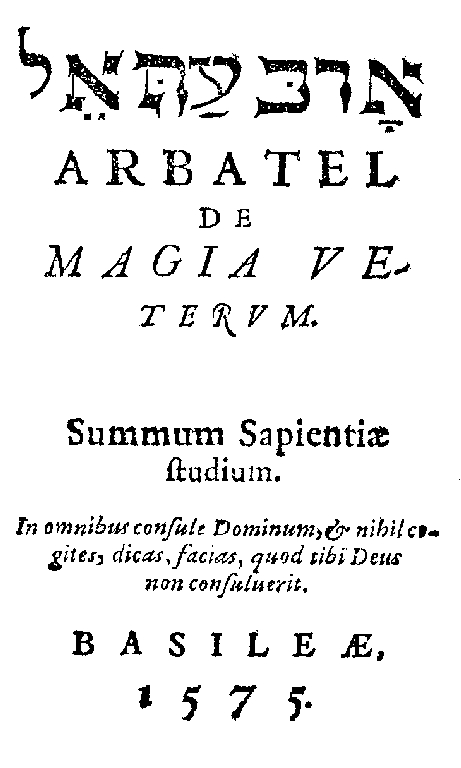
A dated print instead of a legendary king
Arbatel de magia veterum first appeared in Latin at Basel in 1575. That date and place come from the printed title page, a firmer starting point than its appeal to ancient wisdom. The author’s identity is not secure. The surviving book is organized in seven septenaries, or groups of seven aphorisms, although its framing gestures toward a larger planned structure. Calling it an ancient handbook without mentioning its sixteenth-century printing would confuse rhetoric of antiquity with bibliographic evidence. Joseph H. Peterson’s edition preserves the Latin beside Robert Turner’s later English translation and explains the publication context. The aphorisms and title page show how a Renaissance author presented the work as both old and freshly offered to the public.
What the seven septenaries actually do
The forty-nine surviving aphorisms build an argument in seven groups rather than hiding a conventional ritual manual inside short sayings. The first septenary establishes secrecy, prayer, repeated learning, humility, and benefit to one’s neighbor as conditions for knowledge. The second explains names, characters, and a hierarchy of wisdom under divine permission. The third introduces the seven Olympic spirits and assigns them planetary offices, provinces, times, and characters. The fourth expands from those rulers to a diagram of secrets flowing from one center and returns to prayer as the controlling principle. The fifth classifies spirits and asks the reader to judge an intended end; the sixth insists on ordered, simple operations rather than mixtures; the seventh closes by contrasting obedient and rebellious powers and limiting human ambition. The sequence moves from ethics to cosmology, then to named intermediaries, method, and final judgment. Reading only the Olympic-spirit entries removes the moral premises and the later cautions that frame them.
The tone of its advice
The book repeatedly places piety, divine permission, gratitude, and the neighbor’s good within its account of magic. It is therefore misleading to introduce Arbatel as a simple catalogue of demons or as interchangeable with the Goetia. Even its treatment of names and characters says that their authority does not come from shape or pronunciation alone but from an office assigned by God or nature. The third septenary’s Olympic spirits sit inside that hierarchy: their planetary rule is described as real within the text but bounded by divine permission. Later aphorisms return to the reader’s intention, warn against deceptive spirits, and reject practices the author categorizes as unlawful. These are claims internal to a sixteenth-century Christian cosmology, not evidence that the beings exist or the operations work. The aphoristic form matters because the text asks its reader to revisit principles and compare them, rather than follow one long conjuration from beginning to end.
Later use and edition cautions
Arbatel’s circulation through reprinting, quotation, and English translation made it influential for later esoteric readers. The change from a 1575 Latin imprint to a seventeenth-century English rendering can alter word choice and emphasis. Wellcome’s catalogue shows Arbatel printed alongside other works in a collected Agrippa volume, which illustrates how publishers made separate texts look like one inherited corpus. A bound collection is evidence of reception, not evidence of common authorship. The title page and section on Olympic spirits also reveal how the text limits and justifies those figures. That combination helps explain why this work may attract a reader interested in Renaissance Christian magic even when they are not looking for a ritual manual.
Questions to explore
- Does a quotation come from the Latin print or Turner’s English version?
- What parts of the larger advertised plan actually survive?
- How does the book frame its Olympic spirits ethically?