Grimoires
Medieval Ars Notoria witnesses bind prayer and diagrams to promised learning; the Lemegeton appendix preserves a later, altered form.

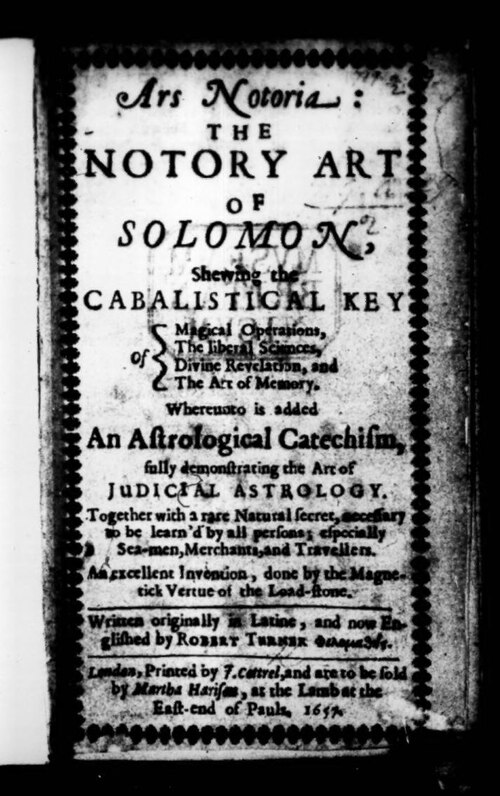
A medieval work about learning
Ars Notoria names a family of medieval texts that associate prayers, sacred names, and graphic notae with the hoped-for acquisition of knowledge. Grammar, logic, rhetoric, arithmetic, geometry, music, astronomy, philosophy, and theology are treated as distinct fields rather than as one vague promise of “wisdom.” The texts coordinate a discipline with particular figures and prayers, and they distinguish preliminary preparation from the orations attached to an individual nota. British Library Sloane MS 1712 is a concrete thirteenth-century witness: its catalogue records two Ars Notoria texts, diagrams, and a derivative Opus Operum associated with John of Morigny. The Solomonic attribution forms part of the work’s claim to authority, while the surviving folios reveal the method’s actual shape. Studying what a reader sees on the page changes interpretation: an edition that omits the notae removes a central visual component but leaves instructions about inspection and repetition, making the surviving prose look more like a collection of free-standing prayers than the text it represents.
The method joins inspection, prayer, and repetition
The notae are not presented as emblems whose meaning can be decoded once and remembered. A reader is directed through preparatory prayers, prescribed inspections or repetitions, and discipline-specific orations associated with particular figures. The visual and verbal tracks work together: the figure marks a field of study, while the accompanying prayers ask for faculties such as memory, eloquence, comprehension, or orderly speech. Time matters because the same material is revisited in a sequence rather than glanced at casually. This structure explains why a transcription without diagrams is incomplete and why a gallery of diagrams without its rubrics is equally misleading. The first reduces a visual practice to devotional prose; the second turns an ordered reading discipline into unexplained symbols. The promised acceleration of learning belongs to the medieval text’s theory of divinely granted knowledge. Its repetitions also resemble study in the ordinary sense, but that resemblance does not demonstrate that the sacred names or figures caused mastery.
Worked comparison: grammar and rhetoric
The allocation of notae shows that the liberal arts are analyzed into different faculties. In Turner’s English text, grammar receives three notes: they correspond to ordering words and times, arranging parts, and dividing simple and compound forms. Rhetoric receives four, associated with fluent expression, discerning judgments, discovering offices and causes, and achieving understanding and eloquence. The unequal counts are the point. Ars Notoria does not treat every subject as the same mental substance reached through one universal design; it gives each art a small visual and verbal curriculum based on what the text thinks that art requires. Compare the first grammar prayer with a rhetoric instruction and the desired faculty changes even when both appeal to divine illumination. A modern “memory sigil” extracted from either set erases this analysis. The figure’s subject, its numbered place, its attached prayer, and its relation to the other figures determine its role.
What Book Five of the Lemegeton is
The Lemegeton places an Ars Notoria at the end of its five-part sequence, but the appended form is not evidence that all five parts had the same time and place of composition. Peterson notes that Sloane MS 3825 contains an abbreviated Notory Art to which material from Robert Turner’s printed 1657 English translation was added. Turner’s version itself lacks the figures and makes some references hard to follow. The bibliographic chain matters: a browser page might reproduce Turner, a modern editor’s expansion of Turner, or a medieval Latin manuscript. All three can carry the same heading while offering different visual and verbal material. Calling the Lemegeton appendix “the original Ars Notoria” erases the earlier manuscript history and the editorial construction of that particular English witness.
How the surviving witnesses differ
British Library Sloane MS 1712 preserves Latin texts, folio divisions, diagrams, and thirteenth-century material. Wellcome MS 110 is another digitized witness, though its Ars Notoria section is incomplete and bound with other magical texts; a composite volume is not a single-author book. A seventeenth-century printed title page and the later Lemegeton copy represent further stages. One witness preserves a diagram, another describes it in words, and a modern webpage may supply a speculative replacement. These differences reveal a history of learning, prayer, and visual memory without making any diagram evidence of instant mastery. Several editors stand between the medieval manuscripts and modern occult websites.
Questions to explore
- Why do some Ars Notoria witnesses lack the notae drawings?
- How does the medieval Latin tradition differ from Turner’s 1657 print and the Lemegeton appendix?
- How does an incomplete manuscript change the surviving sequence?