Grimoires
Abramelin places months of angel-centered devotion before its letter squares, with the preparation changing length between editions.

What is the Book of Abramelin?
The book speaks in the voice of Abraham of Worms, who recounts his travels, his meeting with a teacher named Abramelin, and the knowledge he wishes to leave to his son Lamech. That story gives the work its human center: a search for a teacher becomes a legacy addressed to one person. The date 1458 appears in the tradition, but it is a date claimed by the narrative, not the date of the surviving copies. The Herzog August Bibliothek catalogues a Wolfenbüttel witness as a seventeenth-century manuscript. The work is best known in English through S. L. MacGregor Mathers’s 1898 translation of a French copy. Despite the familiar label “grimoire,” its pages devote substantial space to prayer, religious discipline, and an encounter with a guardian angel before describing any letter squares.
What is the Abramelin operation?
In the text, the central operation is an extended period of preparation directed toward the knowledge and conversation of a Holy Guardian Angel. The narrator describes a place set apart for prayer, repeated devotion, restraint, and a gradual intensification of the practice. The angelic encounter comes before the later command of spirits and use of the letter squares; reversing that order changes the book’s own logic. Mathers’s edition divides its program into three successive periods of two months. It is not a quick spell selected from a list. Modern occultists sometimes use “Abramelin operation” as shorthand for an intensely personal spiritual undertaking, but that later phrase can obscure the specific prayers, religious assumptions, and textual sequence in the older book. The manuscripts describe a hoped-for result; their existence does not establish that the narrated encounter occurred.
Why do some editions say six months and others eighteen?
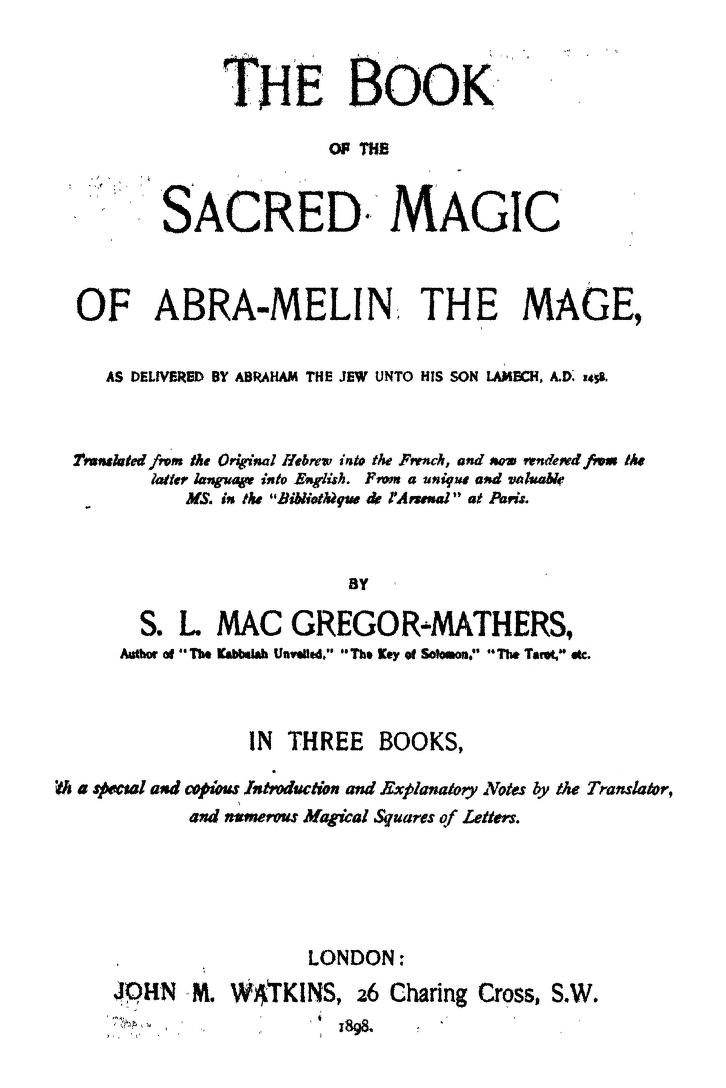
Mathers translated a French manuscript held at the Bibliothèque de l’Arsenal and published a three-book English edition in 1898. Its preparation lasts six months. Fuller German witnesses describe a year and a half and include an additional book of material absent from Mathers’s version. That is a difference in the texts, not a modern correction to a single number in an otherwise identical book. Book numbering and the placement of the squares can change too. The German tradition is not uniform: Wellcome’s MS.820 is catalogued as a 1726 German copy with three books, while MS.821, dated about 1775, has four. A reader comparing instructions or symbols therefore needs the edition as well as the title. The difference explains why two apparently authoritative Abramelin summaries can give incompatible durations without either one inventing its number.
What are the Abramelin magic squares?
The celebrated “squares” are grids of letters, not number puzzles. In Mathers’s third book, groups of letter arrangements are associated with particular aims. One five-by-five example in its chapter on affection reads SALOM, AREPO, LEMEL, OPERA, MOLAS across its rows. It recalls the older SATOR square without being identical to it. Other arrangements in Mathers’s printed text contain blank positions, and comparison with German versions can supply different letters or layouts. A square detached from its chapter loses both its stated purpose and its place after the book’s devotional program. The grids are fascinating visual evidence of how words, symmetry, and textual copying could carry an occult claim; printing one does not show that the claimed effect follows from its letters.
How did the book reach modern readers?
Mathers’s title page announces a translation from a French manuscript and describes the work as “in three books.” His 1898 publication made this particular version available to an English readership and helped place Abramelin in modern ceremonial magic. Aleister Crowley later treated the operation as important; a 1900 typescript in his papers is a concrete record of that engagement. The popularity of the Mathers edition also explains why its six-month schedule and sometimes incomplete letter grids continue to appear online as though no other version exists. A free digital text of Mathers’s edition is available through Joseph H. Peterson’s Esoteric Archives, where editorial notes identify several differences from German witnesses.
Explore Abramelin manuscripts and editions →