
Sigil of Ipos
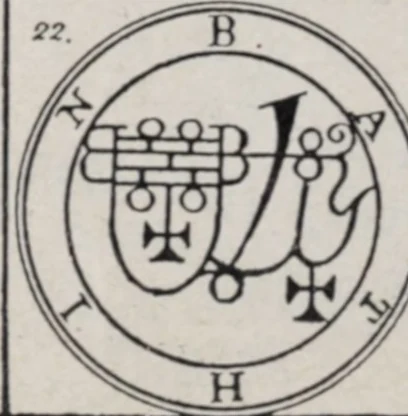
At a glance
- Entry
- 22 of 72
- Rank
- Earl and Prince
- Legions
- 36 in the text
Description in the text
Ipos is credited with knowledge of the past, present, and future. The text also says he makes people witty and bold.
Read entry 22 on page 28 of the 1916 edition
Appearance
An angel-like figure with a lion head, goose foot, and hare tail.
Topics attributed to this entry
- Divination
- Wit
- Boldness
Reading this entry
Ipos is called both earl and prince. His form combines an angel, lion’s head, goose’s foot, and hare’s tail, a compact list of mismatched features with no explanation of their symbolic meaning. The office is knowledge of past, present, and future, together with making people witty and bold. Those last qualities concern temperament, not the recovery of a lost object or a lesson in a named science.
The passage does not describe a second form or a ceremonial entrance. Its 36 legions and seal appear immediately after the attributed offices. What stands out is the mixture of high rank, hybrid appearance, divination, and changed disposition. The source offers the composite image as a report, leaving modern readers to distinguish its actual wording from later illustrations that may choose one animal feature over another.
Read entry 22 on page 28 of the 1916 edition or compare the 1904 transcription.
A closer reading of entry 22
What the numbered text says
Ipos has a double title, earl and prince, and a body assembled from angel, lion, goose, and hare details. The catalogue moves quickly from that elaborate appearance to a short office: knowledge of past, present, and future and the making of witty, bold people. It does not define whether wit is verbal skill, judgment, or something else. A modern illustration may fix the hybrid body more precisely than the sparse prose warrants.
About the printed seal
The 1916 third frontispiece numbers this sign 22. Its printed linework cannot resolve how an angel-like body bears the three animal parts named in the passage. The seal is evidence for the edition’s assigned mark, not a diagram of the hybrid anatomy.
Compare another entry
Compare entry 27: Ronove. Ronove also has two ranks and a social skill office, but specifies rhetoric, tongues, servants, and favor. Ipos does not teach a named art: he is said to make a person witty and bold. Their broad “communication” overlap is therefore limited.