
In 1863 Le Breton seats crowned Amduscias among brass instruments, giving invisible music a body; Ars Goetia 67 spells the duke Amdusias.
- 1863 headword
- Amduscias
- Ars Goetia
- No. 67 · Duke
- Legions
- Dictionnaire 29 · Goetia 29
What Collin de Plancy’s Amduscias entry says
Amduscias is a great duke who has the form of a unicorn but can appear as a human when called. At command he produces concerts whose trumpets and other instruments are heard without visible players. Trees bow at his voice, and twenty-nine legions follow him. The article links transformation, disembodied sound, and moving vegetation in a compact sequence of effects.
Sound is the bridge between the unseen musicians and bending trees. The entry never says the trees move to the music; it assigns the movement to Amduscias’s voice. Keeping those clauses separate avoids turning three neighboring marvels into one invented concert scene.
Reading Louis Le Breton’s 1863 portrait
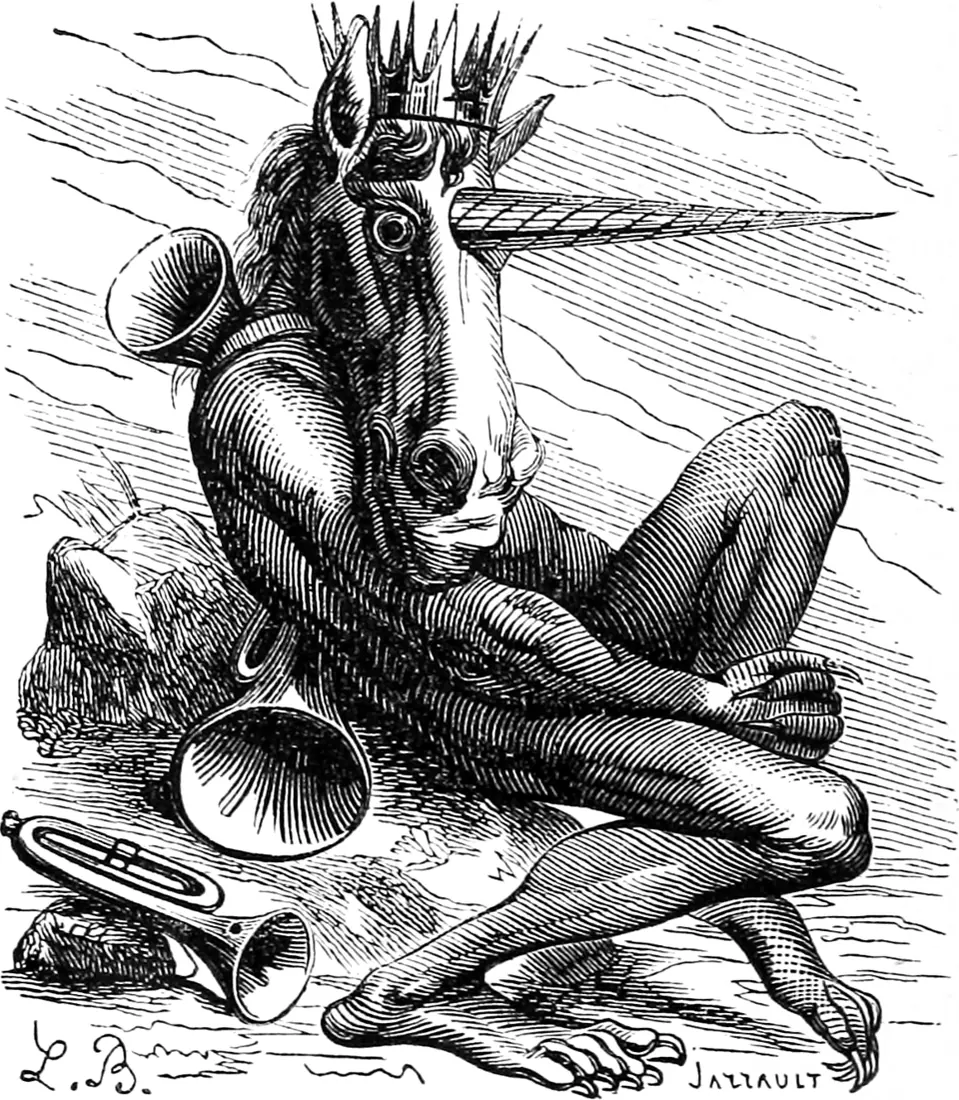
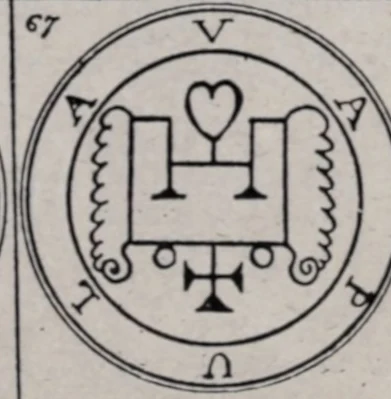
Le Breton draws a crowned unicorn-headed humanoid seated with bare human arms and legs among trumpets and other brass horns. The long spiral horn creates the main diagonal, while the scattered instruments turn the musical office into visible objects even though no players appear. No tree or bending vegetation enters the scene.
The engraving compresses transformation and concert into one emblem: unicorn head, human body, and instruments occupy the same moment. The empty horns preserve the entry’s invisible agency without showing who plays them, but they cannot communicate the Goetia’s delay or the distinction between music and the voice that bends trees. Amdusias’s separate seal is genuinely nonmusical and operates only as a catalogue sign.
Amduscias and Ars Goetia spirit 67
The Goetia likewise begins with a unicorn, permits human form, describes trumpets and other instruments, makes trees bend, provides familiars, gives ducal rank, and counts twenty-nine legions.
The Dictionnaire says concerts occur on command and that trees bow at the voice, while the Goetia notes that the instrument sounds are not heard immediately and adds good familiars. The French form Amduscias and Goetia form Amdusias differ by one consonant but clearly share the profile.
Worked comparison: music, voice, and timing
Make a three-row sequence. First, unicorn changes to human. Second, instruments are heard although players are unseen; the Goetia adds a delay. Third, trees bend; the French entry connects this to the voice. The engraving compresses the first two rows into a unicorn-headed human surrounded by unplayed horns, while omitting the trees. It therefore does not prove that music and tree movement are simultaneous.
The exercise recovers sequence from an image that already combines several clauses. Visible brass instruments represent an invisible concert, and the human limbs fuse the two bodily stages rather than choosing only the unicorn. Text, portrait, and seal still preserve different information: neither picture supplies the timing detail, tree-moving voice, familiars, or twenty-nine-legion total. The composition is memorable precisely because it turns transformation and sound into one crowded visual emblem.