
Le Breton fixes 1863 Flauros as a spotted leopard, excluding the fiery-eyed human transformation promised by the entry; the Ars Goetia name is Haures.
- 1863 headword
- Flauros
- Ars Goetia
- No. 64 · Duke
- Legions
- Dictionnaire 20 · Goetia 36
What Collin de Plancy’s Flauros entry says
Flauros is a great infernal general who appears as a terrible leopard. In human form he has fiery eyes and a frightening face. The dictionary credits him with knowledge of present, past, and future and says he is hostile toward exorcists unless compelled into a triangle. Twenty legions serve him. The entry makes bodily change, knowledge, aggression, and ritual constraint its entire structure.
The leopard gives visible form to the danger assigned to the encounter, while the human transformation retains fiery eyes between bodies. The triangle conditions reliable speech inside the historical narrative; it supplies no evidence that the attributed knowledge can be obtained.
Reading Louis Le Breton’s 1863 portrait
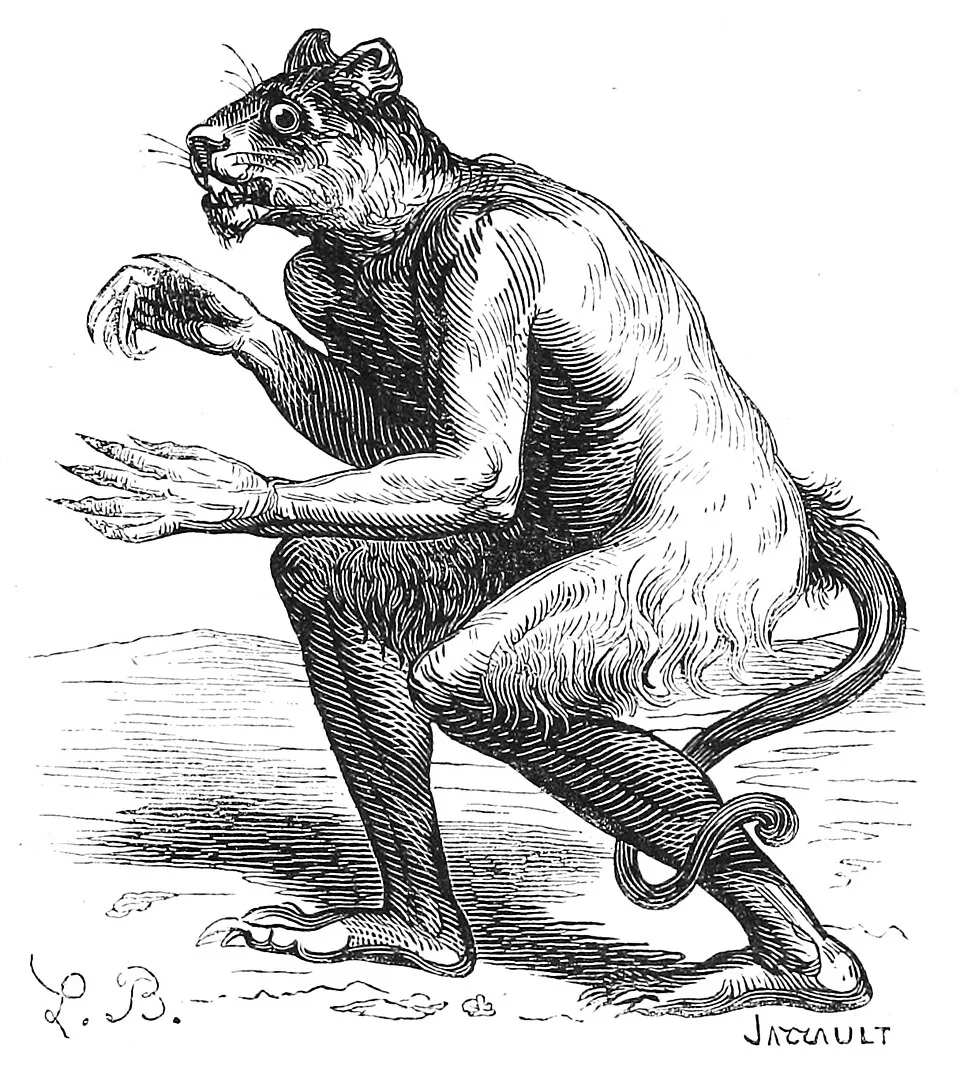
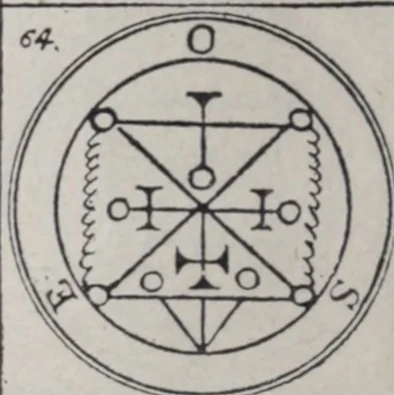
Le Breton shows a spotted leopard moving low across the frame with its head turned toward the viewer. Dark rosettes cover the body, and the direct gaze supplies the threat that the short entry emphasizes. The human form and triangle are absent, so the print fixes the first phase of the transformation.
The portrait’s naturalistic animal body contrasts sharply with Haures’s abstract Goetia seal. Name forms also diverge: the French illustration is Flauros, while the corresponding numbered profile is commonly indexed as Haures. Labels are required to keep those linked traditions intelligible.
Flauros and Ars Goetia spirit 64
Both accounts begin with a leopard, allow a fiery-eyed human form, connect the spirit with knowledge across time, warn of hostility or deception outside a ritual constraint, and preserve the Flauros name among their variants.
The Dictionnaire calls Flauros a general, gives twenty legions, and stresses danger to exorcists. The Goetia calls Haures a duke, gives thirty-six legions, expands the speech to creation and the fall of spirits, and adds both destruction of enemies and protection from temptation. The sixteen-legion gap is substantial.
Worked comparison: twenty or thirty-six legions?
Place rank and following together for each source. Dictionnaire: great general, twenty legions. Goetia: duke, thirty-six legions. The shared leopard and fiery eyes make the entries easy to align, but visual agreement does not authorize choosing one number. The seal’s catalogue position, sixty-four, is a third number with a different function.
The comparison turns apparent contradiction into transmission evidence. A profile can identify Flauros with the Haures entry while keeping rank and legion totals source-specific. The leopard engraving visualizes the shared body but settles neither field. The Goetia’s creation speech, enemy destruction, and protective claim further broaden the office, so the difference is larger than the sixteen-legion gap alone.