
At the 1863 Agarès cross-reference, only a direction to Aguarès appears; there Le Breton pictures an old crocodile rider with hawk, the figure called Agares in Ars Goetia 2.
- 1863 headword
- Aguarès
- Ars Goetia
- No. 2 · Duke
- Legions
- Dictionnaire 31 · Goetia 31
What Collin de Plancy’s Aguarès entry says
The printed headword Agarès sends the reader to Aguarès, where the full article describes an old lord riding a crocodile and carrying a hawk on his fist. He brings fugitives back, sends enemies fleeing, distributes dignities and titles, teaches languages, and makes earth spirits dance. Collin de Plancy also assigns him command of thirty-one legions. The cross-reference and alternate spelling are part of the entry’s structure, not errors to smooth away.
Aguarès joins opposed kinds of movement. The spirit returns someone who has fled, drives an enemy away, and animates the earth itself. Language teaching and social dignity sit beside those motions, producing an office wider than the memorable crocodile portrait suggests. The dictionary’s internal redirect also records how a French reader was expected to find the name.
Reading Louis Le Breton’s 1863 portrait
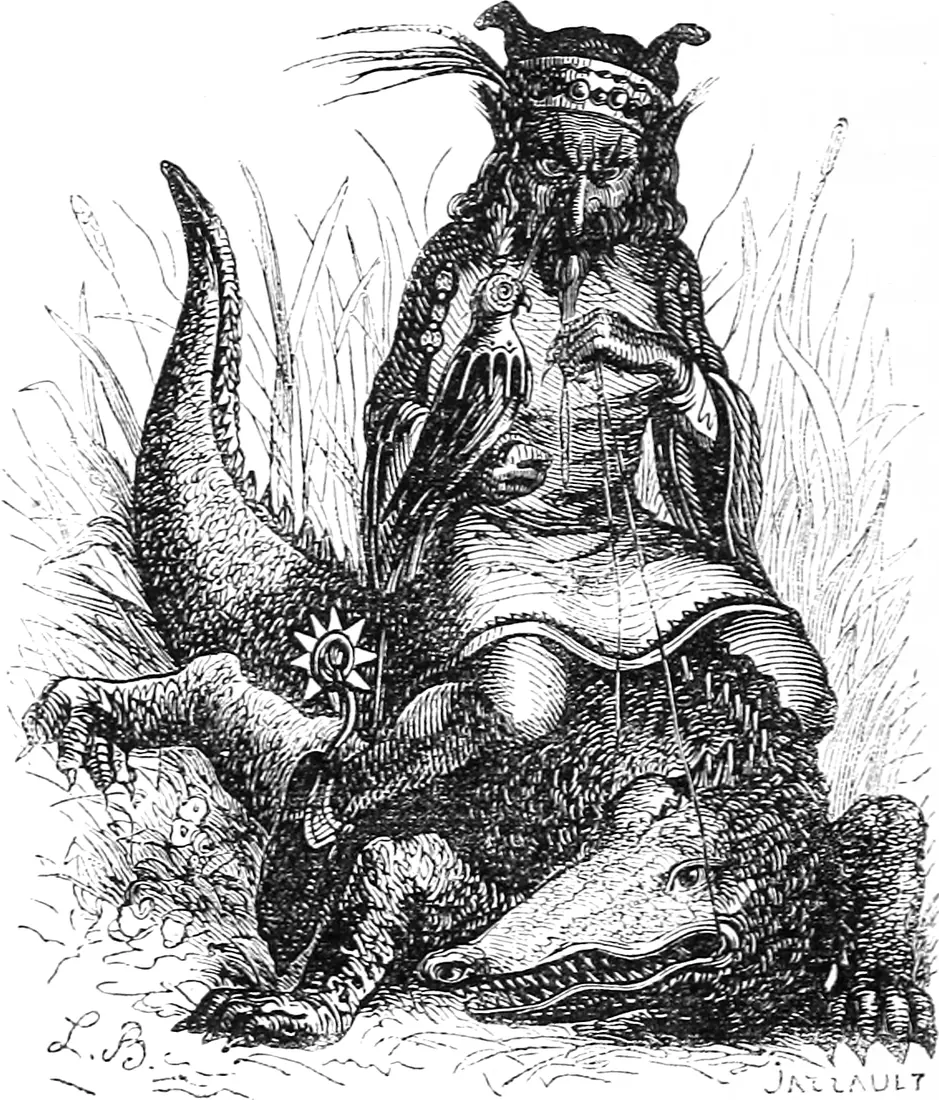
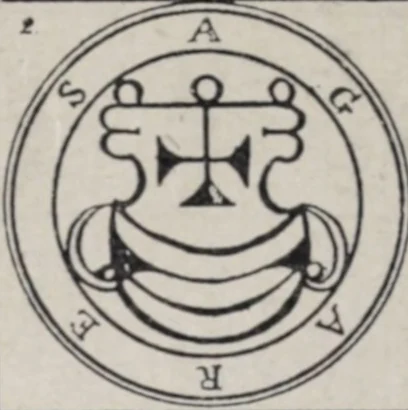
Le Breton presents an elderly, robed rider sitting low on a long crocodile, one arm extended to support a bird of prey. The horizontal reptile acts as a platform while the upright rider and hawk form a balanced central group. Fine textures distinguish cloth, feathers, skin, and scales, turning a short catalogue description into a quiet processional scene.
The picture emphasizes command through stillness: animal, rider, and hawk appear controlled rather than chaotic. Agares’s Goetia seal is a separate diagram, and neither its strokes nor its number represent the crocodile’s body. The two images preserve different parts of the spirit’s textual reception.
Aguarès and Ars Goetia spirit 2
Ars Goetia spirit 2 is likewise a duke, an elderly rider on a crocodile with a goshawk, a teacher of languages, a returner of runaways, a mover of the stationary, and a ruler of thirty-one legions. Both accounts also connect the office with undermining dignity.
The Dictionnaire recasts setting the stationary in motion as making spirits of the earth dance, adds the flight of enemies, and speaks of granting dignities as well as overturning them. The Goetia wording names earthquakes and the destruction of temporal and supernatural dignities more directly. The French entry’s Aguarès spelling and redirect remain visible evidence of transmission.
Worked comparison: three kinds of motion
Sort the shared claims into human, political, and physical movement. A fugitive returning is human movement; dignities rising or falling are changes in status; earth moving or earth spirits dancing is physical or cosmological motion. Le Breton illustrates none of those actions. He instead shows controlled travel on the crocodile, creating a fourth, purely visual movement.
The portrait makes the rider memorable, while the comparison reveals that movement is the deeper pattern connecting the offices. The seal adds identification but no narrative scene. Reading all three layers prevents the crocodile from becoming the entire meaning of the entry.