
A printed program in two dependent books
Wellcome Collection catalogues the George Redway edition of 1889 as 114 pages with fifteen leaves of plates and identifies Mathers as editor and translator. The edition’s physical sequence matters because the prose and plates form one designed reading path. Book I opens with devotion and planetary timing, then moves through circles, conjurations, experiments, and pentacles. Book II turns to purification, fasting, clothing, places, knives, pens, ink, paper, incense, water, and other prepared things.
The division does not create an abstract theory book followed by an optional appendix. Book I repeatedly presupposes the conditions supplied by Book II. An operation must occur at a selected time, with a purified operator, in a prepared place, using consecrated instruments and materials. Book II in turn sends the reader back to prayers and figures already printed in Book I. Mathers’s clean two-book table of contents is therefore a dependency chain in which timing, body, speech, image, and object authorize one another.
Seven codices become one editorial voice
Mathers names Additional 10862, Sloane 1307 and 3091, Harley 3981, King’s 288, and Lansdowne 1202 and 1203. He says the manuscripts differ, that some supply matter omitted by others, and that chapter material can be transposed. The printed English text is consequently not a translation of any one codex. It selects, combines, and reorders witnesses, sometimes recording a variant in a note and sometimes choosing the reading he considered most likely.
The witnesses are not equally close. Mathers describes Harley 3981, King’s 288, and Sloane 3091 as similar French texts; Lansdowne 1202 as concise and incomplete; Additional 10862 as a shorter Latin copy; Sloane 1307 as an Italian mixture; and Lansdowne 1203 as a radically different single book without chapters. Folding them into one structure converts manuscript disagreement into editorial continuity. The edition’s fluent voice is an achievement of collation, not evidence that the sources already agreed.
The preface declares its interventions
Mathers says he omitted one or two experiments he judged to be black magic and warns against blood. The surviving manuscript comparisons make the effect clearer: operations concerning love, hate, or destruction do not all pass into the printed sequence. Omission is part of the edition’s moral argument. The printed Key presents what Mathers wanted readers to understand as a coherent and legitimate ritual system, rather than mechanically reproducing everything in his sources.
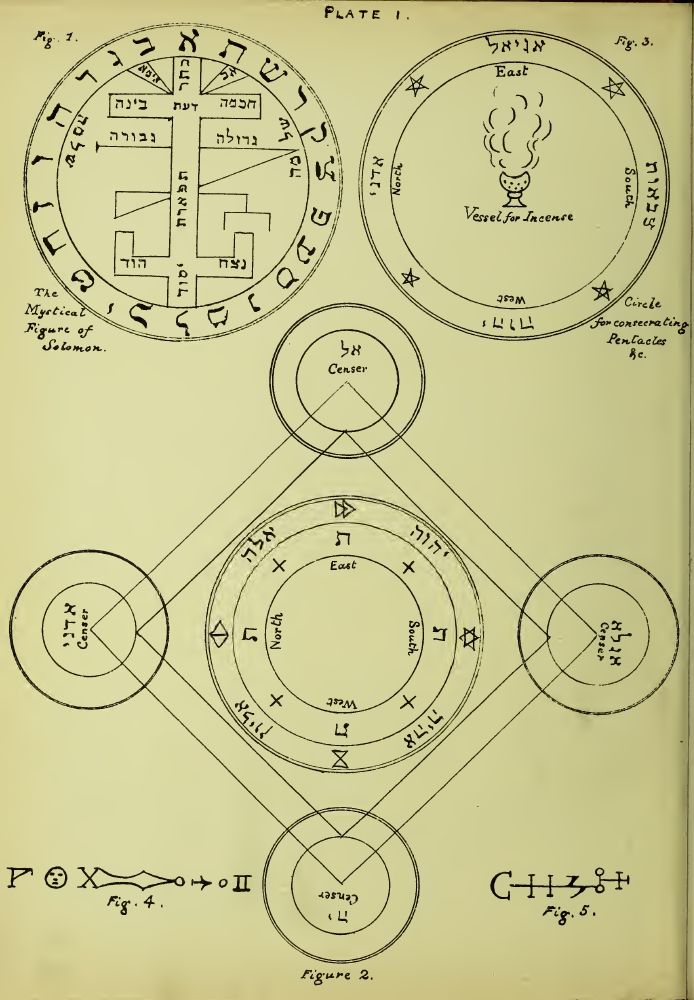
He also says that damaged Hebrew names were corrected into recognizable or usual forms and that years were spent restoring Hebrew and magical characters in the pentacles, with Wynn Westcott assisting. Elsewhere he substitutes “Azoth” for “Alpha and Omega” and permits a sword in place of a knife. These are explicit acts of reconstruction and normalization. A familiar pentacle in the plates records Mathers’s proposed repair of difficult manuscript lettering, not an untouched tracing from one codex.
Worked collation: one planetary-hours paragraph
Book I, chapter II begins by telling the operator to prepare all requisites in advance and then sets out the planetary order. The variant notes report that the opening paragraph is absent from Sloane 1307 and Additional 10862. A later sentence explaining the weekday rulers ends more fully in Lansdowne 1202 than in King’s 288, Harley 3981, and Sloane 3091, and the sentence that carries the repeating planetary sequence beyond its first cycle again depends on Lansdowne 1202.
On the printed page, these pieces read as one continuous lesson: prepare, identify the weekday ruler, then cycle the seven planets through successive hours. At manuscript level, the lesson has been built from unequal witnesses. This small example shows Mathers’s method without relying on an abstract label such as “eclectic edition.” A practical rule becomes clear because the editor supplies material from the copy that completes each step, while the notes preserve only part of the underlying disagreement.
Worked reading: an operation crosses both books
Follow the preparation for a formal operation. Book I selects a planetary day and hour, distinguishes the intended class of work, introduces master and companions, and calls for prayer, fasting, bathing, clean white linen, a circle, incense, and pentacles. Several instructions explicitly point forward to Book II. There the reader finds the baths and fasting regimen, the construction and consecration of clothing and tools, the preparation of paper and ink, the choice of place, and the handling of incense and water.
The operation is thus assembled by moving back and forth across the edition. Book I supplies purpose, celestial timing, spoken command, and the dramatic order of the rite; Book II produces authorized bodies, space, and equipment. The plates cannot function as a detachable symbol deck because their use depends on this distributed chain. Mathers’s strongest editorial decision is structural: he makes many variants appear to participate in one coordinated system, even where a witness such as Lansdowne 1203 arranges similar materials in a single continuous sequence.
Source records
- Wellcome Collection, Mathers 1889 edition and Public Domain Mark ↗
- Wellcome Collection, digitized 1889 edition ↗
- Mathers’s 1889 text and preface, with manuscript variant notes ↗
- Lansdowne MS 1203 excerpts and internal contents ↗
- Open Library, 1889 edition record ↗
- Wikimedia Commons, public-domain scan of the 1889 edition ↗