
Sigil of Paimon
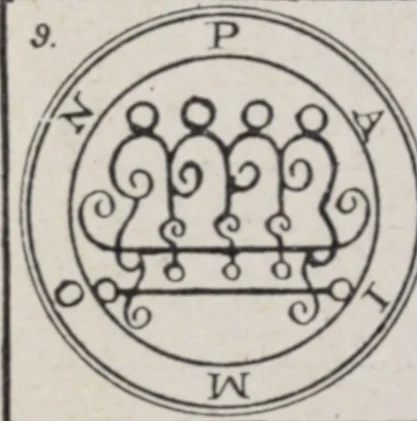
At a glance
- Entry
- 9 of 72
- Rank
- King
- Legions
- 200 in the text
Description in the text
Paimon is assigned an unusually broad office: the arts and sciences, secret knowledge, questions about the world and mind, and the granting of dignity. The text places him toward the west and describes a large following that includes other named kings.
Read entry 9 on page 24 of the 1916 edition
Appearance
A crowned figure riding a dromedary, preceded by musicians and a host of spirits.
Topics attributed to this entry
- Arts and sciences
- Secret knowledge
- Dignity
Reading this entry
Paimon receives one of the catalogue’s longest and most ceremonial introductions. A crowned rider on a dromedary is preceded by spirits with trumpets, cymbals, and other instruments. His voice is said to roar and initially resist comprehension. The account places him toward the west and makes him a king with 200 legions. It also names two attending kings, Labal and Abalim, while noting that not all subordinate spirits are automatically present.
The offices reach from arts and sciences to questions about the earth and mind, honors, subjection of others, and instructive familiars. This breadth is a feature of the entry, not evidence that each subject had a coherent doctrine attached to Paimon. The text invokes Lucifer and the Order of Dominations as parts of its own hierarchy. Modern portraits often focus on the camel and crown, but the musical procession and complicated following are equally central to the source.
Read entry 9 on page 24 of the 1916 edition or compare the 1904 transcription.
A closer reading of entry 9
What the numbered text says
Paimon’s 200 legions are not described as a single undifferentiated crowd. The entry divides them between two orders and separately names Labal and Abalim as attending kings with an associated group of 25 legions. Its grand entrance, difficult voice, and questions about earth and mind receive more space than the typical one-paragraph entry. These quantities and attendants belong to the book’s imagined hierarchy, not an external census.
About the printed seal
The 1916 image plate numbers Paimon’s character 9. His written portrait includes crown, dromedary, and musicians; the emblem is not a miniature illustration of that procession. Keeping the two kinds of source evidence separate makes the entry easier to compare with other kings.
Compare another entry
Compare entry 1: Bael. Bael is also a king, yet his entry gives one central attributed effect and several bodily forms. Paimon is defined through entourage, broad instruction, named subordinate kings, and a westward placement. The printed rank connects them, while the prose gives very different royal portraits.