
Sigil of Dantalion
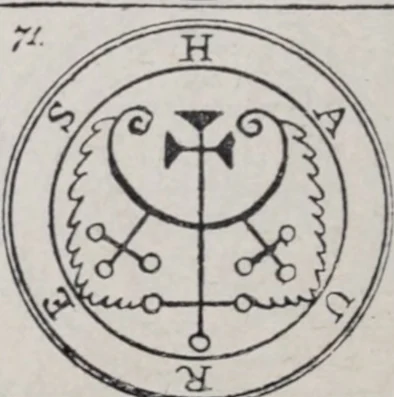
At a glance
- Entry
- 71 of 72
- Rank
- Duke
- Legions
- 36 in the text
Description in the text
Dantalion is said to teach arts and sciences and reveal or alter people’s thoughts. The entry also associates him with love and with showing a vision of someone far away.
Read entry 71 on page 45 of the 1916 edition
Appearance
A book-bearing figure with many men’s and women’s faces.
Topics attributed to this entry
- Arts and sciences
- Thoughts
- Love
Reading this entry
Dantalion appears as a human figure with many faces, both male and female, and a book in the right hand. The duke is credited with teaching arts and sciences and revealing people’s private counsel or thoughts. The entry also says he can change thoughts, cause love, and display a distant person’s likeness in a vision. The many faces and book are powerful images, but the text does not explicitly assign each face to a particular person or discipline.
The attributed manipulation of thoughts and feelings reflects the coercive assumptions of the source and should not be reframed as consent-based relationship advice. Dantalion governs 36 legions and has a seal. The visible multiplicity, written book, mental knowledge, and projected image create a tightly connected portrait even though the passage does not offer a theory of mind.
Read entry 71 on page 45 of the 1916 edition or compare the 1904 transcription.
A closer reading of entry 71
What the numbered text says
Dantalion’s many male and female faces, book, and human form lead into an office involving knowledge and intrusion. The text credits teaching all arts and sciences, revealing private counsel and thoughts, changing those thoughts, provoking love, and showing a distant person in vision. These are historical claims about access to other people’s minds and feelings, not ethical permission to obtain or manipulate them. The book in the right hand is a portrait detail; the passage never says the book contains the thoughts, arts, or visions.
About the printed seal
The fifth plate numbers Dantalion’s sign 71. Multiple faces in the prose do not imply multiple seals, and the printed emblem supplies no key to the faces’ identities. The safest reading of the image is as an edition-specific mark assigned to one spirit.
Compare another entry
Compare entry 56: Gremory. Gremory also has a love claim, beside time knowledge and hidden treasure. Dantalion instead links love to private thought, instruction, and vision. The difference has ethical as well as descriptive weight when these sources are summarized for modern readers.