
Sigil of Bael
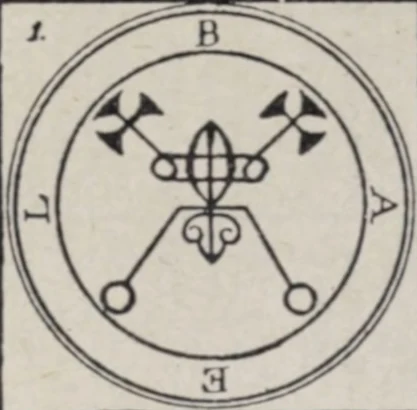
At a glance
- Entry
- 1 of 72
- Rank
- King
- Legions
- 66 in the text
Description in the text
Bael opens the catalogue as an eastern king to whom the text attributes invisibility. His entry says that his seal is the character by which the summoner identifies him.
Read entry 1 on page 22 of the 1916 edition
Appearance
A cat, a toad, a man, or a form combining all three; the text gives him a hoarse voice.
Topics attributed to this entry
- Invisibility
- Eastern kings
Reading this entry
Bael opens the numbered catalogue as a king associated with the east. The account allows several visible forms: cat, toad, man, or a composite of all three. It also singles out a hoarse voice. The shifting appearance distinguishes him more sharply than his assigned office: the ability to make a person invisible. The entry gives no explanation of how those forms relate to the claimed power, so a reader should resist treating the animal shapes as a fixed symbolic code.
The passage calls his graphic character a lamen to be worn before an encounter. It says recognition of that character is a condition of homage. Bael’s entry displays the catalogue’s recurring order: title and direction, described form, attributed office, legion count, and seal. His 66 legions belong to the text’s imagined hierarchy; they are not a historical census.
Read entry 1 on page 22 of the 1916 edition or compare the 1904 transcription.
A closer reading of entry 1
What the numbered text says
Several possible appearances and a specified voice surround Bael’s one attributed power, invisibility. The text allows cat, toad, and human forms separately or together. A composite picture is therefore only one of its options, not the single canonical portrait. It locates him in the east, a directional detail attached to his kingship rather than an explanation of the claimed effect.
About the printed seal
The passage calls the emblem a “character” and gives it a role in recognizing Bael. The reproduced drawing is seal 1 on the 1916 numbered plate. Its lines do not identify which of Bael’s several bodies is present; the prose does not supply that connection.
Compare another entry
Compare entry 9: Paimon. Paimon is the other king among the first twelve. His entry builds a public procession, named attendants, and a broad teaching office; Bael’s is compact and centered on variable appearance. A spirit’s rank alone does not predict how much narrative space the entry receives.