
- Early record
- Dee and Kelley, 1580s
- Printed plate set
- The Equinox I:7, 1912
- Historical layers
- Manuscript, print, and later ritual system
What the 1912 plates actually show
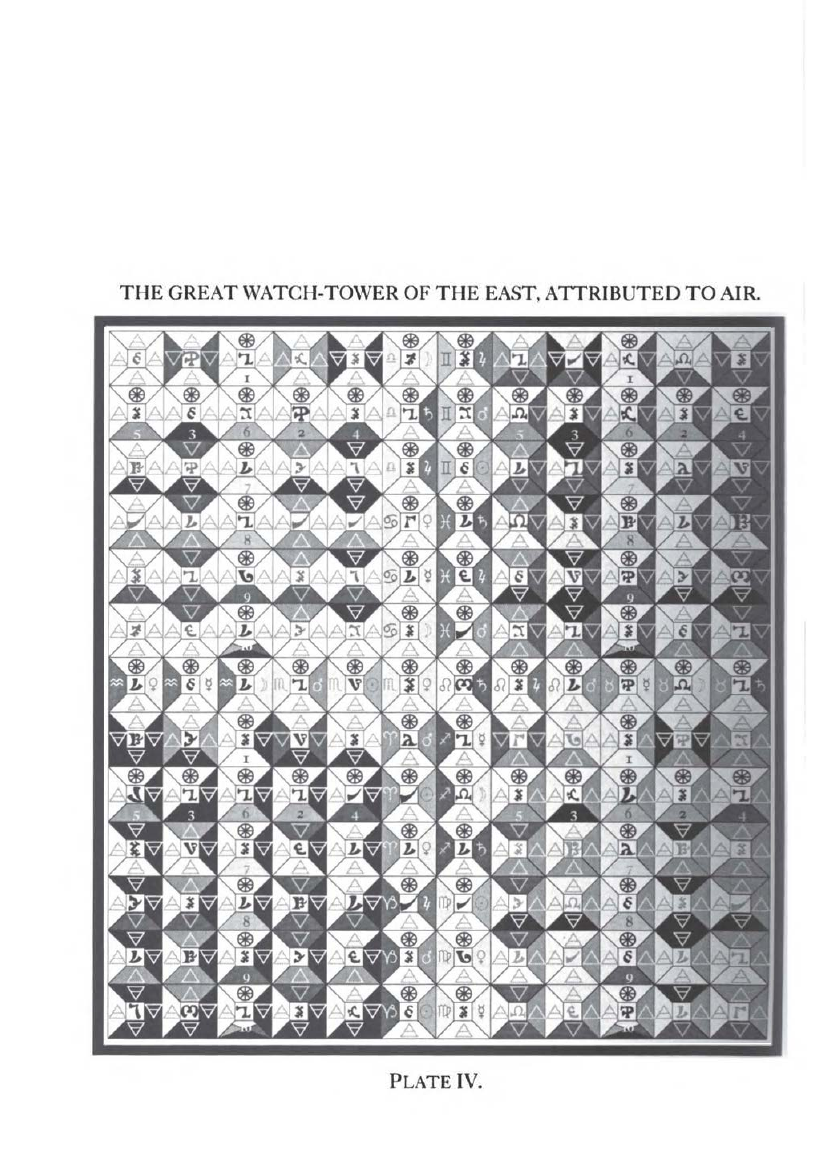
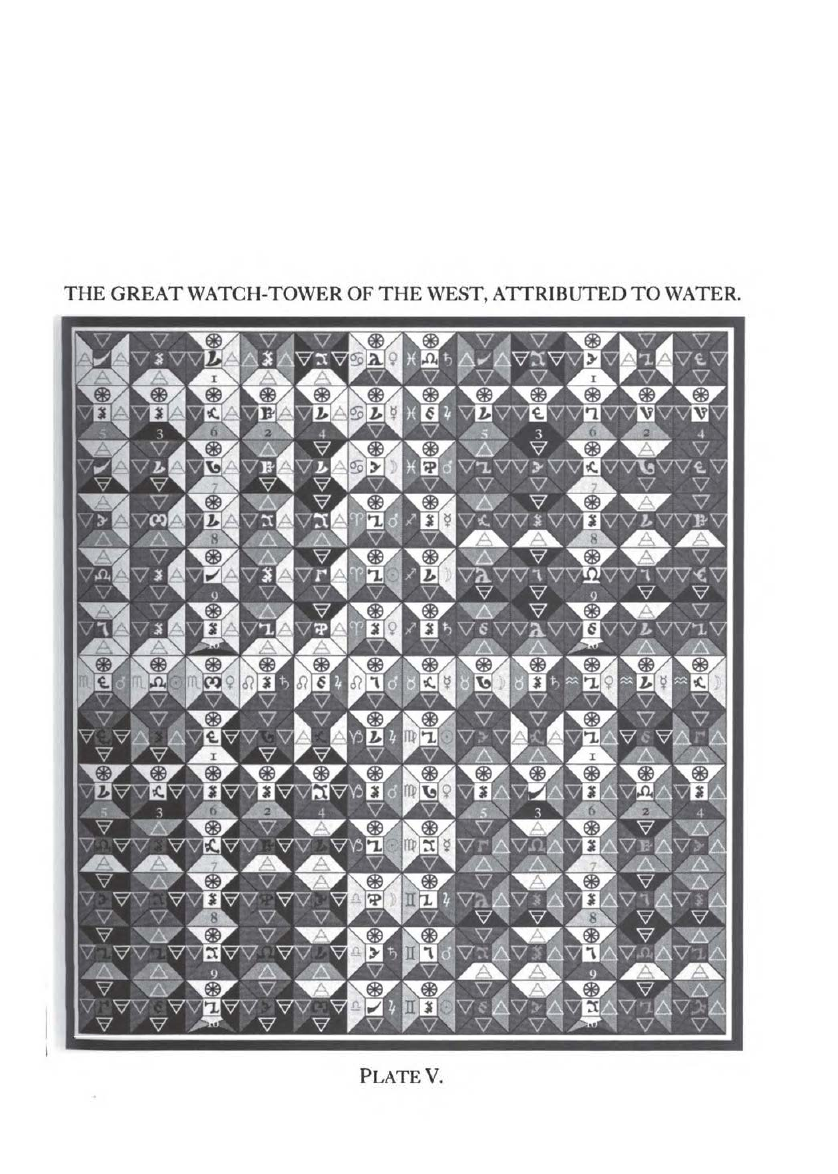
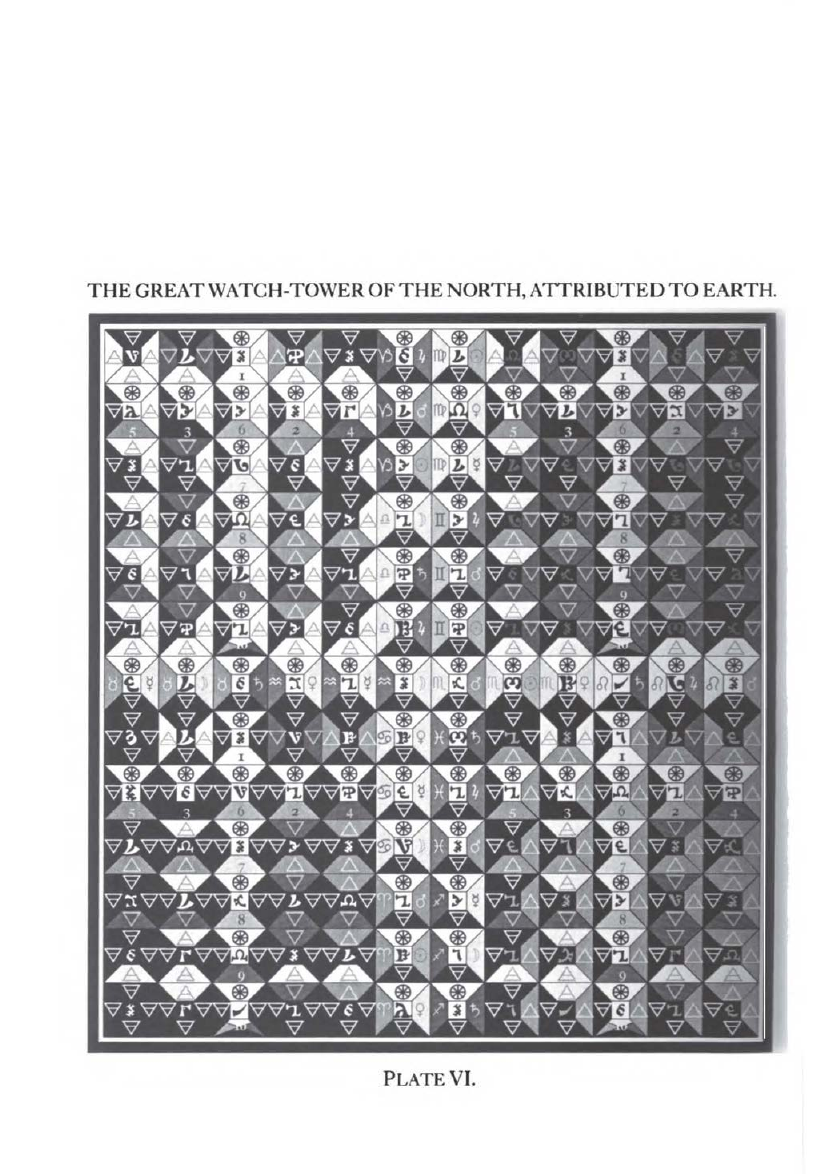
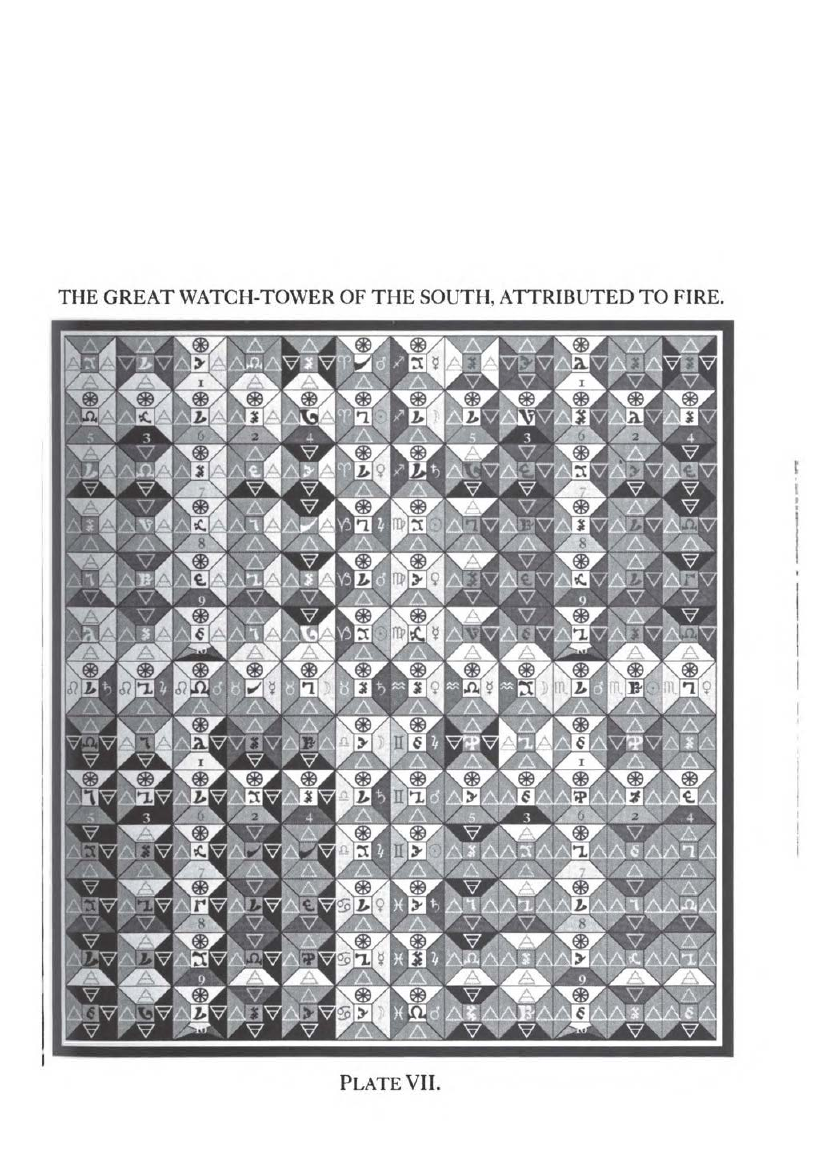
The bibliographic record for The Equinox I:7 lists a plate of “The Four Great Watch-Towers Within General View” and separate plates for East, West, North, and South, facing page 234. The issue itself is available as a scan. This is primary evidence for how an early twentieth-century occult publisher presented the tables. It is a 1912 printed plate, not an image of Cotton MS Appendix XLVI.
Plates IV and V identify East with Air and West with Water in their headings. Inside each 12-by-13 field, the letters remain visible beneath a dense second syntax of divided pyramids, planetary and zodiacal signs, elemental marks, and small numbers. The images therefore do more than reproduce two quadrants. They instruct a reader to treat each letter-square as a composite of later attributions, which is why the plate cannot be substituted for Dee’s manuscript grid when deciding an early letter or layout.
The plates are associated with the Golden Dawn-derived “Brief Abstract of the Symbolic Representation of the Universe” printed by Crowley. Later systems assign the four quadrants to elements, directions, color scales, angelic names, and ritual calls. Those assignments have an internal logic within those systems. Dee’s dated diary, Golden Dawn teaching documents, and Crowley’s presentation preserve different stages of the claims.
Why “elemental tablet” needs a date
A contemporary “Enochian fire tablet” usually refers to a directional, elemental chart. The four quadrants of the Great Table are earlier; assigning each a stable ritual station and color treatment belongs to later reception unless an earlier passage supports the specific correspondence.
Plates VI and VII complete the printed compass by naming North as Earth and South as Fire. They repeat the same subdivided-square grammar seen in Air and Water rather than changing to a new manuscript format. The repetition is analytical evidence: the four plates were coordinated as one teaching system, while their different letters and face assignments preserve the four elemental fields inside that common template.
Colored elemental grids often combine letters from one Great Table recension with the colors and titles of a later school. The result belongs to that school’s arrangement rather than to an unchanged image from Dee’s 1584 record.
Crowley’s place in the chain
Crowley was a publisher and interpreter of Enochian material, not a participant in Dee and Kelley’s sessions. The Equinox I:7 plates and I:8 continuation are dated witnesses to what his circle placed before readers in 1912. The printed material can be studied alongside later visionary writing such as The Vision and the Voice, but the latter reports Crowley’s own experience and does not amend Dee’s autograph record.
Following a Golden Dawn or Crowley method is a later historical choice. It does not become a sixteenth-century instruction merely because it uses Dee’s lettered squares. The manuscript record, 1659 print, and 1912 plates preserve distinct stages of that chronology. They also differ in color, typography, and the names arranged around the four quadrants.
Worked comparison: one Water-table cell in Dee’s record and the 1912 plate
The most useful single-cell lens is the penultimate position in the third central name of the quadrant later presented as Water. Burns and Moore report that Dee’s Sloane MS 3191 material retains O and C as alternatives there; the neighboring final position likewise retains L and H. Reading the first pair yields GAIOL, while reading the second yields GAICH. No numeric row-and-column coordinate is supplied here because the public catalogue does not establish one and competing charts number the table differently.
The Equinox I:7 resolves the ambiguity for its own 1912 teaching system. In the prose accompanying the Water examples, the three names on the central line are printed MPH, ARSL, GAIOL. The penultimate square is therefore O in that edition, and the final square is L. Plate V presents the West or Water tablet within a broader system of directional, elemental, color, and pyramid attributions. The letter selection and the ceremonial setting arrive together for the issue’s readers, but they are two editorial decisions.
A modern rectified table can choose C and H instead. Burns and Moore justify GAICH by following the governor VIROCHI across the disputed crossing: C and H preserve that governor’s name, so their stated rule lets the governor sequence control the table letters. This is a reasoned reconstruction. It does not make the 1912 GAIOL a printing accident by definition, and it does not prove which alternative a reader in every earlier moment accepted.
The cell comparison locates the historical change precisely. Dee’s working manuscript preserves alternatives; the 1912 text selects O and prints a stable name; a modern editor may select C under a governor-continuity rule. The bright elemental plate can make its grid look timeless, yet one square exposes its editorial date. Golden Dawn and Crowley reception selected letters, assigned directions, added color, and taught derived names through a later ceremonial grammar.
Sources
- British Library, Cotton MS Appendix XLVI catalogue ↗The surviving conference record, dated 1583–1587, containing the 1584 and 1587 episodes.
- The Equinox I:7 (1912), original issue scan ↗Printed Plates III–VIII: a general view, four directional Watch-Towers, and the detached Black Cross or Table of Union, all listed facing printed page 234.
- The Equinox I:8 (1912), original issue scan ↗Continuation including the Calls and later occult use.
- 100th Monkey Press, bibliography of The Equinox I:7 plates ↗Identifies Plates III–VIII and lists the general view, four directional Watch-Towers, and Black Cross as facing page 234 in the March 1912 first edition.
- Burns and Moore, Great Table, Part II ↗Discussion of the Black Cross, textual variants, and later attributions.