
The demon portraits associated with the Dictionnaire Infernal come from its sixth edition, published in 1863. Many were drawn by the French artist Louis Le Breton and translated into printable engravings. Their compact silhouettes, theatrical attributes, and labeled names helped turn an alphabetical reference book into one of demonology’s most recognizable visual archives.
- Edition
- Paris, 1863
- Named artist
- Louis Le Breton
- Advertised total
- 550 engravings
Images designed for a dictionary page
The portraits work at small scale. Strong outlines separate figure from blank paper, while a few attributes carry the identity: a mount, weapon, animal body, crown, or cluster of limbs. This economy suits a dense reference volume where the illustration must share space with an entry and remain legible after engraving and printing.
A printed name beneath the image anchors the figure to its article. That label has become especially important online, where the picture is often detached from the surrounding French text. The original page context connects a portrait to Collin de Plancy’s encyclopedia; the floating image alone can make it look like an independent occult diagram.
The page also fixes the image inside a hierarchy of headings, columns, and neighboring entries. Seeing that typography restores the work’s reference-book character. The demon is one illustrated term among many, not a full-page devotional plate or a self-contained set of ritual directions.
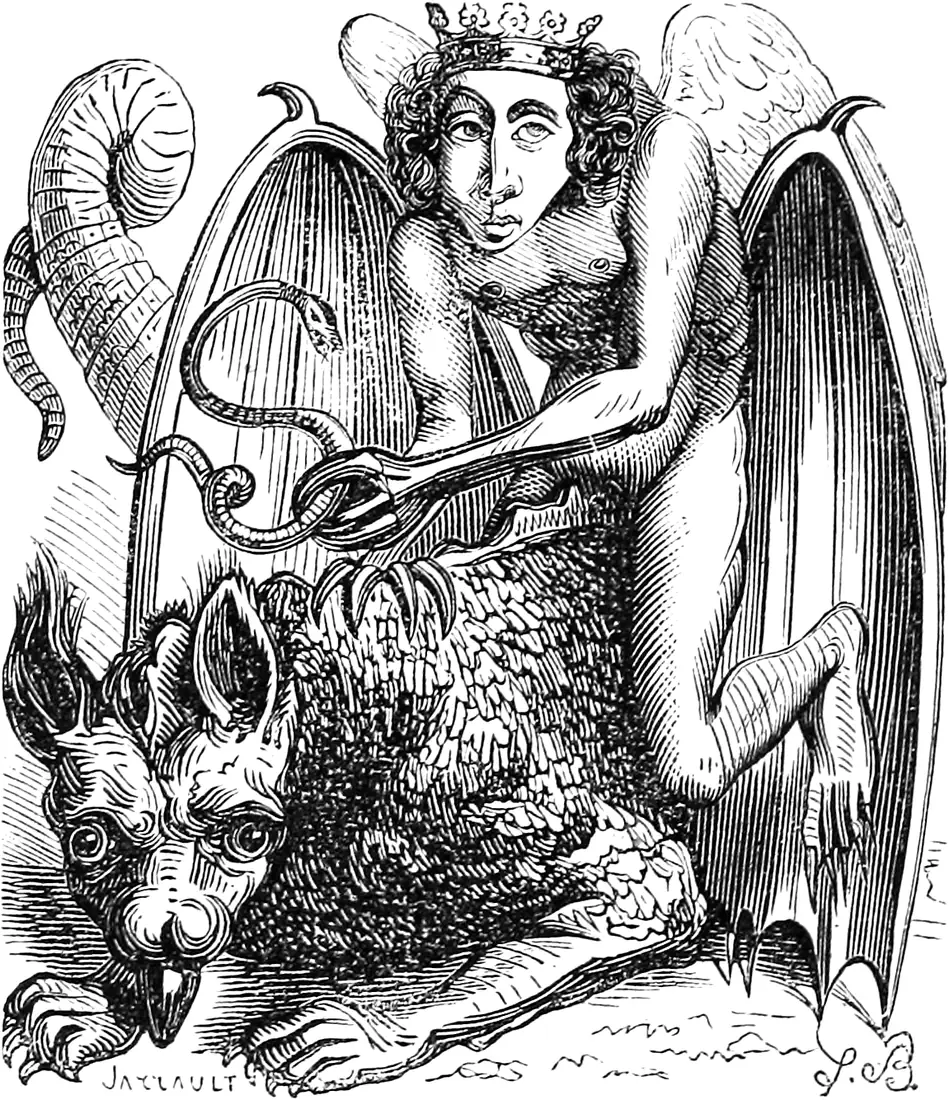
Astaroth: rank staged as spectacle
Le Breton’s Astaroth is a winged, crowned rider holding a serpent and seated on a dragonlike beast. The image compresses several textual attributes into a heraldic scene. The crown signals rank, the mount creates motion, and the serpent gives the hand a readable object even when the engraving is reduced.
The picture is neither a seal nor a plan for ritual work. It is a nineteenth-century character portrait attached to an encyclopedia entry. Its dramatic clarity is one reason it has migrated so widely into posters, reference charts, games, and modern demon imagery.
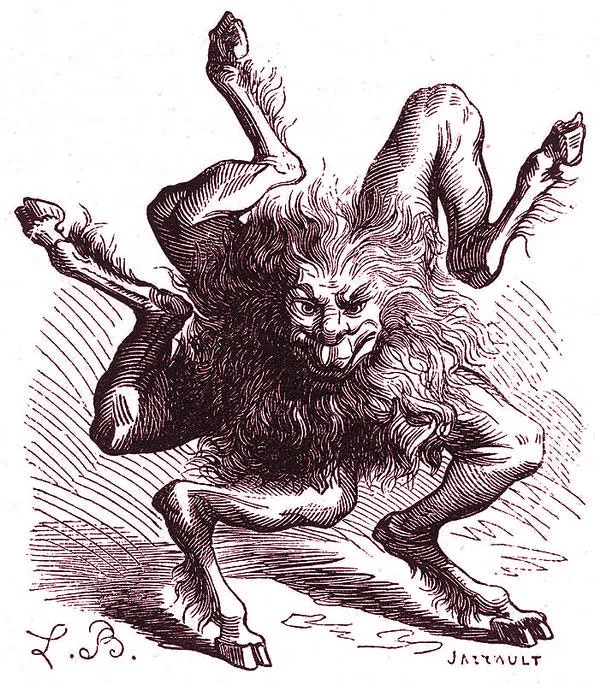
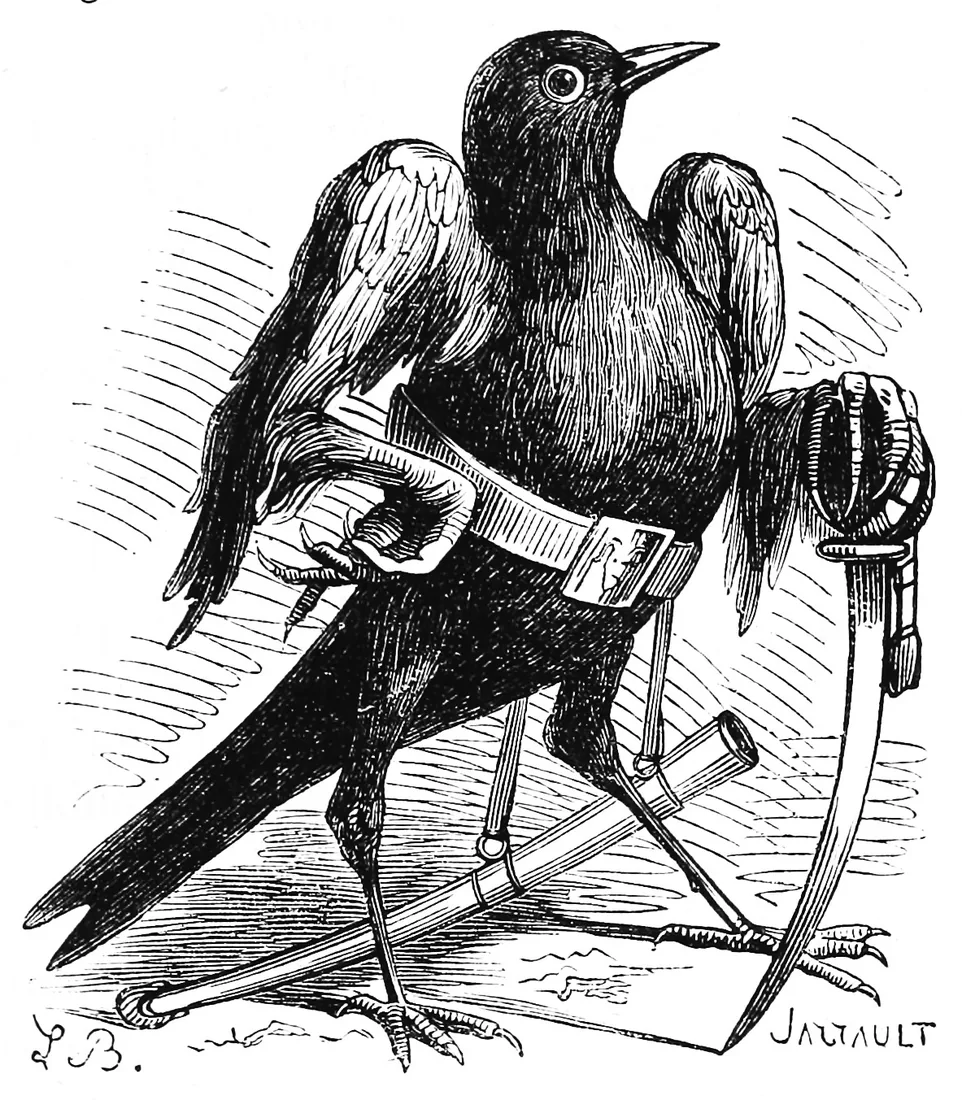
Buer and Caym: memorable silhouettes
Buer’s image is built around a central leonine head surrounded by five goatlike legs. The radial form has no conventional upright posture, so it remains recognizable from almost any angle. It is an unusually effective example of visual shorthand: a complex creature becomes a single wheel-shaped mark without becoming a formal sigil.
Caym, also spelled Caim in many Goetia lists, appears as a dark bird carrying a sword. The long blade and compact avian body create a sharp diagonal composition. The engraving chooses the bird form over the human form that some texts say the spirit can assume, making one stage of a changing description the permanent visual emblem.
Illustration, seal, and description are different layers
A Le Breton portrait shows how an artist and publisher imagined an entry for an 1863 audience. A spirit seal belongs to a separate diagram tradition, and a prose description may derive from earlier printed or manuscript lists. When the three appear together on a modern profile, their apparent unity is retrospective.
Keeping those layers visible makes the images more interesting. They document nineteenth-century book design and the growth of popular demon iconography. Their value comes from a specific artist, edition, and print setting, while their later reuse shows how strongly the sixth edition shaped the visual memory of older names.
Source records and digitized editions
- Bibliothèque nationale de France record for the 1863 sixth edition ↗
- Library of Congress record and digital copy for the 1863 edition ↗
- WorldCat record for the illustrated 1863 sixth edition ↗
- Wikimedia Commons gallery for the sixth-edition illustrations ↗
- Wikimedia Commons record for Le Breton’s Astaroth engraving ↗
- Wikimedia Commons record for the Buer engraving ↗
- Wikimedia Commons record for the Caym engraving ↗