
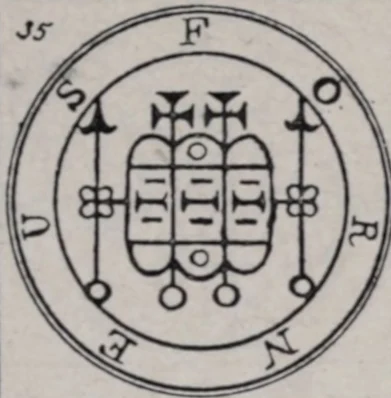
Fire leaves Marchocias’s mouth in Le Breton’s 1863 plate, where griffin wings and a serpent tail exclude the optional soldier form; Ars Goetia 35 spells Marchosias.
- 1863 headword
- Marchocias
- Ars Goetia
- No. 35 · Marquis
- Legions
- Dictionnaire 30 · Goetia 30
What Collin de Plancy’s Marchocias entry says
Marchocias is a great marquis who appears as a fierce she-wolf with griffin wings and a serpent tail. The source text describes fire issuing from the mouth; a faulty optical character recognition can turn the French word for flames into an absurd reference to women, so the scanned page matters. In human form Marchocias resembles a tall soldier, obeys exorcists, formerly belonged to the Dominations, and commands thirty legions.
Transformation links beast and soldier, while the former angelic order supplies a third identity behind both. The compact entry is concerned with martial obedience and fallen status more than with a list of services. Correcting the obvious OCR error restores the fire-breathing feature shared by the source family and visible in later summaries.
Reading Louis Le Breton’s 1863 portrait
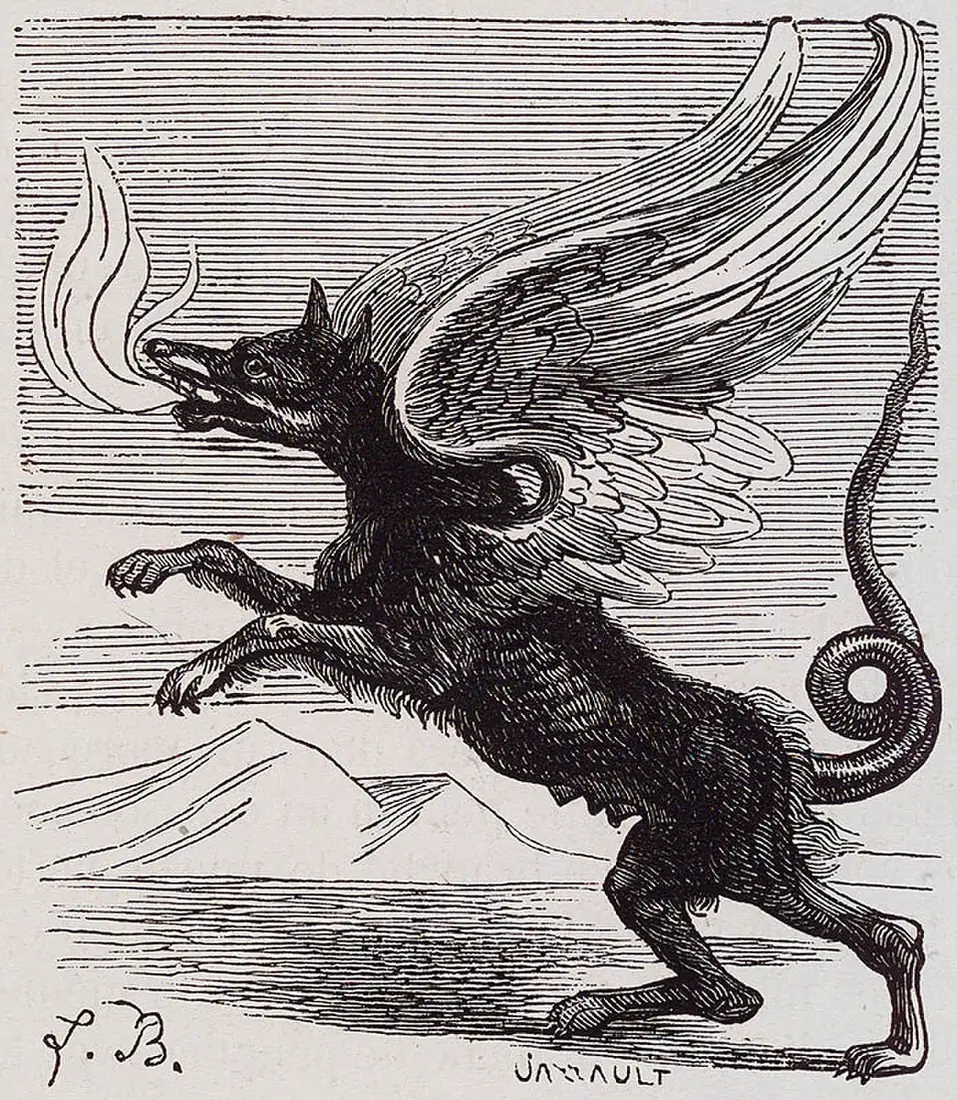
Le Breton draws a lean wolf in profile with large feathered wings, a curling serpent tail, and flame streaming from the jaws. The horizontal body and backward sweep of wing and tail create speed even though the animal is standing. Hybrid components remain clearly separable, making the prose list easy to read in the picture.
The portrait follows the beast stage and omits the tall soldier. Marchosias’s Goetia seal is another form of compression: it marks number 35 without showing wolf, griffin, serpent, flame, or human change. The engraving’s close fit with the animal description does not make it a sigil.
Marchocias and Ars Goetia spirit 35
Both traditions give a fire-breathing wolf, griffin wings, serpent tail, later human form, strong martial character, former place among Dominations, thirty legions, and obedient behavior. The Goetia also records a hope of returning to a heavenly throne after twelve hundred years.
The Dictionnaire calls the animal a she-wolf and the human a great soldier, then stops after rank, obedience, ancestry, and legion count. The Goetia makes fighting ability and the stated hope of restoration more explicit. The French spelling Marchocias differs from the Goetia index form Marchosias.
Worked comparison: correcting a scan with image and parallel text
The OCR phrase that says the wolf “vomits women” fails three checks. The page image supports the French word for flames, Le Breton draws fire at the mouth, and the Goetia parallel also describes flames. Agreement among scan, illustration, and related witness identifies a transcription error without rewriting a genuine variant.
This is a practical textual comparison rather than a citation lesson. Each layer contributes evidence: the scan preserves letters, the portrait preserves the understood attribute, and the Goetia preserves a cognate sentence. Together they recover a coherent fire-breathing figure.