
Cat, man, and toad form a vertical three-headed Baël in Le Breton’s 1863 engraving; Ars Goetia 1 permits Bael’s faces separately or together.
- 1863 headword
- Baël
- Ars Goetia
- No. 1 · King
- Legions
- Dictionnaire 66 · Goetia 66
What Collin de Plancy’s Baël entry says
Baël opens Weyer’s infernal inventory and appears at the head of powers in the Grand Grimoire, points Collin de Plancy foregrounds before describing him. The first king rules in the east and combines the heads of a toad, a man, and a cat. He has a hoarse voice, fights well, makes his followers cunning, and teaches invisibility. Sixty-six legions obey him. The article ends by asking whether this Baël should be identified with Baal rather than silently deciding the question.
The final question mark matters. Collin de Plancy transmits a catalogue figure while also exposing a naming problem produced by language, theology, and earlier antiquarian comparison. The entry is therefore both a demon profile and a small note on unstable identity. Rank, direction, heads, office, and legion count are confident; the larger equation with Baal remains open.
Reading Louis Le Breton’s 1863 portrait
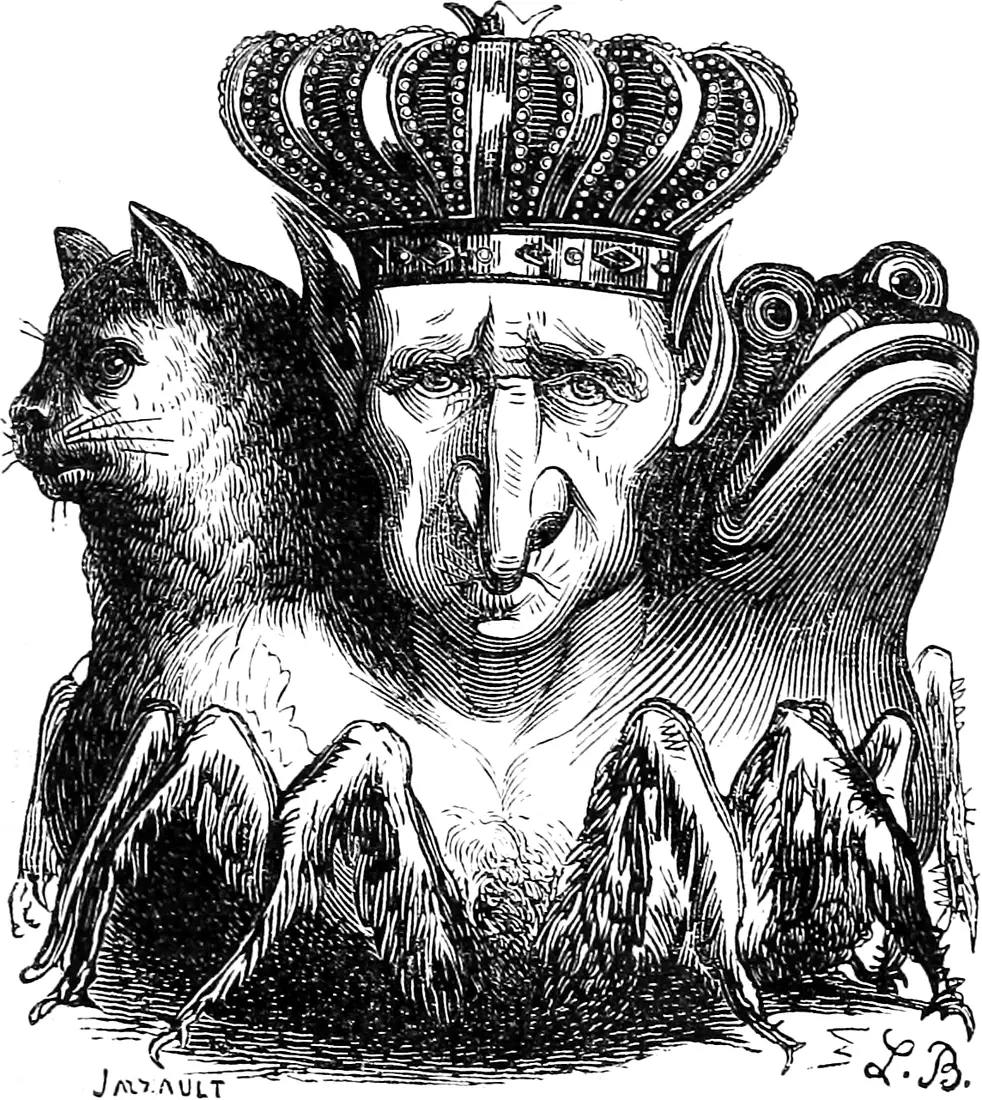
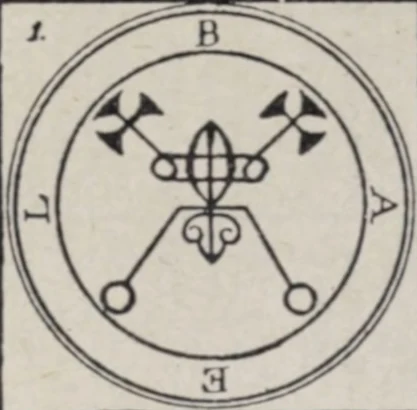
Le Breton stacks the three heads into a compact frontal creature. The human face occupies the center, a cat looks outward above it, and a broad toad anchors the lower body. Rather than show three separate bodies, the engraving joins their faces within a dark mass, making the hybrid readable as a single king without relying on crown, throne, or landscape.
The portrait visualizes multiplicity through anatomy. Bael’s Goetia seal instead uses a linear sign attached to the first numbered entry. Because the page begins the catalogue, the number and seal establish sequence; the later engraving supplies a body that the seal never claims to depict.
Baël and Ars Goetia spirit 1
The Goetia also starts with Bael as an eastern king, describes cat, toad, and human forms that may be combined, notes the hoarse voice, attributes invisibility, and gives sixty-six legions. The strong overlap makes this one of the clearest demonstrations of shared catalogue descent.
The Dictionnaire adds martial ability and cunning, explicitly cites the Grand Grimoire and Weyer, and raises the Baal question. The Goetia emphasizes the character or seal used to identify the spirit and does not turn the name problem into an editorial aside. Its wording allows separate or combined forms, while Le Breton commits to the composite.
Worked comparison: separate forms become one body
Read the Goetia’s alternatives first: cat, toad, man, or all three at once. Then inspect Le Breton’s image. It chooses the last option and uses vertical arrangement to keep every face visible. Finally return to the Dictionnaire wording, which simply lists three heads. The portrait resolves an ambiguity that the English text keeps open and the French summary narrows.
The comparison shows how a widely reproduced image can make one variant feel mandatory. The composite is historically grounded, but it is still a choice among options. The separate seal proves only that spirit 1 received a sign in the Goetia edition; it does not settle which body should be drawn.