
Reginald Scot’s Discoverie of Witchcraft is often cited by occult sites for its spirit descriptions. That use can invert the book’s aim. Scot challenged witchcraft accusations, exposed conjuring tricks, and argued against the treatment of vulnerable people as witches.
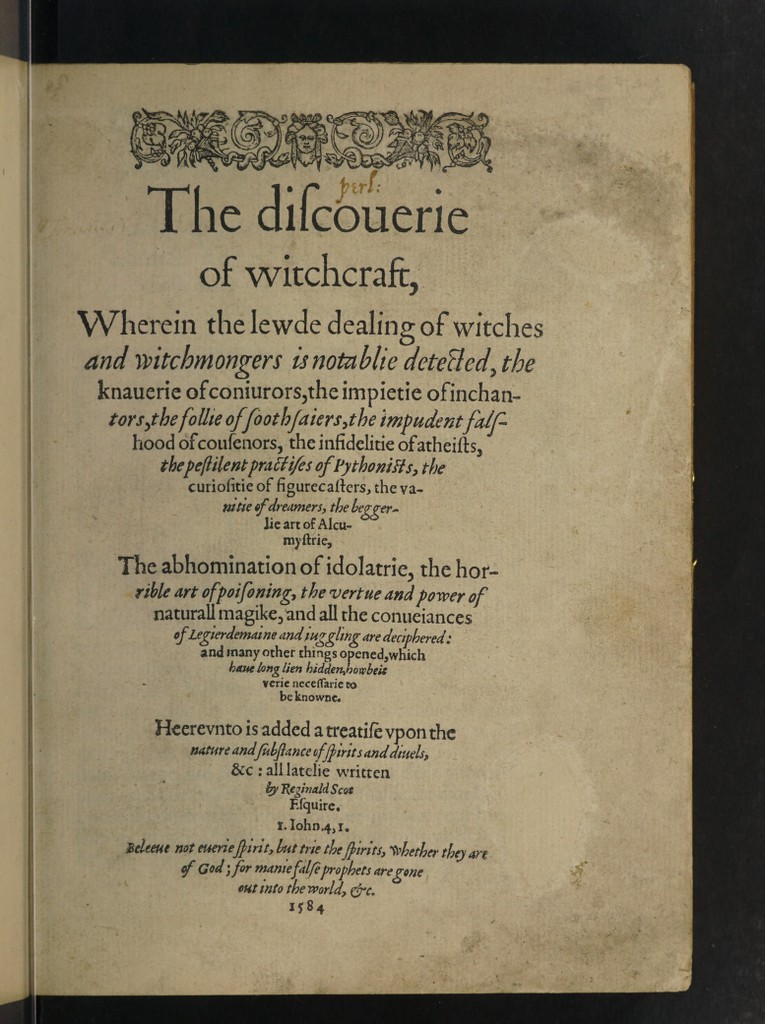
- Period
- First printed in London, 1584
- Form
- English printed polemic
- Anchor witness
- Wellcome Collection, 1584 printing
A skeptical book with an unexpected afterlife
The 1584 title page advertises the exposure of witchmongers, conjurors, diviners, and sleight of hand. Folger Shakespeare Library describes the book as a skeptical pushback against witchcraft beliefs and attention to the social circumstances of accused older women. Scot also printed material about spirits and demons, including English descriptions related to Weyer’s catalogue. It is historically important that he chose to show readers such material within a critical argument. Someone searching for a demon “power” may land on an English phrase in Scot, but the publisher’s surrounding chapters do not present it as a verified ability. The text records what people claimed and how Scot debated it.
From the 1584 printing to later reprints
Wellcome Collection holds and digitizes a 1584 printing with an index and a section on spirits near the end. It also catalogues an 1886 reprint and other later versions. Later transcriptions can modernize spelling, change punctuation, or draw from a reprint. The original imprint, pagination, and notes reveal differences from Weyer and the Ars Goetia. Copied descriptions entered new settings where Scot’s argumentative frame could disappear. This is textual reuse rather than evidence that Scot secretly endorsed the practice he criticized.
Worked comparison: what Scot leaves out
Pruflas exposes the selectivity of Scot’s transmission. Weyer places this spirit fourth and gives the entry the catalogue’s usual working parts: a rank, a location and manifestation, attributed offices involving discord and deception, a promise of responses, and twenty-six legions. Scot’s English sequence omits the entry. The later Ars Goetia omits it too, while adding other names and reorganizing the list. The missing record changes more than the final count: it closes a gap near the beginning and shifts the neighborhood against which later entries are compared. In Scot’s book that omission sits inside a second transformation. Material adapted from Weyer appears within an English polemic that attacks credulity, conjuring claims, and harmful witch accusations. The catalogue can preserve a spirit description without endorsing its attributed power, just as an omission can reveal editorial transmission without proving deliberate censorship. Reading the absent Pruflas beside Scot’s surrounding skeptical chapters shows how textual selection and argumentative purpose work together.