
James VI of Scotland, later James I of England, wrote Daemonologie as a dialogue arguing for belief in witchcraft. Its manuscript and printed editions reveal a working text and a public argument. The book’s accusations and proposed punishments belong to the history of witch persecution, not to a timeless map of supernatural beings.
- Period
- Manuscript c. 1592; print 1597 and 1603
- Form
- English dialogue in three books
- Anchor witness
- Folger V.a.185 and Wellcome 1603 printing
The dialogue narrows doubt instead of leaving it open
Daemonologie gives its argument to two speakers. Philomathes, the learner, voices uncertainty and asks for distinctions; Epistemon, whose name signals knowledge, supplies definitions and conclusions. The format produces motion: a claim is raised, divided into categories, answered from scripture or reported experience, then carried into a new question. It can look like balanced debate when a sentence is isolated, but the roles are unequal. Philomathes repeatedly accepts the teacher’s frame, so doubt becomes the device that lets the authoritative answer advance.
The three books enlarge that answer. Book I distinguishes forms of magic and concentrates on necromancy and a demonic contract. Book II turns to sorcery and witchcraft, including alleged practices and signs. Book III classifies spirits, apparitions, possession, and related phenomena. The structure moves from definition, through accused human agents, to a populated demonology. It is an argumentative sequence rather than a field catalogue: categories introduced early determine how later reports will be interpreted.
A revised manuscript becomes a royal printed position
Folger V.a.185 is a fair copy from about 1592 in a scribal hand, with extensive corrections and additions identified as James VI’s. The material record shows revision before the 1597 Edinburgh print. Its base hand, royal revisions, and possible additional annotator limit claims about individual marks. The manuscript records composition in motion, with wording still changing before the finished 1603 printing.
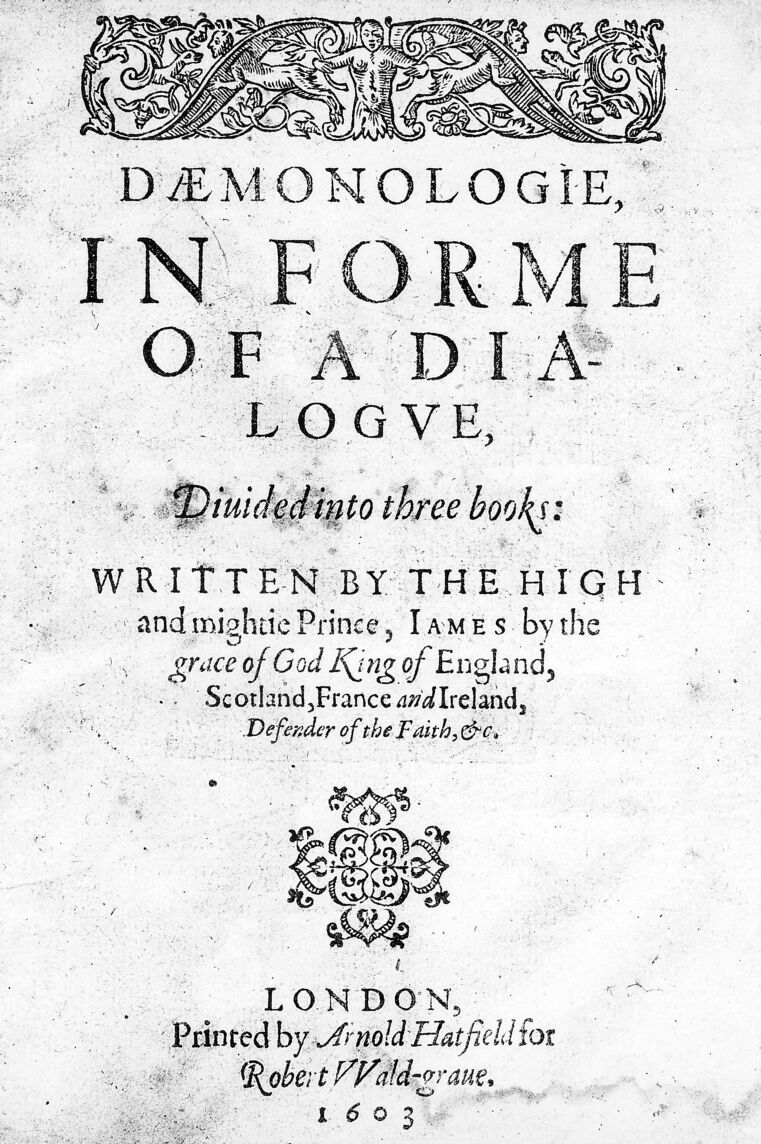
The 1603 London title page shown here names James as ruler of England as well as Scotland. That change of royal style gives the later printing a new political setting even where an argument remains textually stable. The title promises a dialogue divided into three books, while the prefatory address tells the reader why the author published: to resolve doubt, affirm the assaults attributed to Satan, and argue that the alleged human instruments merit severe punishment. Form and consequence are joined before Philomathes asks his first question.
Worked reading: how a dialogue question becomes a prosecution argument
Book I opens with Philomathes asking about the “strange news” of witches and then doubting whether witchcraft or witches exist at all. Epistemon answers first with a rule of debate: against someone who denies first principles, discussion is difficult. He then declares the former part proved by scripture and the present existence proved by daily experience and confessions. The sequence converts the disputed conclusion into a starting point. Once existence is treated as a principle, the skeptic may question kinds and causes but cannot easily reopen the category itself.
The dialogue’s question-and-answer rhythm hides that burden shift in plain sight. Philomathes supplies short objections; Epistemon supplies the vocabulary, authorities, and final divisions. A later discussion of proof shows the legal reach of the method. Philomathes warns that judges must not condemn on gossip and asks what the confessions of accused people can prove against another defendant. Epistemon concedes that one disreputable report is insufficient, then compares witchcraft to high treason against God and argues that witches may serve as witnesses to witches. The initial appeal to “confessions” has become a rationale for circulating accusation.
The preface closes the loop. It names Scot’s denial and Weyer’s defence of accused people as “damnable opinions,” then says the alleged instruments deserve severe punishment. The dialogue therefore does not travel from neutral doubt to a surprising conclusion. It begins with a declared prosecutorial destination and stages the route by which a reader is meant to reach it. The worked passage is valuable because it shows argument becoming procedure: define denial as a refusal of principle, treat confession as experience, admit implicated witnesses under a treason analogy, and make punishment appear as the logical end.
Contract, mark, and confession form an evidence loop
In Book I the demonic contract explains both command and subjection. Epistemon says the apparent power of a necromancer over a spirit exists only by pact: the demon concedes trifles to claim body and soul. The contract may be written in blood or confirmed by touch, with a bodily mark said to remain in the case of witches. That model makes an invisible agreement the cause and a hidden mark its possible residue. Later examination can then search the body for a sign whose meaning the theory has already fixed.
James also treats reluctance to confess as evidence against a melancholy explanation, reasoning that the accused resist until torture whereas melancholy people speak freely. This is a self-sealing argument: confession confirms the charge, while resistance under coercion confirms guilt of another kind. Reading those pieces together exposes the book’s internal logic more clearly than a list of edition dates. It also keeps the human stakes visible. The text’s supernatural assertions were claims, but its recommendations concerned real bodies, testimony, punishment, and royal authority.
Sources and editions
- Folger Shakespeare Library, Daemonologie manuscript V.a.185, c. 1592 ↗
- Folger Shakespeare Library, 1597 Edinburgh Daemonologie printing ↗
- Wellcome Collection, digitized 1603 London Daemonologie printing ↗
- Wellcome Collection, 1955 negative of the 1603 title page and Public Domain rights ↗
- Folger Shakespeare Library, Scot and James in the collection exhibition ↗
- Folger Shakespeare Library, I Put a Spell on You exhibition ↗
- Project Gutenberg, searchable text of the 1597 Daemonologie ↗
- Almond, James I and the supposed burning of Scot’s Discoverie ↗