
The familiar “Crowley Goetia” is a particular 1904 printed book. Its text, title page, added interpretive material, and later reprints should be distinguished from the manuscript Lemegeton and from one another.
The physical book announces an intervention
The National Library of New Zealand catalogues The Book of the Goetia of Solomon the King under a Boleskine, Foyers, Inverness imprint from the Society for the Propagation of Religious Truth, dated 1904. The title page assigns Crowley four roles; editor, verifier, introducer, and commentator; while calling the English translation the work of “a dead hand.” That theatrical phrase conceals a contributor at the point where the rest of the page advertises Crowley’s presence. Later bibliographies generally identify the translator as S. L. MacGregor Mathers. The title page therefore acts as editorial staging: it makes anonymity part of the book’s atmosphere and makes Crowley the visible guide through the inherited text.
The sequence of the printed volume reinforces that role. A prefatory note and preliminary invocation lead into Crowley’s “Initiated Interpretation of Ceremonial Magic” before the reader reaches the Solomonic apparatus and the seventy-two entries. The order asks a modern essay to control the meaning of older material placed after it. This is a designed reading experience, not a neutral transcription of a manuscript. The edition announces how it wants seals, divine names, perfumes, commands, and spirit offices to be understood before it presents their details.
The book gives the ritual two explanations
The Goetia text describes an operator who stands within a protective circle, directs a spirit into a triangle, invokes divine authority, displays a seal, and demands a visible appearance or service. Its instructions treat names, figures, ranks, materials, and spatial boundaries as operative parts of an encounter. Crowley’s introductory essay keeps that sensory machinery but changes its explanatory center. He distributes the rite across sight, sound, smell, taste, touch, and concentrated thought, then interprets the resulting experience as an unusual synthesis of impressions.
This produces a double text. The inherited instructions speak as commands addressed to ranked spirits. The introduction treats spirits as portions of the human brain, seals as visual means of stimulating particular areas, divine names as graduated controls, and perfumes as aids working through smell. Crowley does not remove the circle, seal, or invocation; he translates their claimed agency into a model of attention and mental effect. A reader can therefore move from a psychological explanation into pages whose grammar still assumes an external being that appears, speaks, teaches, or obeys. The tension between those voices is one of the 1904 edition’s central additions.
Worked reading: Buer between office and brain model
Printed page 15 places Buer between the longer entries for Paimon and Gusion. The paragraph identifies him as the tenth spirit and a Great President, assigns an appearance “in Sagittary,” lists philosophy, logic, herbs, healing, and good familiars as his offices, gives him fifty legions, and ends by requiring his character to be worn when he is called into appearance. The entry is compact because each phrase performs a different job. Number fixes sequence; rank places Buer inside the hierarchy; appearance supplies recognition; offices define the expected answer or service; legions quantify authority; and the character links the written catalogue to the operator’s body.
Crowley’s introductory model changes how that same record can be read. Under his account, wearing Buer’s character is a visual method for focusing a specific mental operation, while rank and name narrow control from a general ritual state toward a particular faculty. Buer’s cluster of philosophy, logic, plants, and healing then looks less like a miscellaneous list than a target profile. The seal selects Buer; the title “President” identifies a type; the offices specify what the stimulated faculty is expected to produce. Yet the entry’s final demand for an appearance does not disappear. The psychological frame interprets the encounter, while the older paragraph continues to stage an address to an obedient spirit.
The nearby Paimon and Gusion entries show the catalogue’s repeatable grammar. Each combines rank, form or identifying behavior, powers, subordinates, and a seal, but the balance changes. Paimon receives an elaborate arrival with music, speech, attendants, and two named kings. Buer receives a compressed office list. Gusion emphasizes answers across time and the reconciliation of friendships. The page is therefore more than three demon descriptions: it is a small database printed as prose. Crowley’s essay overlays that database with a theory of mental specialization, turning variation among spirit offices into variation among faculties while leaving the ritual instructions intact.
A printed diagram makes a textual claim
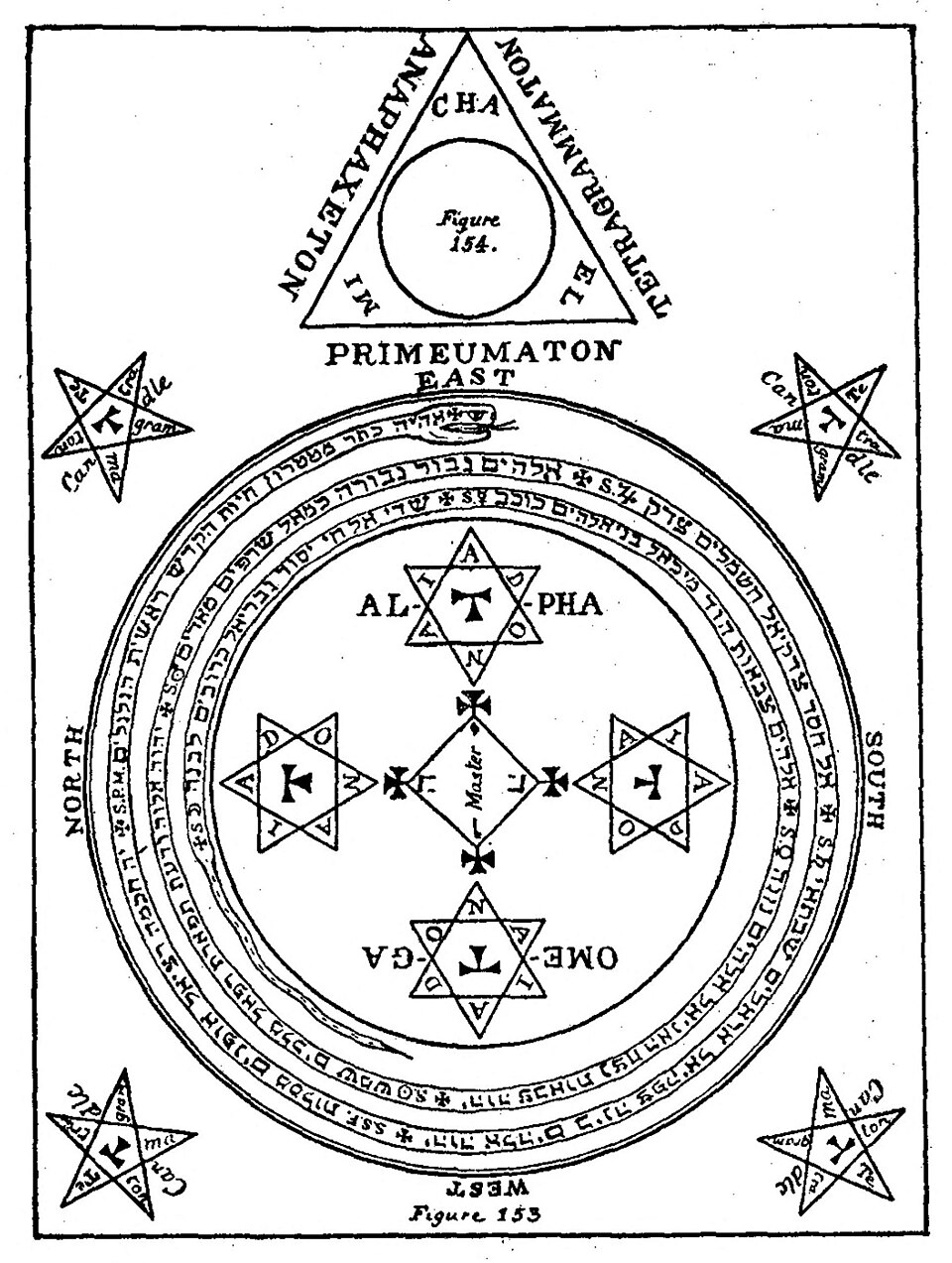
The frontispiece gathers circles, pentagrams, divine names, and bounded spaces into a clean black-and-white plate. Its symmetry gives the operation an appearance of completeness before the prose begins. In the ritual text, however, a diagram is one component among prayers, threats, timing rules, seals, suffumigations, and instructions about where the spirit should appear. Reading the plate as a self-sufficient “Goetia circle” removes the sequence of acts that gives its labels a job.
The printed line also stabilizes forms that vary in handwritten witnesses. Peterson’s comparisons show errors, omissions, modernized spellings, and differences among Sloane manuscripts. A seal or perimeter name reproduced crisply in 1904 records what this edition chose to print. It does not prove that every seventeenth-century copy carried the same strokes. The frontispiece is evidence for the edition’s visual argument: hierarchy has been converted into geometry, and a variable manuscript apparatus has been presented as a finished system.
One book selected from a five-part compilation
Goetia is the first of five works grouped in the Lemegeton. The manuscript collection continues with aerial spirits in the Theurgia Goetia, planetary-hour and zodiacal material in Ars Paulina, the altitude structure of Ars Almadel, and a notory-art section in some witnesses. The 1904 volume selects the first book and gives that selection its own title, front matter, and interpretive essay. That act helped “the Goetia” circulate as an apparently complete book even though its manuscript setting describes it as one part of a larger architecture.
The spirit catalogue itself also carries older layers. Peterson connects much of its sequence to Weyer’s Pseudomonarchia daemonum and Reginald Scot’s English transmission, while the ritual apparatus draws on other Solomonic and ceremonial sources. The printed edition joins those inherited components without exposing every seam. Crowley’s intervention happens after that earlier compilation: he does not invent the seventy-two-entry system, but he supplies a new theory for how the compiled rites might work.
What remains unresolved
Peterson identifies 1904 as the first edition supervised by Crowley and regards the 1903 date found on a Chicago copy as mistaken or fictitious. That conclusion concerns this printing history, not the age of the Goetia material. Stories about exactly how Crowley acquired Mathers’s translation also exceed what the title page proves. The visible evidence establishes a deliberately anonymous translation credit, Crowley’s named editorial roles, and the arrangement of the surviving volume; it does not document the private transfer of the manuscript.
Later reprints can preserve the same words while changing pagination, plate placement, title, and surrounding commentary. Those changes matter because the 1904 book’s argument depends on sequence. Moving or removing the introductory essay leaves the spirit catalogue with a different interpretive threshold. The edition’s lasting influence comes from that arrangement: an inherited command manual is made to pass through Crowley’s sensory and psychological explanation before the first spirit is named.
Edition at a glance
The book’s 1904 date identifies this printing. Mathers’s translation, Crowley’s editorial additions, and earlier manuscript readings belong to different stages of the Goetia’s history.
Sources and further research
- National Library of New Zealand: 1904 edition catalogue ↗
- Wikisource: indexed scan of the 1904 printing ↗
- Wikisource: Crowley’s brain-model argument on printed page 3 ↗
- Wikisource: Paimon, Buer, and Gusion on printed page 15 ↗
- Wikimedia Commons: scan provenance and Public Domain Mark ↗
- Peterson: Lemegeton manuscripts and edition notes ↗
- 100th Monkey Press: copy-based 1904 bibliography ↗
Next: Aleister Crowley: A Documentary Chronology · Ars Goetia reference