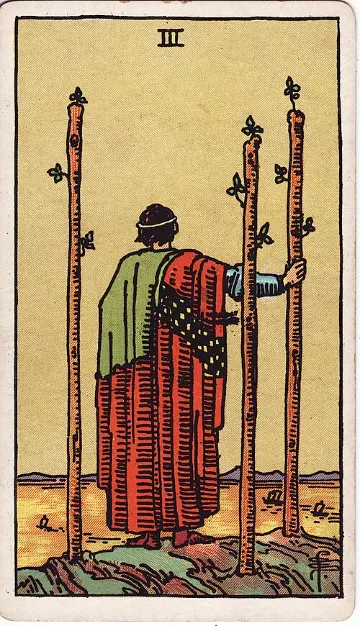
A cloaked figure stands on a rocky rise with one hand on a wand, looking toward small ships on a pale sea. The Three of Wands gives a wider view after a plan has begun to meet the world. Waite's upright meanings include enterprise, trade, discovery, and capable cooperation. His reversal can mean the end of toil and adversity, even though modern readers often use it for a delayed expansion. In love or work, the card asks what has been put in motion, who is carrying it, and what actual response will guide the next step.
Look at the image
Pamela Colman Smith turns the figure's back toward us and places one hand on the rightmost of three planted wands. A rocky rise drops toward a pale sea where small ships are visible. The figure can watch their movement, but the picture does not reveal the ships' cargo, destination, or whether they are coming or going. The open shore also differs from the walled terrace of the Two of Wands. What was once viewed from a protected height now seems to have entered a wider setting. The distance leaves room for both opportunity and uncertainty, which is why the next useful detail is a real signal from beyond the shore.
Upright: enterprise meets the world
Waite's upright Three includes established strength, enterprise, trade, discovery, and able cooperation in business. The card can fit a proposal sent, a product offered to shops, or a project entering a partnership. Something has moved beyond private planning, but continued work may depend on other people's responses. Name the next handoff and the date when information should come back. Meanwhile, maintain the work on shore: inventory, communication, a usable schedule, or a backup route. Waiting is active when there is a reason to watch and a plan for what to do with the reply. The card shows a broad view, not a guaranteed successful return.
Reversed: relief or delayed expansion?
Waite's reversed meaning is strikingly hopeful: the end or suspension of adversity, toil, and disappointment. That can fit a hard phase finally easing, even when the next voyage is still uncertain. Many modern readers instead use the reversed Three for a late response, stalled expansion, or a plan stretched beyond capacity. The two readings should be tested against what has changed. Has a real burden lifted, or has an expected handoff failed to happen? If the delay is concrete, confirm the new date and adjust the scope. If the strain has eased, make space to recognize that before loading the next venture onto the same people.
Three of Wands in love and relationships
In love, the Three can appear when a relationship is taking shape beyond the first private decision: a visit is planned, a move is discussed, or two people are building something together across distance. Upright, shared direction matters more than one person's hopeful gaze. Ask what each has agreed to do and when they will talk again. Reversed, a long period of uncertainty may finally ease, or a plan may be held up by travel, work, or unequal effort. Do not read the ships as a promised reunion. A workable connection gives both people a say in the route and a clear way to check whether the plan is still wanted.
Three of Wands as feelings
When asking about your own feelings, the Three may capture anticipation after you have reached out or made a choice. You can care about the outcome while still using the waiting period well. If the question concerns another person's feelings, a back-turned figure and distant ships cannot disclose their private answer. Notice what they have actually committed to, whether they update you when plans change, and whether the next contact has a date. Reversed, relief after a difficult conversation may be as relevant as frustration over silence. A direct question about the next step does more than guessing which way a ship is sailing.
Three of Wands in career and money
At work, the Three can fit distribution, publishing, applications, trade, or a new customer reached through a partner. Waite's emphasis on commerce and cooperation is useful here: record what was sent, who will carry the next stage, when feedback or payment is due, and what capacity remains at home. A large order can be promising and still overwhelm production. For money questions, compare the actual terms of the expansion with its expected return rather than treating distant ships as proof of profit. Reversed, a costly trial might be ending, or a promised response might be late. The figures and dates will distinguish relief from a bottleneck.
Two versus Three of Wands
The Two of Wands shows a figure on a walled terrace holding a globe, weighing a wider direction from an established position. The Three stands on open ground watching ships beyond the shore. The Two asks which route to choose; the Three asks how to work with the wider world after a route has begun. If both cards appear, do not remain forever at the globe, but do not launch without a way to receive news either. Make a bounded choice under the Two, then set a review point under the Three. The difference is not that planning ends; it becomes a plan that can be tested by contact beyond the wall.
Is the Three of Wands a yes or no card?
For a measured expansion with a responsible partner and a way to learn from results, the upright Three can lean yes. It supports sending the proposal or trial batch, not assuming every ship will return with profit. Reversed does not mean an automatic no: in Waite's account it may mark relief from a difficult period. Ask what has been put in motion and what the next commitment would cost. “Should I offer a small batch to two shops under these payment terms?” can be checked. “Will the world reward my plan?” asks more than the figure on shore can see. A conditional yes depends on the route back for information.
A reading example: a trial shipment
An independent ceramicist sends a trial batch to two local shops and draws the Three of Wands. Each shop has different terms, so the ceramicist records the number of pieces, the agreed price, who pays for breakage, and the date sales figures will be shared. They keep enough stock for existing customers rather than committing all their capacity to the new outlets. After the first month, one shop has sold most of its batch while the other has not displayed it prominently. The next shipment goes only where demand is visible, and the second shop gets a conversation about placement. Watching the ships becomes a feedback loop rather than passive hope.
Questions to ask
- What has already moved beyond my direct control?
- Who will send the next useful signal, and when?
- What can I maintain while I wait for that response?