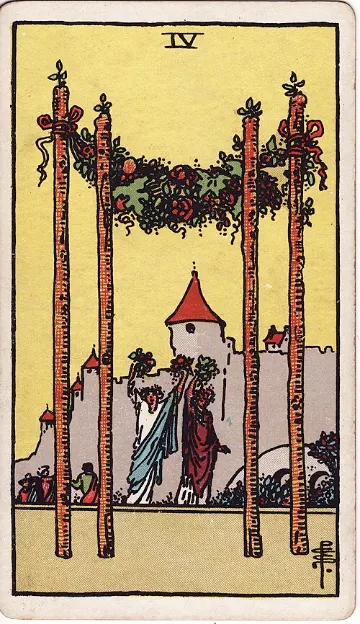
Four flower-topped wands and a garland frame two people raising bouquets before buildings in the distance. The Four of Wands can mark a completed phase, a welcoming place, or a moment of rest shared with others. Waite's upright meanings include haven, harmony, prosperity, and work completed; unusually, he says the positive meaning remains when the card is reversed. Modern readings may still ask whether a celebration is delayed or uneven. In love or work, the card brings the focus back to the people who made the gathering possible and the base that will support what follows.
Look at the image
Pamela Colman Smith places four flower-topped staffs in the foreground, with a garland crossing between them. Two figures raise bouquets beyond the frame, and smaller onlookers and buildings sit farther back. The wands create an open threshold, not a closed gate. Waite describes a bridge over a moat near the figures and an old house beyond, details that make the scene feel like an arrival. The picture does not identify the occasion or the relationship between the two people with flowers. What is visible is a place prepared for welcome and a gathering that has already begun. The frame invites us to ask what work made this moment possible.
Upright: a haven after completed work
Waite's upright Four of Wands includes country life, haven, a harvest-home, repose, harmony, peace, prosperity, and completed work. A modern upright reading can fit a homecoming, finished pilot, reunion, or practical milestone worth sharing. Name what has actually been completed before deciding how to celebrate it. A meal, a day of rest, or specific thanks to the people who carried the work may mean more than a large event. The buildings behind the garland suggest a base to return to after the gathering. The Four does not ask for celebration without limits; it asks whether the achievement has made a place where people can pause together.
Reversed: the good meaning may remain
Waite says the reversed Four of Wands is unaltered: prosperity, increase, happiness, and beauty remain in his account. That is different from the common modern reading of a delayed party, a home that feels unstable, or a milestone that only some people can enjoy. Either approach can be useful if the situation makes it clear why it applies. Has the welcome actually been postponed, or are people simply too tired to notice what has gone well? Did an event succeed while leaving one contributor with all the cleanup? A reversal need not erase the achievement. It can focus attention on the conditions that let everyone share in it.
Four of Wands in love and relationships
In love, the Four can point to a shared home, an invitation into one another's lives, or a milestone both people want to mark. Many readers associate it with weddings, but the image shows a gathering rather than a definite marriage ceremony. Upright, a couple may have built a routine or place that feels welcoming to both. Reversed in a modern reading, the celebration may need a better date, a clearer invitation, or a fairer division of preparation. Ask what each person considers home and which practical arrangements support it. The most useful sign of commitment is not the garland alone, but the way both people help keep the welcome real.
Four of Wands as feelings
When asking about your own feelings, the Four may describe relief, belonging, or a wish to celebrate something you have built with others. That warmth can be genuine even when the next stage is undecided. If you ask what another person feels, two raised bouquets cannot speak for them. Notice whether they invite you into plans, make room for your needs, and share the work of hosting or maintaining a common space. Reversed, mixed feelings about an event do not automatically cancel affection; the gathering may be joyful and tiring at once. A direct question about what each person wants to mark gives the scene a clearer meaning.
Four of Wands in career and money
At work, the Four can suit a launch, completed phase, team recognition, or a stable base from which the next project can begin. Credit the people who built the result, including those who handled testing, scheduling, or cleanup away from the spotlight. A celebration budget should fit the actual resources available, and the next stage still needs staff and maintenance. Waite's prosperity language need not mean an automatic cash gain; the concrete success may be a reliable service or a room that people can use. Reversed, check whether the apparent finish hides unfinished work or whether a difficult phase has truly ended and deserves acknowledgment.
Three versus Four of Wands
The Three of Wands shows a figure watching ships from open ground after work has reached a wider world. The Four gathers people under a garland near a settled place. The Three asks what response is coming back and how to support an effort in motion. The Four asks what phase has finished and who can share in the result. If both appear, a venture may have reached a checkpoint even while more work lies ahead. Review the evidence from the Three, then recognize the people and conditions that made the Four possible. A celebration can close one phase without pretending the entire journey is over.
Is the Four of Wands a yes or no card?
For a specific gathering, shared-home step, or milestone supported by agreement and resources, the upright Four can lean yes. It is a stronger answer when everyone involved knows the date, place, cost, and part they are willing to play. Reversed is not automatically no, especially because Waite kept its favorable meaning. A modern reversed reading may call for a changed plan if one person cannot attend or the work of hosting is unfairly placed. Ask “Should we hold a small celebration after this pilot closes?” rather than “Will this card guarantee lasting happiness?” The first question has a practical way to succeed.
A reading example: marking a pilot launch
A neighborhood team has finished a three-month food-sharing pilot and draws the Four of Wands before its final meeting. The public-facing volunteers want a launch meal, but one coordinator has handled most of the scheduling and storage work. The team invites that coordinator to help choose the format, sets a modest budget, and names everyone's contribution during the gathering. They also review which storage and pickup duties must continue if the pilot becomes permanent. The meal marks a real accomplishment without asking celebration to cover an unsupported next phase. The garland is a threshold: a finished trial on one side, a shared decision about continued work on the other.
Questions to ask
- What phase has genuinely reached completion?
- Who made the welcome possible, and who gets to enjoy it?
- What will keep this place or project usable afterward?