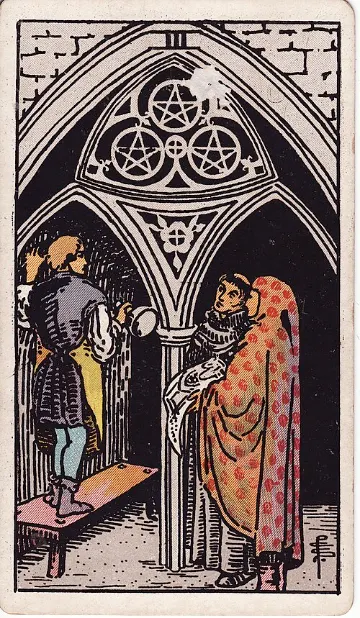
A craftsperson stands on a bench beneath three pentacles carved into an arch, while two visitors stand nearby with a plan. The Three of Pentacles gives skilled work an audience and a setting: the maker's effort becomes visible to people who can discuss, commission, or judge it. Waite linked the card to trade, skill, and recognition; modern readers also see collaboration in Smith's three figures. Upright, it favors clear standards and useful feedback. Reversed, it can raise questions about the quality of the work, the coordination around it, or the credit given to those who contribute.
Look at the image
Pamela Colman Smith places a craftsperson on a bench beneath an arch set with three pentacles. Two other figures stand close by, and one holds what appears to be a plan. Their positions suggest a conversation about the work, although the picture does not assign them fixed jobs or show us the result of that conversation. The pentacles are part of the structure rather than coins being passed from hand to hand. This matters when the question concerns recognition: skill is visible in a place other people use and assess. Look at the distance between the person doing the work and the people discussing it, and ask what each can see from where they stand.
Upright: skill that others can see
Waite associated the Three of Pentacles with skilled labor, trade, and renown. Smith's scene gives that labor a social setting. An upright reading may fit a commission, apprenticeship, review, or team project in which the work needs both craft and conversation. Name what a good result must do before arguing about whether it looks finished. The maker may know a practical constraint that the plan overlooks; the visitors may know a requirement the maker has not heard. Recognition is useful when it reaches the specific work and its contributors. A clear brief, a sample, and a review date can make talent more valuable than vague praise alone.
Reversed: weak work or weak coordination?
Waite's reversed terms include mediocrity, pettiness, and weakness. Contemporary readers may also see a project weakened by unclear instructions, poor feedback, or credit claimed by the wrong person. These are related possibilities, not the same accusation. A skilled worker cannot satisfy a standard that keeps changing; a well-written plan cannot rescue work that needs more practice. Identify which part is actually failing. Ask for an example of the problem, compare it with the agreed brief, and decide who can approve a revision. Reversed can be a prompt to improve the work or the working arrangement, without turning every disagreement into a judgment on someone's talent.
Three of Pentacles in love and relationships
The three figures do not make this a card of a romantic triangle by default. In love, the card can show a couple building something that requires practical cooperation: a home routine, a shared budget, or plans involving family and friends. Upright, both people may be willing to listen to how the other experiences the arrangement. Reversed, the effort may be real but unevenly seen; one partner organizes while the other receives praise for the visible result. Name the task rather than using “teamwork” as a compliment or complaint. Who does it, who decides how it is done, and what help would make the arrangement fairer?
Three of Pentacles as feelings
When asking about your own feelings, the Three can reflect respect for someone's skill and a wish to build something together. It does not necessarily describe romantic attraction. In a question about another person's feelings, their private answer is not pictured in the arch. Their actions can show whether they value your contribution: do they ask for your view, make room for your work, and keep shared agreements? Reversed may fit feeling overlooked, criticized without guidance, or unsure where you stand. A direct conversation about what each person wants to make together is more reliable than treating three figures in one scene as a verdict on affection.
Three of Pentacles in career and money
For career questions, the Three can favor a portfolio review, paid commission, training placement, or project where different expertise must meet. Put the scope, standard, fee, schedule, and approval path in writing. If you are the maker, show a draft early enough for feedback to change the work. If you manage the project, identify who produced each part and pay or credit them accordingly. Waite's emphasis on trade and recognition is a reminder that a finished result has both quality and value. Reversed, check whether the rate covers revisions, whether instructions conflict, or whether more practice is needed before promising a larger job.
Three versus Eight of Pentacles
Waite explicitly compares the Three with the Eight of Pentacles, distinguishing the worker practicing a craft in the Eight from a worker now engaged in recognized work in the Three. Smith's pictures support a useful contrast: the Eight shows one person making pentacles in a repeated sequence, while the Three places craft beneath an arch with other people nearby. The Eight asks what technique needs attention; the Three asks how that technique performs in a shared project. If both appear, keep practicing but also test the work against a real brief. A polished private exercise and a successful commission demand different kinds of evidence.
Is the Three of Pentacles a yes or no card?
For a collaboration with named roles, a clear brief, and a fair way to review the result, the upright Three can lean yes. It does not promise that every group will work well simply because three people are involved. Reversed often means “clarify first”: who owns the decision, who will do the work, and how will changes be paid for or acknowledged? If those questions cannot be answered, waiting may be wiser than accepting a vague commission. Ask “Should I take this project under the proposed scope and fee?” rather than “Will everyone appreciate me?” The first question can be checked against an agreement and a realistic schedule.
A reading example: a paid redesign
A designer is offered a paid website redesign. The client has a visual idea, and a developer will build it, but neither knows who approves changes after the first draft. The Three of Pentacles suggests discussing the work while there is still time to shape it. The designer proposes a short brief, one sample page, two scheduled review rounds, and written approval before development begins. The client identifies who signs off; the developer flags one layout that would be costly to build. The fee now covers the agreed rounds, and extra revisions have a stated price. Craft, planning, and review each become visible, so the final page has a better chance of meeting the actual need.
Questions to ask
- What standard should this work meet?
- Who contributes, decides, and receives credit?
- Which feedback would improve the next version?