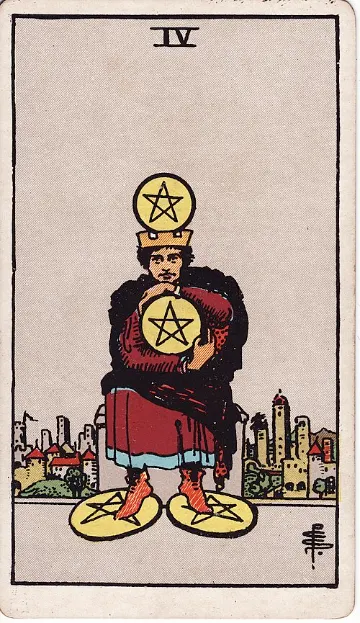
A crowned figure sits before a city with one pentacle held to the chest, one above the head, and two beneath the feet. The Four of Pentacles asks what it takes to keep a resource secure and what becomes difficult when it cannot move. Waite's upright meanings include possession, gift, and inheritance; his reversal points to suspense, delay, and opposition. A modern reading may also consider guardedness or a loosening grip, but the picture does not reveal why the figure holds on. In love and work, the card calls for a clear boundary and a clear reason for it.
Look at the image
Pamela Colman Smith places one pentacle against the seated figure's chest, another above the crown, and one under each foot. Buildings rise in the background, but no other person shares the foreground. The figure's body is organized around keeping all four objects close. That posture can look secure or restrictive depending on the question, yet the image shows no approaching thief and gives no reason for the grip. Notice the difference between having a resource and being able to use it. The two pentacles underfoot provide a base while also making movement seem awkward. The card asks what is protected, from what, and for how long.
Upright: hold with a purpose
Waite connected the upright Four of Pentacles with possession, keeping what one has, and also gift or inheritance. A resource may be received as well as defended. In a modern reading, the card can fit saving money, protecting time, or setting a boundary after uncertainty. A reserve can be useful when its purpose is named: rent due next month, a period between contracts, or rest needed after demanding work. Without a purpose or review point, the same rule can become hard to change even when circumstances do. Ask what amount or space must stay protected and what conditions would allow it to be used. Holding becomes stronger when it serves a life beyond the hold itself.
Reversed: delay, opposition, or release
Waite's reversed meanings emphasize suspense, delay, and opposition. They are not simply instructions to let everything go. A payment may be held up, a purchase blocked, or an agreement stalled while people disagree about control of a resource. Contemporary readers sometimes see a reversed Four as easing a tight grip, or as losing control after holding too firmly. The surrounding facts distinguish those stories. Is the delay external, or has someone not made a decision? If a boundary is changing, what replaces it? A useful reversal identifies the obstacle and the next review point instead of assuming that every open hand means freedom or every closed hand means fear.
Four of Pentacles in love and relationships
In love, the Four may concern boundaries around time, money, privacy, or a shared home. Keeping something for yourself is not automatically selfish; a partner can respect a limit even when they wish it were different. Upright, a couple may agree on what each will save or how much time they need alone. The difficulty begins when a rule is never explained or leaves one person with no room to choose. Reversed, a joint plan could be delayed by disagreement over costs, or a guarded person might be ready to share more. Ask what the boundary protects and how both people will know when it can change. The card does not diagnose anyone as possessive from the picture alone.
Four of Pentacles as feelings
When the question concerns your own feelings, the Four can suggest wanting stability before becoming more open. You may value someone and still need time, privacy, or a dependable pattern of contact. If you ask what another person feels, their thoughts remain their own. Look for observable behavior: do they communicate a limit, make a plan, and show up as agreed, or do they keep the arrangement indefinite? Reversed may fit frustration with waiting or a willingness to relax an old rule, but neither can be confirmed by a card alone. A clear request for the kind of connection you want gives the other person a chance to answer in words.
Four of Pentacles in career and money
For money, the Four can point to a savings target, a held asset, a gift with conditions, or an expected inheritance. Name the amount, owner, timing, and purpose before deciding whether keeping it is wise. A delayed transfer should be checked through the relevant agreement, not guessed from the reversal. At work, protecting a schedule or refusing unpaid extra tasks may preserve the capacity to do your main job well. It can also be worth asking whether a small, planned expense would remove a larger recurring cost. Reversed, a stalled approval or opposition from a decision-maker may matter more than personal reluctance. Find out who can authorize the next step.
Four of Pentacles versus Two of Pentacles
The Two of Pentacles shows a dancer moving two linked objects while ships travel through waves. It asks how to adjust when demands keep changing. The Four seats a figure around four held objects; it asks what should remain protected. If both cards appear, you may need both flexibility and a firm reserve. For example, a freelancer can rearrange two projects while refusing to spend the money set aside for taxes or rent. The Four need not mean stubbornness, and the Two need not mean carelessness. The distinction is between what can move this week and what must remain available for a stated purpose.
Is the Four of Pentacles a yes or no card?
A yes-or-no answer depends on what you are asking. “Should I preserve this reserve until the bill is due?” may lean yes when the amount has a clear job. “Should I refuse every expense or request indefinitely?” calls for more scrutiny. Reversed, Waite's delay and opposition suggest that a proposed transfer or agreement may need time or another person's approval, not that it must fail. If the question is about sharing, specify what, with whom, and under what terms. The Four is most useful when it helps you distinguish a necessary boundary from a rule kept long after its reason has changed.
A reading example: a reserve and a repair
A freelancer has saved money for the next month's fixed bills. Their work laptop begins failing, and a repair quote would use part of that reserve. They draw the Four of Pentacles and start by listing the bills and payment dates the reserve must cover. Then they request a second repair estimate, check whether a short-term replacement is available, and ask when the next client payment is due. If the repair is necessary to finish paid work and the remaining reserve still covers the fixed bills, spending part of it serves the reserve's larger purpose. If it does not, they can seek another arrangement before authorizing the work. The card turns a tight grip into a specific decision.
Questions to ask
- What resource needs protection, and for how long?
- Which expense or request can wait for a clearer plan?
- What would show that this boundary can change?