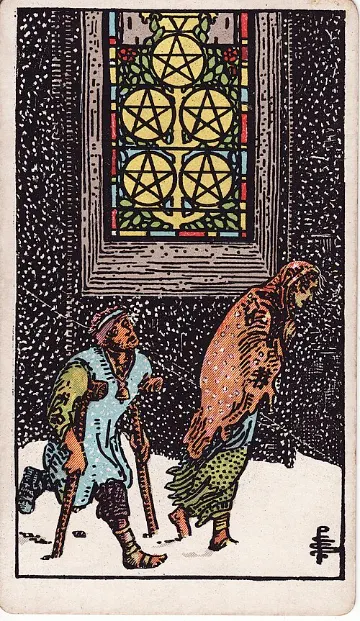
Two people cross snow outside a lit stained-glass window set with five pentacles. One uses crutches; neither holds a coin. The Five of Pentacles can describe material pressure and the loneliness that may accompany it, but the picture does not show whether the building is open to them. Waite gave the upright card a harsh material meaning while noting that some readers also saw love and concord between the figures. His reversal was harsher still; modern readers sometimes use it for recovery. The card asks which support is actually available, on what terms, and what immediate need it could meet.
Look at the image
Pamela Colman Smith sets two people in falling snow beside a high stained-glass window. Five pentacles glow in the glass, but neither traveler carries one. One person uses crutches, and both are exposed to the weather. The window suggests that resources exist somewhere nearby, yet no doorway is visible. We cannot tell whether the people can enter, whether help is offered, or whether the building contains what they need. Their movement together also matters: the scene holds companionship alongside hardship. Begin with that tension rather than turning the illuminated window into a promise that relief is already within reach.
Upright: material trouble, human company
Waite's main upright account is material trouble and destitution. He also records an alternative tradition that sees love, lovers, or concord between the figures, and says the meanings do not neatly harmonize. The card can hold both pressure and connection without making one cancel the other. In a modern question, it may fit lost hours at work, a health-related expense, or a sense of exclusion from a resource others can use. Name the immediate need and the date it becomes urgent. If another person is involved, ask what form of help they want instead of assuming companionship alone solves the material problem.
Reversed: distinguish strain from recovery
Waite's reversed gloss lists disorder, chaos, ruin, discord, and waste. Many modern readers instead use the reversal for emerging from a hard period or discovering support that was previously out of reach. Those readings point in different directions, so the card's orientation cannot settle the matter by itself. Look for evidence: has income returned, has an application been approved, or has a relationship begun to repair? Or are bills, access barriers, and disagreements increasing? The snowy street is still a real setting either way. A reversed reading is most useful when it identifies which condition has changed and what remains unresolved.
Five of Pentacles in love and relationships
In love, the card can show how financial strain, illness, or exclusion affects time and closeness. Waite's note about lovers and concord cautions against reading the snowy scene as a breakup verdict. Two people may be facing difficulty together; they may also need different kinds of support. Upright, ask whether each person can state what they need and what they can offer. Reversed, a practical obstacle may be easing, or conflict over that obstacle may be growing. Do not make warmth between the figures a substitute for rent, care, or a fair division of effort. A useful conversation names the problem without making either partner the problem.
Five of Pentacles as feelings
When asking about your own feelings, the Five can capture the fear of being left outside, especially when you need help or reassurance. The feeling deserves attention, but the picture cannot establish another person's intent. If you ask about someone else's feelings, notice what they actually say and do: do they respond to a request, explain a limit, or offer a workable kind of support? Reversed, a sense of isolation might ease when contact becomes reliable, or it might persist despite a friendly message. Ask for a specific form of connection rather than using the lit window to guess whether you are welcome inside.
Five of Pentacles in career and money
At work, the Five may fit reduced shifts, a lost contract, inaccessible training, or a cost that arrives when income is low. Put dates and amounts beside the problem. Which payment is due first, what income is confirmed, and which employer, client, service, or local program can answer a concrete question? A visible opportunity is not usable if its hours, transport, or entry conditions make it unreachable. Reversed, verify whether a promised change has actually begun and what terms still apply. The card's strength is its attention to access: a posted vacancy, benefit, or glowing window is only useful if someone can reach and use it.
Four, Five, and Six of Pentacles
The Four of Pentacles shows one figure holding resources close; the Five shows two people outside a window whose resources they do not hold; the Six shows coins being given under a scale. Together they trace a change in who possesses, needs, and distributes material help. Do not treat the sequence as a guarantee that hardship will automatically turn into aid. If these cards appear together, ask whose reserve exists, what the immediate gap is, and who sets the terms of any transfer. The Five is the point where a resource visible in the world may still be inaccessible to the people who need it.
Is the Five of Pentacles a yes or no card?
For a question that assumes everything will resolve without a change, the upright Five leans no: the visible conditions need attention. It is not a no to seeking help or to a relationship simply because life is difficult. Reversed does not promise recovery, given the sharply different historical and modern meanings. Ask a narrower question: “Will this support cover the payment due next week under the stated terms?” can be checked against an amount and date. “Am I doomed to remain outside?” cannot. The card is more useful for locating a gap and testing a real option than for declaring a fixed future.
A reading example: reduced hours and rent
A worker's shifts are cut just before rent is due, and they draw the Five of Pentacles. They calculate the shortfall rather than treating the whole month as one indistinct crisis. They ask the employer whether extra shifts are available and when the next schedule will be confirmed. They contact the housing provider before the due date to ask what payment arrangements are possible, and check one local assistance source for eligibility and timing. A friend offers transport to an appointment, which helps but does not erase the shortfall. The reading keeps companionship and material facts in view while turning a frightening image into a sequence of specific questions.
Questions to ask
- What is the first need with a real deadline?
- Which visible support can I actually access?
- What precise help can be requested or offered?