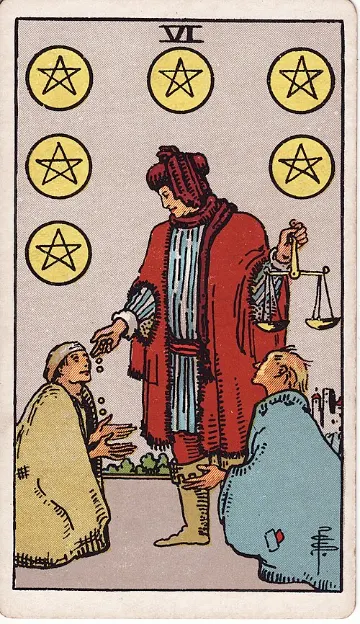
A standing figure holds scales while giving coins to one of two kneeling people. The Six of Pentacles pictures help in motion, with the giver deciding how much and to whom. Waite associated it with gifts, attention, and present prosperity; the reversed card included desire, envy, and illusion. Modern readers also ask whether aid comes with unequal power or hidden terms. The card can describe generosity, but the scene invites a closer question: does the offer meet a real need, and can the receiver understand and accept its terms with dignity?
Look at the image
Pamela Colman Smith gives the standing figure a set of scales in one hand and coins to distribute with the other. One kneeling person receives the coins while another waits nearby. Six pentacles frame the scene above them. The picture shows a real transfer, but it also shows who controls the purse and the measure. We cannot tell whether the two kneeling people asked for the same help or whether the giver's standard is fair. Notice both the relief an outstretched hand could bring and the difference in position between giver and receiver. The scales invite a question about terms, not an automatic verdict on anyone's motives.
Upright: a gift that meets a need
Waite's upright account includes gifts, gratification, attention, and present prosperity; he also describes the giver as successful and good-hearted. In a reading, the Six can fit a grant, favor, payment, or act of care that reaches someone now. The gift becomes more useful when its form matches the need. If money is needed by Friday, help promised next month may not solve the immediate problem. If time is offered, ask which task the person actually wants taken on. A giver can state the amount and limits plainly; a receiver can ask questions and still be grateful. The card's generosity is strongest when the people involved know what is being exchanged.
Reversed: desire and the terms of aid
Waite's reversed meanings include desire, cupidity, envy, jealousy, and illusion. A modern reading may also examine aid that comes with strings or is distributed unevenly. The picture can support that question, but it does not prove the giver is exploiting anyone. Reversed may point to wanting what another person received, promising more than can be given, or confusing an apparent gift with an obligation. Separate the feeling from the agreement. Is repayment expected? Can the receiver refuse a condition? Who decides what counts as enough? Clear terms can expose a real imbalance or quiet a fear that came from uncertainty rather than a harmful act.
Six of Pentacles in love and relationships
In love, giving and receiving rarely look identical every day. One person may have more time, money, or energy during a difficult period, and care can be fair without being split into equal units. Upright, the Six may show a specific offer of help that is welcomed. Reversed, either partner may begin keeping score, giving beyond their limits, or feeling that a favor must be repaid with affection. Name the help and the expectation attached to it. A gift should not become a silent contract, and a request for help should leave the other person room to answer honestly. The scales ask whether both people can speak about need and capacity.
Six of Pentacles as feelings
When asking about your own feelings, the Six can reflect a wish to support someone or a worry about becoming dependent. Neither feeling is shameful, and both deserve clear words. If the question concerns another person's feelings, a coin being handed over cannot reveal affection by itself. Notice whether the person listens to what you ask for, offers help they can sustain, and respects a refusal. Reversed, envy or discomfort with an uneven exchange may be part of the story, but a card cannot identify which person feels it. Ask what each expects from the exchange before interpreting a helpful act as proof of closeness or control.
Six of Pentacles in career and money
For money, the Six may appear around a grant, loan, repayment, bonus, or informal help. Check the amount, timing, conditions, and person with authority to approve it. A gift and a loan should not be described with the same word. At work, the card may concern pay, training access, credit, or support from someone who controls a budget. Make the criteria visible: who qualifies, what is covered, and whether the decision can be reviewed. Reversed, an unequal award or an unclear repayment term may cause conflict. Smith's scales make fairness worth examining, while the actual agreement tells you what is being offered.
Five versus Six of Pentacles
The Five of Pentacles shows two travelers outside a lit window whose resources they cannot be assumed to reach. The Six shows coins moving from a giver's hand to someone kneeling nearby. The change is from possible access to an actual transfer, but the transfer still has terms and a decision-maker. If the Five and Six appear together, ask what the immediate shortfall is and which offer will address it in time. Do not assume the visible giver can solve every need, or that the person receiving has surrendered judgment. An offer becomes help when its form, timing, and conditions work for the person who needs it.
Is the Six of Pentacles a yes or no card?
For a specific offer that meets a stated need and has acceptable terms, the upright Six can lean yes: ask for the grant, accept the help, or make the promised contribution. It is not an automatic yes to borrowing or giving beyond your capacity. Reversed suggests clarifying expectations before agreeing, especially if gratitude, repayment, or eligibility is left vague. Frame the question around a real exchange: “Should I accept this training fund if I must repay it when I leave?” has terms to inspect. “Will generosity fix everything?” does not. The card points to a fair, usable offer rather than a universal answer.
A reading example: a training allowance
A manager offers an employee money for a course, and the Six of Pentacles appears in a work reading. The offer could improve the employee's skills, but the written policy says part of the cost must be repaid if they leave within a year. They ask which courses qualify, when payment is made, how the repayment amount is calculated, and whether study hours are paid. The manager clarifies the budget and offers a choice of two courses. The employee can now compare the benefit with the condition and decide without guessing what gratitude requires. The gift remains valuable, while the scales become a practical discussion about its terms.
Questions to ask
- What is being offered, and when is it available?
- Who sets the terms of this exchange?
- Does the help match the need that was expressed?