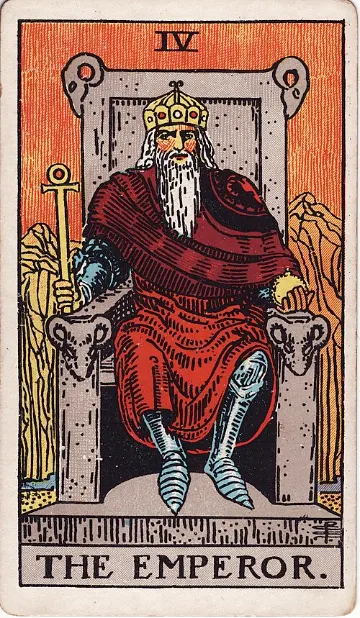
The Emperor tarot card asks what kind of authority a situation needs and who will answer for using it. Upright, it may favor dependable structure, clear decisions, and protection that has a practical form. Reversed, a modern reading may ask whether rules have become rigid or whether nobody is willing to take responsibility. Pamela Colman Smith shows a crowned ruler in armor on a ram-headed stone throne, holding a sceptre and orb before bare mountains. The card is not proof that a person is controlling or that a plan will succeed. Its sharper question is whether the arrangement serves the people who must live with it.
Look at the image
The Emperor sits alone on a stone throne whose arms end in ram heads. His red robe covers armor; he holds a globe in one hand and an ankh-shaped sceptre in the other. Bare mountains rise behind him, with little of the lush setting that surrounds The Empress. A. E. Waite described this figure as a crowned monarch concerned with executive power and realization. Smith's picture also invites a less comfortable question: a ruler is visible, but the people affected by his decisions are not. The armor can suggest preparedness or distance, while the fixed throne can suggest steadiness or an unwillingness to move. Those are possible readings of the image, not secret facts encoded in its objects. Ask what the situation needs from authority and what a person in that seat would owe to others.
Upright: make a structure people can rely on
Upright, The Emperor can favor a plan whose responsibilities and limits are clear. Someone sets a schedule, defines who may decide, keeps a promise, and explains how disagreements will be handled. The result is not automatically harsh: a dependable rule can give people room to work without guessing what changes tomorrow. Waite's historical list includes stability, protection, reason, and authority alongside power and will. In a reading, name the particular structure rather than praising control in general. Is it a household agreement, a project brief, or a boundary you can maintain? Who benefits, who bears the cost, and when can it be reviewed? If the answer is vague, the work of the card may be to make the framework legible before asking anyone to trust it.
Reversed: too much control, or too little?
A contemporary reversed reading often asks whether structure has hardened into micromanagement or disappeared when it was needed. These are opposite failures. One person may demand approval for every small choice; another may refuse to decide and leave everyone else to absorb the consequences. The card does not diagnose a partner or manager from a distance. Look at what actually happens: which decisions are blocked, which promises are broken, and who can raise an objection safely? Waite's own reversed list is mixed and even includes benevolence and compassion, so “reversed means tyranny” is not his fixed rule. A repair might be a narrower boundary, a shared decision, or a named person willing to take responsibility. The surrounding cards and the real situation help distinguish them.
The Emperor in love and relationships
In love, The Emperor can describe dependability expressed through action: keeping commitments, making plans together, and respecting the boundaries both people choose. Upright, the card may favor a relationship in which steadiness makes vulnerability easier. Reversed, it may ask whether one person sets the pace and rules while the other has little say, or whether neither person will address a recurring problem. It does not prove that someone is controlling, emotionally unavailable, or destined to be a parent. Ask how decisions are made: who chooses where time is spent, how conflict is revisited, and whether either person can say no without punishment. The useful distinction is between a boundary that protects both people and a rule that mainly protects one person's position.
The Emperor in career and money
At work, The Emperor can point to leadership, a demanding brief, or a need to bring order to a process that has become unpredictable. If you manage others, upright may call for clear priorities, delegated authority, and a way to hear problems before they become crises. If you report to someone else, it may help to ask who approves changes and what success will be measured against. Reversed can fit a bottleneck in which every decision waits on one desk, or a project with no accountable owner. For money, this is a prompt to examine a budget, terms, and responsibilities; it does not predict a profitable outcome. A strong framework makes it possible to see a problem early and change course, not merely to demand compliance.
The Emperor as feelings or as a person
When a question asks how someone feels, The Emperor is better read as a theme than as access to their mind. It might describe a wish for steadiness, an effort to appear composed, or discomfort with uncertainty. It might equally reflect your own expectation that they should take charge. Nothing in the card proves affection, indifference, or a particular intention. As a person card, it can point toward someone with formal responsibility, firm habits, or a preference for plans, regardless of gender. The useful follow-up is observable: do they keep agreements, listen when plans affect others, and revise a rule that does harm? Those actions tell you more than deciding that a crowned figure must represent a father, boss, or romantic partner in every spread.
Is The Emperor a yes or no card?
The Emperor can lean toward yes when the question is whether to establish a clear, fair structure you can actually maintain. “Should we write down who decides what?” is different from “Will my plan definitely work?” The first can benefit from this card; the second needs facts and other people's participation. Upright may support a considered commitment with named responsibilities. Reversed may suggest pausing to check whether the rules are too tight, too vague, or imposed without consent. Neither position guarantees an outcome. Before answering yes, ask what the plan protects, who can question it, and what would trigger a review. If those answers cannot be given, a smaller experiment may be wiser than a sweeping decree.
A reading example: a team without a decision maker
Imagine a small team preparing an event. The venue needs a final layout, but two organizers keep revising it and nobody knows who may approve the change. You draw The Emperor upright. The stone throne suggests a seat where responsibility must finally rest; it does not tell you that the loudest organizer should occupy it. Agree on a deadline, name one approver for the layout, let others raise specific concerns before that point, and record what can still change afterward. A reversed Emperor might highlight the opposite problem: one organizer refuses all input, or the team avoids choosing an approver at all. In either case, the card becomes useful when the group makes authority visible and accountable instead of waiting for a commanding personality to solve the confusion.
Questions to ask
- Which decision needs a clear owner?
- Who can question or revise the rule?
- What responsibility can I accept and carry through?