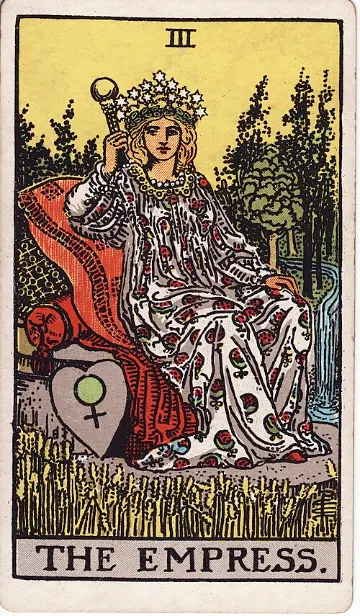
The Empress tarot card is about growth that has something to live on. Upright, it can suggest creativity, pleasure, and the choice to give a relationship or project the time and resources it needs. Reversed, a modern reading may ask whether care has become one-sided, controlling, or exhausting. In Pamela Colman Smith's image, the figure is a crowned ruler with a sceptre, not merely a caretaker; wheat and water fill the land around her. The card does not promise pregnancy, wealth, or an effortless result. It asks what you want to grow, who is helping, and whether the conditions can support it.
Look at the image
The Empress sits on cushions in a landscape of ripe wheat, trees, and running water. A crown of twelve stars rests on her head, and the sceptre in her hand is topped by a globe. Beside her is a shield bearing the sign of Venus. These are not merely signs of softness: she is enthroned and holds a symbol of rule. A. E. Waite described the scene as an earthly paradise and stressed its fruitfulness, but the card's interest lies in how the person and the place belong together. The grain has had time to ripen; the water continues to flow. In a reading, notice both what is flourishing and what sustains it. The picture invites questions about pleasure, stewardship, choice, and power, without reducing the figure to motherhood alone.
Upright: choose what you will help grow
Upright, The Empress can favor a project or relationship that has room to develop. It is an active card: choose the conditions, secure the resources, invite help, and enjoy the work while it is being made. Waite's older divinatory list includes fruitfulness but also action and initiative. If you are starting something, ask what a first season of growth would realistically require in time, money, and attention. If something is already going well, you may be allowed to appreciate it instead of immediately enlarging it. Care can mean offering support, but it can also mean setting a limit that keeps the support possible. The card works best when abundance is understood as a living arrangement, not an endless supply to be extracted from one person.
Reversed: where has care become costly?
Reversed, a contemporary Empress reading may ask whether generosity has turned into overextension, a creative idea is being protected from every test, or someone is making decisions for another person in the name of care. The reversal does not diagnose burnout or identify who is at fault. Look at the actual exchange: who gives time, who has a say, and what would make the arrangement fairer? A project can also stall because it lacks materials, not because anyone lacks commitment. Waite's original reversed list is different, beginning with light, truth, and the unraveling of involved matters; depleted care is a modern interpretive lens rather than his fixed meaning. In either approach, the next useful step is to name the condition that is missing or the assumption that needs daylight.
The Empress in love and relationships
In love, The Empress can point to affection made tangible through attention, pleasure, and shared routines. Upright, it may favor a connection where both people can relax and grow without being managed. Ask what each person enjoys giving and receiving, rather than assuming care must look the same on both sides. Reversed, it may suggest that one person is carrying the planning, comfort, or emotional work while the other treats it as automatic. It can also describe a wish to protect someone that has begun to limit their choices. The card cannot reveal a partner's private feelings or promise commitment. A more useful question is whether the relationship's daily conditions match the warmth you want: time together, room for independence, honest requests, and the ability to say no.
The Empress in career and creative work
For work, The Empress can describe an idea that needs a supportive environment more than another burst of urgency. A writer may need uninterrupted hours; a small team may need a realistic budget, materials, and a decision maker; a new employee may need time to learn. Upright can favor making those conditions explicit and taking initiative to build them. Reversed may point to a project funded by one person's unpaid labor, or to polishing an idea so long that nobody sees it. It does not guarantee profit or a successful launch. List what the work requires and what you can provide without emptying other commitments. The crown and sceptre are a reminder that nurturing also involves decisions about scope, priorities, and how resources are shared.
Does The Empress mean pregnancy?
The Empress's wheat, flowing water, and historical association with fruitfulness can bring pregnancy or fertility to mind, especially when that is already the reader's question. The image does not tell you whether a pregnancy exists or will occur, and the card's appearance should not be treated as a medical result. If a literal pregnancy is the concern, use an appropriate pregnancy test and speak with a health professional when needed. In many readings, “growth” may instead concern a friendship, a garden, a piece of art, or a changing home. No one needs to be pregnant, a parent, or a woman for this card to matter. Its broader question is what can be nurtured, by whom, and under what conditions.
Is The Empress a yes or no card?
The Empress may lean toward yes when the question is whether to nurture something that already has support and room to grow. “Should I make time for this promising idea?” is different from “Will it certainly succeed?” The card can favor the first choice without answering the second. Upright, ask what people, materials, and time are available. Reversed, check whether the plan asks too much from one person or keeps growing without a clear purpose. If the issue is a relationship, another person's agreement still matters; if it is money, examine the actual cost. Rather than treating the card as a verdict, use it to make the conditions of your yes visible and to decide what would need to change before a larger commitment.
A reading example: the community mural
Imagine neighbors invite you to organize a community mural. You like the design and the group, but everyone assumes you will coordinate supplies, permissions, and painting days. You draw The Empress upright. The ripe field and flowing water suggest real potential, while the crown asks you to make decisions about how the work will be supported. Ask for a materials budget, divide the organizing tasks, and choose a painting schedule you can enjoy. If no one else can help, make the mural smaller or postpone it. A reversed Empress in the same situation might focus attention on that unequal workload or on the pleasure already being lost. Neither card orientation tells you whether the mural will succeed; the arrangement you build will matter more.
Questions to ask
- What has the conditions to grow right now?
- Who is choosing and sharing the work of care?
- What would make this more sustainable and enjoyable?