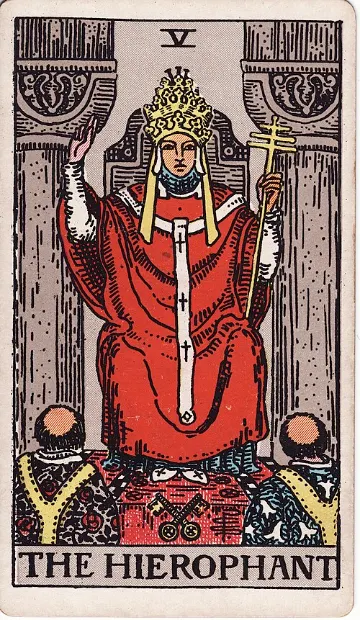
The Hierophant tarot card can point to a teacher, a shared tradition, or the moment you decide whether to join a larger system. Upright, it may favor learning from an experienced community and understanding the reasons behind its practices. Reversed, a modern reading may ask whose voice a rule excludes or whether you are rejecting guidance before you understand it. Pamela Colman Smith shows a robed figure with two attendants and crossed keys, so the card is about people as well as doctrine. It does not require obedience or predict marriage. Its useful question is what knowledge a group preserves, and what it asks of you in return.
Look at the image
The Hierophant wears a triple crown and holds a sceptre ending in a triple cross. He raises his other hand in a formal gesture. Crossed keys lie near his feet, while two robed attendants kneel before him. Pillars frame the scene, but A. E. Waite specifically distinguished them from the pillars beside The High Priestess. Her scroll is partly concealed; here a public office and its followers are plainly visible. Waite connected the image to organized religion and recognized hierarchy. A modern reading may extend that pattern to a school, guild, family custom, or other institution, but that is an interpretation rather than a hidden label on every symbol. Look at the attendants as closely as the teacher. Are they receiving something valuable, choosing to belong, or waiting for permission? The picture leaves that human question open.
Upright: learn from a living tradition
Upright, The Hierophant can favor a teacher, an established method, or a community that carries knowledge farther than one person could alone. A course can give a beginner vocabulary and practice; a ritual can make a promise visible to others; a mentor can explain why a rule exists. This does not mean accepting every claim unexamined. Ask what the tradition has learned through experience, how new members are taught, and whether questions receive an answer. Waite's older divinatory list included alliance and mercy as well as more restrictive words such as captivity and servitude. That tension is useful: belonging can support a person, but it can also narrow their choices. The upright card invites you to learn enough to tell the difference before committing yourself.
Reversed: which rule still serves its purpose?
A contemporary reversed Hierophant reading can ask whether a rule has become a test of loyalty instead of a way to help people learn or cooperate. It can also describe leaving a group too quickly because its first unfamiliar practice feels uncomfortable. Those are not the same story. Find out what the rule was meant to do, whose participation it makes possible, and whose questions it silences. If you change a method, name the value you are keeping as well as the form you are leaving behind. Waite's own reversed list included society, concord, overkindness, and weakness, not a single slogan of rebellion. The card does not prove an institution is harmful or that a teacher is trustworthy. It asks for evidence about how guidance and dissent work in this particular setting.
The Hierophant in love and relationships
In love, The Hierophant can bring shared values, family expectations, and public commitment into view. Upright may suit a conversation about what partnership means to each person: ceremony, faith, living arrangements, or simply a promise made and kept. It can also show the comfort of being welcomed into another person's community. Reversed may raise a question about pressure to follow a script that neither person chose, or about avoiding an honest commitment because it resembles an old expectation. The card does not predict a wedding or tell you what a partner secretly wants. Ask directly which customs matter to them and which are optional. A good shared practice has room for both people to consent, question, and take part without pretending their histories are identical.
The Hierophant in career and study
At work or in study, The Hierophant can point to training, a professional standard, a mentor, or a qualification that grants access to a field. Upright, it may favor learning the accepted method before improvising, especially when other people rely on the result. Reversed, it may ask whether the credential measures useful skill or merely protects a gate, and whether an alternative route would be respected. If you are choosing a course, compare its syllabus, cost, instructors, outcomes, and the work of former students. The card cannot guarantee a job or certify an adviser as honest. It can help you ask what knowledge is being passed on, who recognizes it, and whether the institution's promises match what participants actually receive.
When does guidance become obedience?
The crossed keys and kneeling figures make access and authority part of this card's story. A teacher may open a subject that felt closed; a community may give language to an experience you could not name alone. The same structure can become difficult when every question is treated as disloyalty. Notice how the group responds to a respectful disagreement. Can a member leave without threats? Can an instructor explain a rule without relying only on rank? Are mistakes corrected in ways that help people learn? These are observable signs, unlike a claim that the card has revealed an institution's hidden motives. The Hierophant is strongest as an invitation to participate knowingly: receive what is valuable, understand what you are asked to give, and keep your ability to think.
Is The Hierophant a yes or no card?
The Hierophant may lean toward yes when the question is whether to seek instruction, discuss shared commitments, or use a well-understood method. It is a weaker yes when you have not examined the terms of belonging. “Should I ask an experienced person to teach me?” differs from “Will this particular institution be right for me?” The first may be a useful step; the second calls for information about the people, costs, and rules involved. Reversed may suggest revisiting an assumption or seeking a different teacher, but it does not automatically say no. Neither orientation guarantees another person's consent or a future result. Turn the binary question into a practical one: what would you need to know before you could join, stay, or leave freely?
A reading example: the promising course
Imagine you are considering a paid course to enter a new creative field. The instructor's work impresses you, and the group offers useful contacts, but the sales page is vague about feedback and refunds. You draw The Hierophant upright. The teacher and attendants make the appeal of learning within a community easy to understand. They do not verify the course's claims. Ask for a sample lesson, the feedback schedule, the full price, and examples of work by recent students. Speak with a former participant if you can. A reversed Hierophant might bring the restrictive terms or your own impatience with structured learning into focus; the facts help distinguish them. The decision improves when you know what the institution will teach and what freedom you keep after joining.
Questions to ask
- What can this teacher or tradition help me learn?
- Who may ask questions or leave without penalty?
- Which commitment would I choose freely?