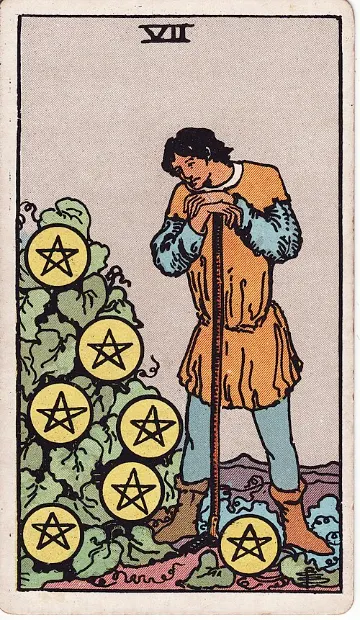
A worker leans on a staff and looks at six pentacles among the leaves, with a seventh low near the feet. The Seven of Pentacles can mark a pause to judge what sustained effort has produced. That familiar patience reading comes from Smith's image; Waite called the upright card's older meanings contradictory, ranging from money and business to quarrels or innocence. His reversal singled out anxiety about money proposed as a loan. In love, work, or finances, the card is most useful when it turns waiting into a review of real results, remaining costs, and the time a process genuinely needs.
Look at the image
Pamela Colman Smith shows a worker leaning on a staff beside leafy growth. Six pentacles appear among the leaves, and a seventh sits low near the worker's feet. The figure is looking at the plant, but there is no pictured harvest and no clear next action. A pause might mean satisfaction, fatigue, doubt, or calculation; the face alone does not settle it. The distance between a visible result and a completed goal gives the card its force. Ask what has grown, what it cost to bring it this far, and whether the next season of work has the same value as the last one.
Upright: pause where the evidence is
A modern upright reading often emphasizes patience and assessment because Smith places the worker next to something already growing. Waite's older account is less unified: he describes the meanings as contradictory, listing money, business, and barter alongside quarrels and even innocence. The card can therefore involve both a material return and disagreement over what that return means. Set a fair time frame for the question. A new skill, a relationship, and a small business each develop on different schedules. Look at what can be observed now, then decide which further effort could change the result. Waiting without a question is different from giving a process time to answer one.
Reversed: worry about the next investment
Waite's reversed meaning is unusually specific: anxiety about money proposed to be lent. That concern may belong to the lender, the borrower, or someone affected by the promise, depending on the question. Contemporary readers may also use the reversed Seven for impatience, a poor return, or effort continued mainly because so much has already been spent. Do not merge these into a single prediction. If a loan is involved, clarify the amount, repayment date, and relationship at stake. If the issue is time or labor, ask what new evidence would justify another round. The reversal is a reason to inspect the next commitment, not proof that all earlier work was wasted.
Seven of Pentacles in love and relationships
In love, the Seven can describe a bond that has had time and care but still needs an honest look at what is growing. Effort from one person is not enough evidence that a shared future is forming. Upright, both partners may be able to name improvements and agree on a reasonable interval for the next conversation. Reversed, one may fear that further effort will not be returned, or a practical obligation may be causing strain. Ask for specific changes rather than a vague promise to “try harder.” The plant is visible, but the picture does not show who tends it every day or whether both people want the same harvest.
Seven of Pentacles as feelings
For your own feelings, the Seven may fit a mix of investment and uncertainty: you care enough to pause and examine where the connection stands. That pause need not mean affection has ended. If you ask about another person's feelings, their inner state cannot be counted like pentacles on a plant. Notice whether they make time, follow through, and speak about the future in ways that match their actions. Reversed, anxiety about giving more without clarity may be yours, theirs, or both. A direct conversation can establish whether patience is shared or whether one person is waiting for a result the other has not promised.
Seven of Pentacles in career and money
At work, the Seven can mark a review after a course, trial role, sales period, or long project. Compare the visible result with the original goal: pay earned, skill gained, clients retained, or hours saved. Include the cost of the next stage rather than judging only what has already been spent. For money questions, Waite's mixed account cautions against turning the card into a simple promise of profit. A reversed card makes proposed lending especially worth examining: who is asking, when would repayment be due, and what can each person afford if plans change? A written checkpoint helps separate a slow return from an arrangement with no clear return at all.
Seven versus Eight of Pentacles
The Seven shows a worker stopped beside growing pentacles; the Eight shows a craftsperson making pentacles one after another. The Seven asks whether the accumulated result merits more effort. The Eight asks whether the method and practice are improving. If both appear, review the outcome and the technique separately. A project may be worthwhile but need a better process, or the technique may be satisfying while the project no longer serves its purpose. The Seven's pause is not laziness, just as the Eight's repetition is not proof of progress. One card checks the return; the other looks closely at the work that produces it.
Is the Seven of Pentacles a yes or no card?
The Seven rarely supports an immediate yes based only on how much has already been invested. Upright, continuing can make sense when the early result is visible and a realistic next interval may add to it. Reversed, review the next cost before agreeing, especially when lending money or committing more time out of obligation. A narrow question works best: “Should I renew this project for one month at the current rate?” can be weighed against hours, payment, and a review date. “Will all my patience be rewarded?” asks the card to promise what the image has not shown. Let the evidence decide the next step.
A reading example: renewing a freelance project
A freelancer has spent three months building a client's newsletter, but the first two months brought few paid leads. They draw the Seven of Pentacles before agreeing to another month. Instead of treating the sunk hours as a reason to continue, they compare the third month's results with the earlier ones and calculate the hours needed for a revised approach. The client agrees to a one-month trial with a fixed fee and a target for qualified inquiries. They set a review date before the next renewal. If the target is met, both can invest further; if not, they can change the method or end the project. The pause makes the next commitment deliberate.
Questions to ask
- What result can I see from the effort already spent?
- What would the next round cost?
- Which evidence would change my decision to continue?