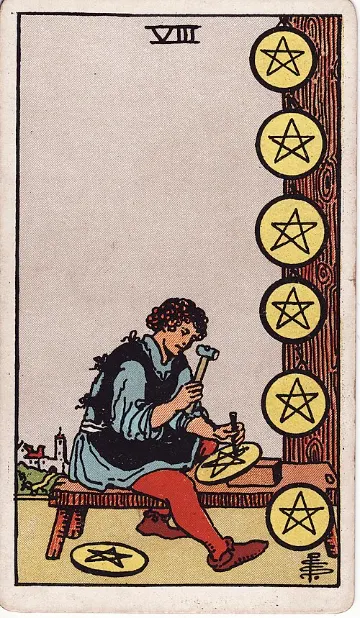
A seated craftsperson works on one pentacle while six hang in a column and another lies near the ground. The Eight of Pentacles draws attention to skill made through repeated work, whether in study, employment, or a commission. Waite's upright meanings include craftsmanship and business ability; his reversal turns toward empty ambition or skill used for cunning. Modern readers may also see monotonous work or perfectionism, but those are readings of the scene rather than Waite's stated gloss. The card asks what the work is teaching, who it serves, and when a version is ready to leave the bench.
Look at the image
Pamela Colman Smith places a seated craftsperson close to one pentacle being worked with a tool. Six pentacles hang in a vertical column nearby, while another lies below. A town appears in the distance. The picture gives more room to the bench and the repeated objects than to any audience for the work. Similar pieces make comparison possible, but we cannot tell which are finished or who will use them. Notice the worker's close attention to one object at a time. The card invites questions about method, quality, and the point at which practiced skill becomes work that can be offered to others.
Upright: make the next version better
Waite's upright meanings include employment, commission, craftsmanship, business skill, and work still in a preparatory stage. An upright Eight may fit learning a trade, refining a portfolio, or producing careful work for pay. Repetition matters when each attempt provides information: a cleaner line, a sturdier joint, a clearer explanation, or fewer errors. Choose one criterion before making the next version, then compare results. A piece need not be perfect to be useful, but a deadline should not erase the time needed for competent work. The column of pentacles suggests accumulated effort; the hand at the bench shows where improvement can happen now.
Reversed: what is the skill serving?
Waite's reversed terms are sharper than simple burnout: he names empty ambition, vanity, greed, excessive demands, and ability used for cunning. They warn that technical skill can be directed toward a poor end. Contemporary readers may also use the reversed Eight for mechanical repetition, perfectionism, or a job that gives no room to learn. The question and surrounding cards help separate motive from working conditions. Is someone using expertise to obscure a bad offer, or is a capable worker repeating tasks without useful feedback? In either case, identify the exact practice or incentive that should change. More hours at the bench will not fix an unclear purpose.
Eight of Pentacles in love and relationships
In love, the Eight can describe affection expressed through consistent acts: making time, repairing a recurring problem, or learning how to support a partner better. A relationship benefits from practice, but one person's labor cannot manufacture the other person's commitment. Upright, both people may be willing to notice what works and change a small habit. Reversed, a person may be doing more and more while the shared aim remains unclear, or a kind act may start to feel like a performance for approval. Name the recurring action and ask whether it meets a real need. Care grows through mutual attention, not through counting finished pentacles as proof of devotion.
Eight of Pentacles as feelings
When the question is about your feelings, the Eight may show a desire to invest steady effort rather than make one grand gesture. That can be meaningful if you also know what kind of connection you are building. If you ask about someone else's feelings, the worker's concentration cannot reveal their private thoughts. Look at whether they keep plans, respond to feedback, and make changes they said they would make. Reversed, intense effort might coexist with uncertainty or fatigue, but the card does not tell you whose. A conversation about the relationship's purpose can prevent both people from working hard toward different results.
Eight of Pentacles in career and money
At work, the Eight can fit paid training, a commission, a repeated production task, or a skill that increases earning power over time. Ask what quality standard applies, who provides feedback, how long each piece takes, and what payment covers. A low fee for a prototype may not cover endless revisions. If you are learning, keep examples that show improvement and identify the next skill a real client or employer values. Reversed, a worker may be asked for more output without a chance to improve, or technical expertise may be used to justify unfair terms. Put the scope and price beside the craft so neither disappears behind the other.
Eight versus Three of Pentacles
The Eight shows a craftsperson focused on making pentacles one by one. The Three places a worker beneath an arch with two other figures nearby, where craft is visible in a shared setting. Waite explicitly compares the cards, treating the Eight's worker as still developing while the Three's labor has gained recognition. If both appear, practice and outside review may both be needed. Make the next version at the Eight's bench, then test it against a real brief with the Three's collaborators. Private improvement and public usefulness are connected, but they are not identical measures of success.
Is the Eight of Pentacles a yes or no card?
For a defined course of practice or a commission with fair terms, the upright Eight can lean yes: the work is likely to reward sustained attention. It is not a promise that effort alone guarantees a promotion, payment, or relationship. Reversed suggests checking whether the next round has a useful purpose and whether its terms are sound. Ask “Should I take this course if it teaches the skill required for the role I want?” and compare its cost and schedule with that goal. “Should I keep working forever until someone notices?” has no clear finish line. The card favors a measurable next version and a reason to make it.
A reading example: a small commission
An illustrator is offered a set of icons for a local business and draws the Eight of Pentacles. The job calls for a consistent style across eight pieces, but the first email says only “make them polished.” The illustrator sends one sample icon, asks which sizes and file formats are needed, and agrees on two review rounds before quoting the full set. They schedule time to test the icons at small sizes and use feedback from the sample to refine the remaining pieces. The fee covers the agreed revisions; extra changes can be priced separately. Repetition now builds a coherent result, and both artist and client know when the work is complete.
Questions to ask
- What skill will the next attempt improve?
- What standard will show the work is ready?
- Does the effort serve a goal with fair terms?