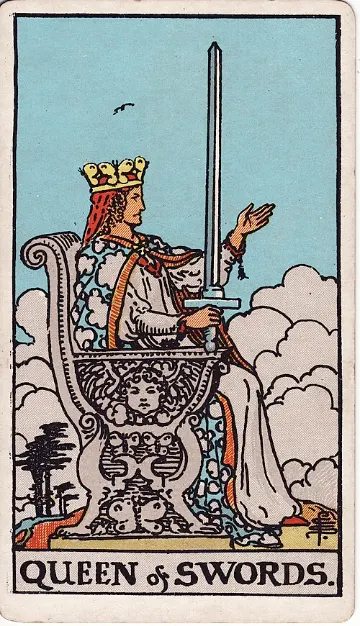
A crowned figure sits with a sword raised in her right hand and her left hand extended. Clouds frame the throne, and a winged child's face appears in its carving. The Queen of Swords can pair an exacting standard with a willingness to hear a response. Waite's older account, however, places sorrow, absence, and separation at the center; he says her face looks chastened by experience rather than presenting her simply as a symbol of power. His reversal names malice and deceit. Modern readings often emphasize clear speech and boundaries. The card asks how experience can sharpen judgment without closing the hand that invites an answer.
Look at the image
Pamela Colman Smith seats the Queen in profile. Her right hand holds a sword upright; the left extends with an open palm. Clouds gather around and below the throne, while one bird crosses the open sky and a winged child's face appears in the carving. The hands give the figure two simultaneous gestures: a firm vertical blade and an invitation to speak. Her face is composed but not empty. Waite saw sorrow in its severity. Look at the relation between the upright sword and the free hand before reducing the Queen to either cold judgment or easy agreement. The image leaves room for experience and contact at once.
Upright: speak from experience
Waite's upright Queen is associated with absence, mourning, privation, and separation; he says her expression suggests familiarity with sorrow and resists treating her as a simple emblem of power. Many contemporary readings emphasize discernment, direct speech, and boundaries. Those ideas can coexist when a difficult experience has made a person more exact about what they will accept. State the standard and the event that made it necessary. Then listen to any information that might change how it applies. A boundary can be firm without becoming a story that everyone else must be distrusted. The Queen's open hand matters because judgment gains strength when it can still receive an answer.
Reversed: test the sharp account
Waite's reversed Queen names malice, bigotry, artifice, and deceit. A modern reading may instead notice criticism that has become cutting, or a fair boundary being called cruel by someone who dislikes it. Examine the words and conduct in the real situation. Has information been withheld or distorted? Is the criticism specific enough to address? Has someone been dismissed for who they are rather than what they did? Reversed does not justify attaching an ugly trait to a woman or to any person represented by the card. It asks whether experience has become a reasoned standard or a fixed accusation that the extended hand can no longer hear.
Queen of Swords in love and relationships
In love, the Queen can fit an honest conversation after disappointment, when affection alone no longer answers a practical concern. Upright, name what you need and why, especially if a past separation has changed your sense of trust. Give the other person room to respond without asking them to guess the rule. Reversed, a cutting remark or rigid assumption may prevent a genuine answer, while a clear boundary may also be unfairly described as harsh. Look at the exchange itself. If a relationship needs distance, state what that means for contact and shared obligations. The Queen's sword helps define the limit; her open hand allows a conversation about it.
Queen of Swords as feelings
For your own feelings, the Queen may describe grief that has made you careful, or the relief of finally saying what you can and cannot accept. Neither requires you to abandon tenderness. If you ask how another person feels, this court card cannot reveal their private motives. Notice whether they speak plainly, make room for your account, and keep the limits they name. Upright may fit thoughtful reserve rather than indifference. Reversed may call attention to resentment or a statement that needs checking for fairness. The most useful question is what experience each person brings into the conversation and whether the present exchange can hold it honestly.
Queen of Swords in career and money
At work, the Queen can represent someone who gives exact feedback, makes a difficult judgment, or protects a standard after earlier mistakes. Explain the criterion, show the evidence, and offer a fair route to respond or improve. Waite's emphasis on loss can also fit a decision shaped by past cuts in resources or trust. Reversed, check whether criticism has become personal or whether an inconvenient fact is being omitted. In money matters, a firm budget boundary works best when the numbers and exceptions are stated plainly. A useful standard is neither an attack nor a vague feeling. It is a rule that can be understood and applied consistently.
Queen of Swords as a person, beside the King
As a person, the Queen may describe someone whose directness comes from experience, but the title does not require a woman or a particular age. The King's image faces forward in a formal seat of judgment; the Queen turns in profile with one hand extended. The Queen can emphasize the lived cost behind a boundary, while the King emphasizes authority and a rule applied to others. If both appear, ask who has the power to decide and who carries the history that informs the decision. A sound outcome may need the King's stated principle and the Queen's attention to what a previous loss taught.
Is the Queen of Swords a yes or no card?
For a question about stating a fair boundary or requesting the facts, the upright Queen can lean yes. She does not guarantee that the other person will welcome the answer. Reversed asks whether the proposed words are accurate and proportionate, or whether a sharp account is covering a bias. Try asking “Should I explain the criterion and invite a response?” rather than “Am I right to cut this person off?” The first question has a concrete process. The second may skip the very facts the Queen would examine. A conditional yes grows stronger when the standard can be explained without turning pain into a permanent verdict.
A reading example: a revised team policy
A team lead has seen two projects fail because deadlines changed without anyone recording who agreed. After another dispute, they draw the Queen of Swords. They write a short policy: deadline changes need a named owner, a reason, and notice to affected people. They show the draft to the team and ask which parts would be hard to use in practice. One colleague suggests a simple emergency exception, which the lead adds. The policy comes from a real loss, but it is not a punishment for everyone who works there. The Queen's blade sets a clear standard, and her open hand improves it before it is applied.
Questions to ask
- What experience shaped this boundary?
- Is the standard fair and explainable?
- What response am I still willing to hear?