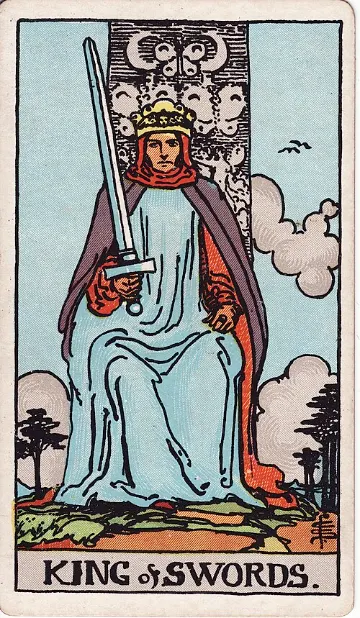
A crowned figure sits facing forward with an unsheathed sword held upright at a slight angle. Clouds, trees, birds, and carved motifs surround the throne. The King of Swords places judgment in an office with real power. Waite's upright account emphasizes command, law, and forceful intelligence; his reversal names cruelty and bad faith. Modern readings often ask for clear reasons, consistent rules, and accountability. The card can represent a decision maker, an approach to a difficult choice, or the need to scrutinize someone who claims authority. Its central question is not whether the ruler sounds certain, but whether the decision can withstand evidence, fairness, and its effect on others.
Look at the image
Pamela Colman Smith seats the crowned King frontally on a carved throne. His sword rises at a slight angle rather than striking, while trees, clouds, and two small birds sit beyond him. The figure holds still after the Knight's charge and faces the viewer as if a decision is about to be given. The scene grants an office and a weapon, but no petitioners, evidence, or written rule appear. That absence is useful. The picture shows who can pronounce judgment without proving that any particular ruling is wise. Ask what the King knows, who can speak before him, and how the power behind the sword will be used.
Upright: judgment with real authority
Waite reads the upright King through judgment, command, law, office, and forceful intelligence. This is not merely a clever person having an opinion; the seated figure may have power to decide for others. In a modern reading, the card can ask for a rule that is stated, evidence that is available, and a decision maker who accepts responsibility for consequences. If you are the one deciding, explain the criterion and apply it to comparable cases. If you are seeking a decision, ask what information is being considered and how an error can be corrected. The sword is most trustworthy when its reasoning is visible to the people it affects.
Reversed: when authority turns cruel
Waite's reversed King names cruelty, betrayal, and evil intention. Those words make the shadow of official power hard to ignore. A contemporary reading may use the card for an arbitrary rule, a persuasive argument that hides a weak case, or your own temptation to win by authority rather than evidence. Examine the conduct, not the title alone. Who can challenge a decision? Are exceptions granted consistently? Has information been concealed from the people carrying the cost? Reversed does not identify a villain by itself, but it does demand scrutiny of how power is exercised. Where the process is unfair, a clear record and an avenue to appeal matter more than another confident speech.
King of Swords in love and relationships
In love, the King may point to a difficult decision that needs direct words and a fair hearing. Upright, each person can state what they need, what they know, and what they are asking the other to decide. A relationship is not a courtroom, however; constant cross-examination can make honesty harder. Reversed, watch for a pattern in which one person treats their interpretation as law or uses sharp reasoning to dismiss the other's experience. If an agreement is needed, write its practical terms without turning every feeling into evidence for a verdict. The King's best contribution is clarity with accountability, not an endless demand to be proved right.
King of Swords as feelings and as a person
As a person, the King can describe someone whose decisions carry weight or who values clear argument, regardless of gender. That tells you a style, not the private feeling beneath it. If you ask how someone feels, listen to what they say and notice whether they make room for your account. Upright may fit a person willing to discuss terms and follow a stated principle. Reversed can raise concern about contempt or inconsistency when actions support that reading. For your own feelings, the card may mark a wish to settle uncertainty by making a rule. Ask whether the rule serves the relationship or merely ends the discomfort of not knowing.
King of Swords in career and money
At work, this card can describe a manager, adviser, reviewer, or formal decision where criteria matter. Put the rule in writing, show which facts count, and let affected people correct mistakes. Waite's association with law and office makes the distinction between expert advice and a commanding manner especially relevant. Reversed, examine conflicts of interest, selective evidence, or a process that cannot be questioned. In money matters, compare the contract with the sales claim, identify who has authority to change terms, and seek an explanation for unusual conditions. A polished argument is valuable only when the figures and obligations underneath it stand up to review.
King of Swords versus Queen of Swords
The Queen sits in profile with one hand extended and a sword raised; Waite connects her with sorrow and separation. The King faces forward in an office of judgment, holding an unsheathed sword. The Queen can emphasize what experience has taught a person to protect. The King emphasizes the authority to set and enforce a rule. If both appear, ask whose lived costs have informed the decision and who can formally change it. A fair outcome may need the Queen's careful standard and the King's public reasoning. Neither card should be reduced to a personality stereotype or a literal gender role.
Is the King of Swords a yes or no card?
For a decision supported by clear evidence, a consistent rule, and a fair process, the upright King may lean yes. If the facts are missing or the decision maker cannot explain the terms, the card points toward more scrutiny before a commitment. Reversed raises a stronger question about misuse of authority or a rule applied to serve one side. Ask “Should I accept these terms after the exception is written into the contract?” instead of “Will the authority figure be fair?” The first can be checked. The second depends on conduct the card cannot supply. A King-style yes should be explainable to those who bear its effects.
A reading example: a hiring decision
A small organization has two strong candidates for a role and draws the King of Swords before making an offer. The panel writes down the job requirements, scores the same work sample for both candidates, and records where each meets the standard. One candidate has a personal connection to a panel member, who steps out of the final vote. The selected applicant receives an offer with clear terms; the other receives a truthful account of the process. The card does not pick a person by magic. It asks the organization to make a consequential judgment that can be explained, reviewed, and defended without leaning on title or preference alone.
Questions to ask
- What rule and evidence support this decision?
- Who carries its consequences and can challenge an error?
- Would the same rule stand if the roles were reversed?