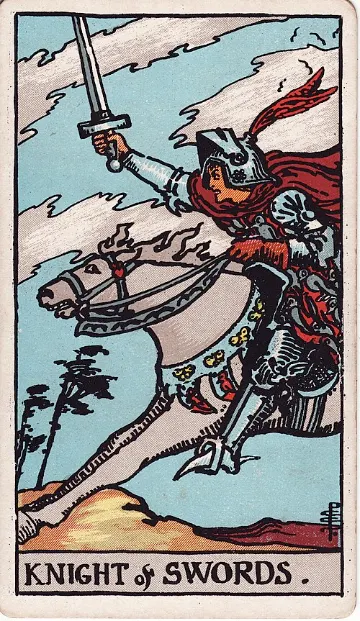
An armored rider charges on a white horse with a sword raised against wind-torn clouds. The Knight of Swords can bring skill and courage to an urgent task, or carry conflict farther than intended. Waite's upright account spans bravery and defense as well as wrath, opposition, and destruction; his reversal names imprudence, incapacity, and extravagance. Modern readings often focus on decisive speech and the risk of rushing. In love or work, the card asks whether the aim is sound, what speed the situation truly requires, and how the people along the route will be affected.
Look at the image
Pamela Colman Smith sends the Knight forward on a white horse, armor and raised sword pointed into the charge. A red mantle and plume stream behind, trees bend, and ragged clouds make the air feel unsettled. Horse and rider lean in the same direction. The target remains beyond the edge of the picture, so the image shows commitment and speed without proving what they serve. Waite saw a chivalric hero in this figure; the visual energy also leaves room for a dangerous rush. Ask what could be accomplished at this pace and what a rider moving so quickly may fail to see on either side.
Upright: courage with an edge
Waite's upright Knight includes skill, bravery, capacity, and defense, alongside enmity, wrath, war, and destruction. This is more than a warning to slow down: sometimes the situation calls for a capable intervention. In a modern reading, the card may fit a decisive message, a rapid correction, or defending a person or principle under pressure. State the aim, the evidence, and the point at which the charge should stop. A quick action can be proportionate when a real deadline exists. It becomes less useful when speed substitutes for knowing the target. Courage and judgment belong together, especially when the rider's words or decisions affect others.
Reversed: prudence before another charge
Waite's reversed Knight names imprudence, incapacity, and extravagance. A modern reading may see impulsive speech, scattered momentum, or action held back because the task feels too large. Check which problem is present. Has a decision outrun the facts, or has the rider been asked to do something without the resources or authority needed? If money is being spent to keep pace with an artificial urgency, identify the cost before another commitment. Reversed need not mean doing nothing. It can call for a narrower task, better support, and a speed that fits the actual capacity. The horse's energy is valuable when someone can steer it.
Knight of Swords in love and relationships
In love, the Knight can describe a direct conversation, quick pursuit, or a conflict entered with strong conviction. Upright, clarity can be welcome when both people have room to answer. A declaration delivered as a demand leaves less room for the relationship to become mutual. Reversed, sharp replies or repeated changes of direction can make trust difficult; check whether the pattern is speed, pressure, or a genuine disagreement. If a conversation is urgent, name the specific issue and the decision it requires. The card's charge is useful when it addresses a real concern. It can do damage when winning the moment matters more than hearing the response.
Knight of Swords as feelings
For your own feelings, the Knight may capture a sudden readiness to speak, defend, or pursue an answer. Ask whether the strength comes from a settled understanding or from discomfort with waiting. If asking about someone else's feelings, a dramatic charge cannot tell you what they privately intend. Notice whether they state an aim, listen to your answer, and follow through after the first fast message. Upright may fit determined interest or principled concern. Reversed may fit intensity that does not translate into capacity. The distinction appears in the exchange itself: genuine engagement leaves space for another person to participate.
Knight of Swords in career and money
At work, the Knight can be valuable when a mistake must be corrected quickly, a deadline is real, or a team needs a clear defender of a decision. Give the action a single aim and a short account others can verify. Waite's skill and capacity matter as much as his battle imagery. Reversed, check whether the person moving fastest has the authority, evidence, and resources to finish what they start. In money matters, compare the cost of urgent action with the cost of delay, especially before paying a premium or signing under pressure. A fast decision is strongest when the terms remain understandable after the rush passes.
Knight of Swords versus Page of Swords
The Page stands on rugged ground with a sword ready, looking around for information. The Knight is already charging. One can ask and examine; the other acts on what has been learned. If both appear, decide whether the urgent action has enough evidence beneath it. The Page may find the source of a claim or identify an exception, while the Knight can deliver the correction or defense. Sometimes the deadline permits only a brief check. Even then, a single verified fact may keep the charge pointed at the right issue. Curiosity and courage work well in sequence when neither tries to replace the other.
Is the Knight of Swords a yes or no card?
For an urgent action with a clear aim, sound facts, and a proportionate cost, the upright Knight can lean yes. It is less reassuring when the question asks whether to rush through an unknown situation simply because waiting feels uncomfortable. Reversed asks for a check on capacity and expense before committing. Ask “Should I send the verified correction today?” rather than “Should I confront everyone now?” The first names the target and the useful action. The second may turn a specific problem into a wider fight. A Knight-style yes is strongest when someone knows how to stop after the task is done.
A reading example: an urgent correction
A team discovers that a public event notice gives the wrong starting time. The coordinator draws the Knight of Swords. They verify the correct time with the venue, update the page and tickets, and send one concise correction through the same channels that carried the original notice. They ask a colleague to check the new text before it goes out and keep a record of affected bookings. Speed matters because guests are making plans now. An angry message blaming the person who entered the old time would not fix the notice faster. The Knight's charge works because the aim is precise and the response can be checked.
Questions to ask
- What is the exact aim of this action?
- Which fact must be checked before moving at speed?
- Do I have the capacity and authority to finish what I start?