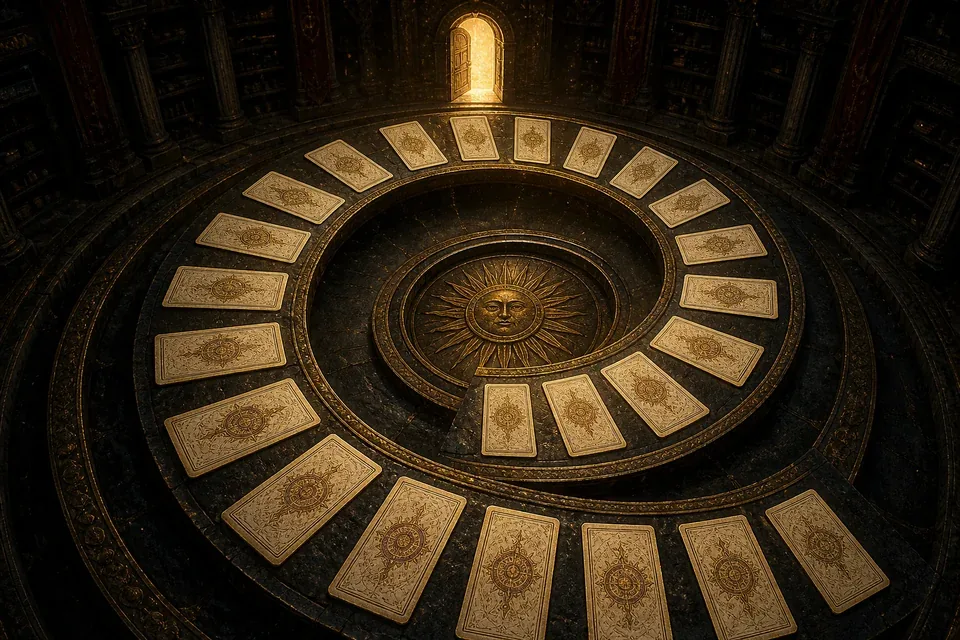
The Celtic Cross puts ten drawn cards into two connected forms. The center and its four sides give the question a setting; the four-card staff asks how the reader, surroundings, hopes, and possible direction fit that setting. It is a structure for interpretation, not a mechanism for certifying a future event.
Where this version comes from
A. E. Waite described a cross-and-staff layout in the divination section of The Pictorial Key to the Tarot, published with illustrations by Pamela Colman Smith. Waite called it an “ancient Celtic” method, but that label in his text is not evidence of an ancient origin. His account chooses a significator before ten further cards are dealt. Many current readings begin directly with ten drawn cards. The version below keeps Waite’s ten-place order and gives each position a practical question.
The free ten-card reading shuffles a full Rider–Waite–Smith deck locally and lets you reveal those places individually. Every card links to its full guide. Nothing about a card’s presence proves a private fact about someone else, and the last card need not be read as fate.
The six cards of the cross
- Present matter. Name the question as it appears today. What can you actually observe? Keep the position broad enough for an unexpected image, but narrow enough to stay connected to one issue.
- Crossing factor. This card can suggest an obstacle, a tension, or a resource that complicates the first card. Compare the two pictures. Are the figures moving in the same direction, or do they pull the story apart?
- Conscious aim. What do you think you are pursuing, defending, or hoping to understand? An appealing card here can show an ideal that needs a practical route; a difficult one can reveal a pressure you already recognize.
- Underlying ground. What need, constraint, assumption, or older condition supports the visible matter? This does not uncover a hidden truth by itself. Use it to form a question you can check.
- Receding influence. What pattern or condition may be losing importance? If a card evokes a past event, compare that thought with memory and records rather than treating the draw as evidence that it happened.
- Approaching possibility. What might become relevant next if present conditions continue? This is a scenario to prepare for or test, not a promise that a specific event will arrive.
The four cards of the staff
- Your stance. How are you participating? Look for an attitude, a habit, or a small decision within your control. A card here can be more useful as a question about agency than as a label for personality.
- Surroundings. Which other people, institutions, or practical conditions affect the matter? Avoid claiming to know another person’s thoughts. Ask what conversation or observation could make the context clearer.
- Hopes and concerns. What desired outcome or worry might be coloring your reading of the other cards? A card can hold both feelings; it need not be assigned only to hope or only to fear.
- Working synthesis. What next step makes sense when you read the other nine together? Waite’s tenth place was an outcome. Here it is a provisional synthesis that can change as real circumstances change.
Positions are prompts, and readers use variant labels. Write down the labels before drawing so the meaning of a place does not shift to fit whichever card appears.
Read relationships between cards
Begin with the first two cards, then compare the conscious aim with the underlying ground. Look across the receding and approaching positions for a change in conditions. Finally compare the personal stance with surroundings, and hopes with the synthesis. A repeated suit may suggest one kind of concern is occupying a lot of attention; opposing images may show a choice worth examining. Neither pattern supplies a universal rule.
Write one observation about a picture and one practical question for each pair. Revisit the reading later: which questions helped, and which interpretations were too forced? You can try the ten-card draw or begin with the three-card reading if you want fewer moving parts.
Waite’s printed version
Waite’s description of the cross, staff, optional significator, and ten dealt positions appears in The Pictorial Key to the Tarot, Part III. Compare its position names with the questions above if you want to try the earlier version.