
Five titles, several histories. The Lemegeton is usually outlined as five books, yet the work was assembled from texts and source traditions of different dates. A manuscript may contain a partial sequence, and an edition may focus on only one book. A page headed “Solomon” is not, by itself, evidence of a single ancient author or a complete five-book sequence.
Explore the books
- IArs GoetiaSeventy-two spiritsThe named spirit catalogue is the best-known part. Its seals and ranks are covered in the separate Goetia reference, with one profile per figure.
- IITheurgia-GoetiaCatalogue and transmissionThe second book is easy to mistake for an extension of the seventy-two Goetic profiles. Its own arrangement, source history, and surviving copies point to a separate compilation problem.
- IIIArs PaulinaHours and degreesBook III uses the language of celestial time, but its two arrangements differ. The title invokes Paul; the English text contains clues to its much later assembly.
- IVArs AlmadelDevice and variantsThe fourth book describes a marked object, but “the Almadel” was never a single timeless diagram. Its English four-altitude form belongs to a wider medieval and early modern family.
- VArs NotoriaLearning and imagesArs Notoria has an earlier manuscript life than the four-book or five-book Lemegeton arrangement. The drawings called notae are central evidence, even where a later English print omits them.
A partial copy is still valuable
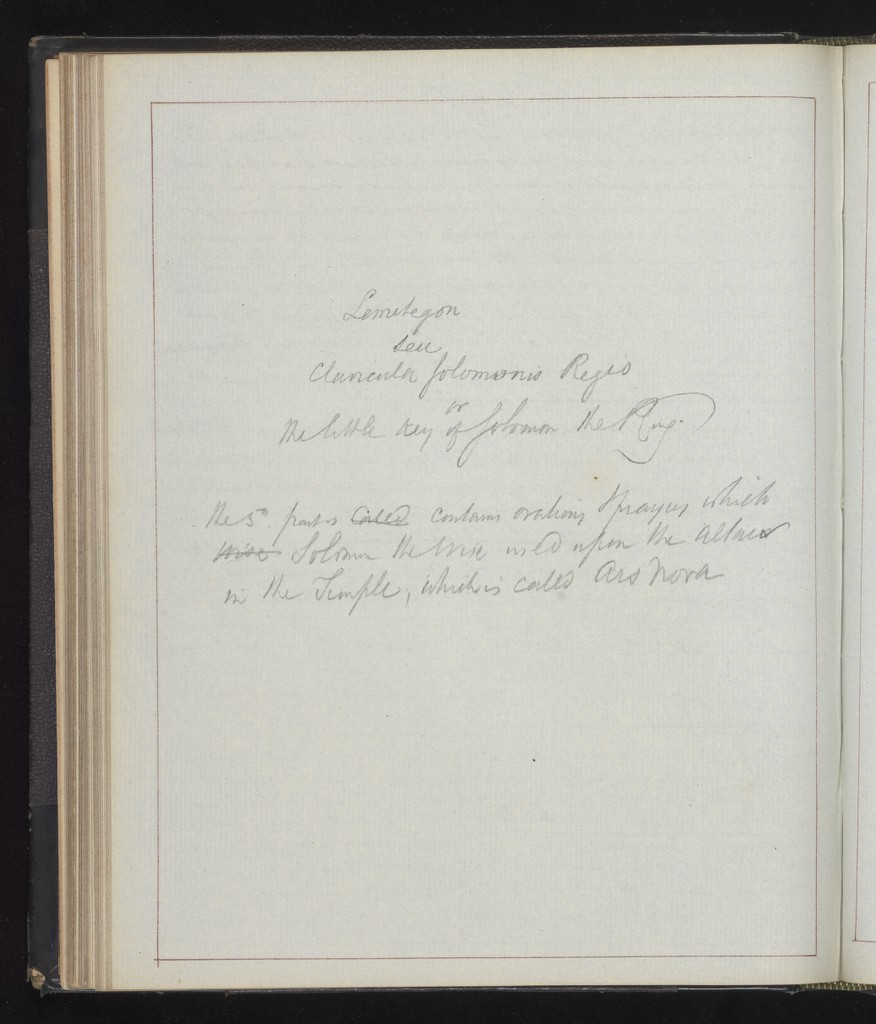
Wellcome Collection MS.3203 calls its fourth treatise a copy of the Goetia and Theurgia-Goetia. It was written by Henry Dawson Lea in a nineteenth-century collecting circle associated with Frederick Hockley. The title leaf below uses the wider name Lemegeton, but this object does not contain the five-book sequence. That fact makes it useful: readers can see how a manuscript title and its actual contents need separate descriptions.
How the books differ
Each book has its own structure and textual history. Theurgia-Goetia juxtaposes aerial-spirit catalogues with Trithemius and a later two-book copy. Ars Paulina separates planetary hours from zodiac degrees. Ars Almadel compares the four-altitude English wax table with earlier Almandal forms. Ars Notoria moves between thirteenth-century illustrated notae, Turner’s 1657 printed translation, and an appendix that does not appear in every Lemegeton witness.
A five-book heading, a shelfmark, and the 1904 Mathers–Crowley Goetia refer to different kinds of evidence. Explore the manuscripts and editions or specific held objects in the grimoire bibliography.