
The dragon carrying a black hen on the frontispiece announces a publishing combination. The Wellcome object binds the Dragon Rouge to La Poule noire, but the second title keeps its own opening and identity.
- Wellcome object
- 2 unnumbered leaves + 108 pages
- Second opening
- La Poule noire begins on page 103
- Rights-safe scan
- 116 IIIF images, Public Domain Mark
The title page says “followed by,” not “also known as”
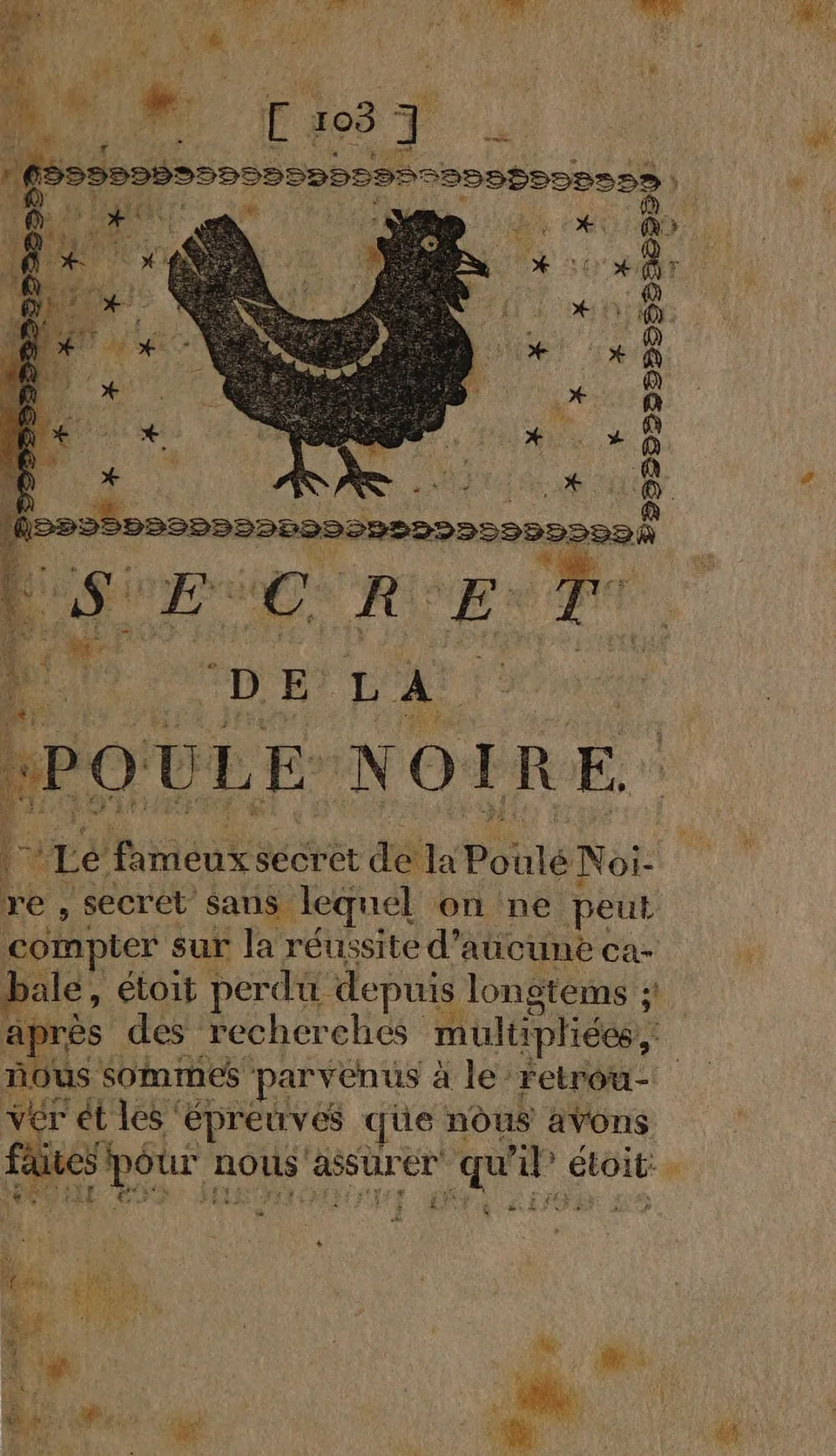
The Wellcome title is unusually clear: Le véritable dragon rouge is “suivi de la poule noire,” followed by the Black Pullet. After the Dragon Rouge material ends, scan 109 opens “Secret de la Poule Noire” on numbered page 103 with a small black-hen woodcut. That new heading and late start make the internal boundary visible. The book is a composite product: one physical volume presents two named works in sequence.
Its frontispiece turns the combination into a single sales image. A red dragon holds a shield containing a black hen, while stars decorate the wings. The picture does not prove that the texts began together. It shows that this edition wanted buyers to recognize both attractions at once. The Wellcome record counts two unnumbered leaves and 108 numbered pages; its IIIF manifest supplies 116 images because covers, preliminary leaves, and final views are included alongside the numbered text.
How the pairing developed in nineteenth-century print
Owen Davies dates the earliest known Black Pullet edition to about 1820. Papot-Libéral’s edition study finds the work joined to the Dragon Rouge by the middle of the nineteenth century and identifies the Wellcome false-1521 printing as probably about 1850. This places the pairing within the same cheap-print environment that reused grand titles, anonymous authority, woodcuts, and false dates. Joining two small books made a thicker and more varied commodity without erasing the internal title of the second one.
The pairing persisted and expanded. The BnF record for V. Goupy’s 1873 Paris edition names the Véritable dragon rouge and La poule noire together, then advertises additional secrets associated with Cleopatra. Its digital copy is marked freely available in Gallica. The longer title demonstrates a common publishing pattern: a recognizable core could acquire another grimoire and a chain of promised additions. Page count and sequence therefore help distinguish a specific edition more reliably than a shortened modern cover title.
Why the boundary matters
The Black Pullet also circulated on its own and in combinations with works other than the Dragon Rouge. Its title centers on a black hen and a treasure-producing legend; the historical text includes a violent animal rite, promises of wealth, and claims about spirits. Those motifs overlap with the Dragon Rouge’s interest in treasure and compulsion, which made the two works commercially compatible. Shared themes explain a useful pairing, but they do not turn the Poule noire into a missing chapter of every Grand Grimoire witness.
Keeping the two titles separate prevents several common errors. A date printed for the Dragon Rouge half should not become the origin date of the Black Pullet. An image from their joint frontispiece should not be treated as proof that all versions used it. Material added to Goupy’s expanded 1873 volume should not be projected backward into the BnF Grand Grimoire catalogued as 1702. WitchcraftDaily grimoire bibliography offers a wider map of title families, while the Grimorium Verum reading room follows a separate work whose spirit lists sometimes circulate beside the same names.
A three-page secret borrows the larger book’s machinery
In the Wellcome copy, the Black Pullet addition is strikingly short. Its fresh heading and hen woodcut begin on page 103; its prose finishes on page 105; the table of contents starts on page 106 and records “Secret de la Poule noire” at page 103. This is not the full adventure narrative and series of talismans found in other Black Pullet editions. It is a compressed annex shaped for this particular Dragon Rouge volume.
The annex begins by claiming that a famous, long-lost secret has been recovered through repeated research and verified by tests. That little authentication story replaces the Grand Grimoire’s extended Solomonic ancestry and false old imprint. Both texts manufacture authority, but at different scales: the larger work appeals to ancient books, sacred names, and a hierarchy of rulers; the appendix promises that unnamed recent discoverers tried a secret and now share their success.
The short addition is separate yet operationally dependent. Page 105 refers backward to a prayer on page 67 and the “great appeal” on page 25, references that work only after the Dragon Rouge fills pages 1–102. The printer edited the second title to borrow the first title’s prayers and conjuration as its missing middle.
Worked comparison: pact negotiation and treasure production in the two bound works
The Dragon Rouge builds desire through delay. Its table of contents lists first, second, and third appeals, the spirit’s appearance, alternating demands and replies, a warning, a convention, a promise, and dismissal. In the second book, the pattern returns as an explicit method of making pacts: another appeal, appearance, question, reply, second appearance, further reply, agreement, and dismissal. The repeated dialogue makes wealth the result of a negotiated hierarchy. Even within the fiction, the operator does not simply ask once and receive; authority must be escalated through named rulers and stabilized in terms.
The Black Pullet annex compresses that dramatic machinery. It claims the secret has already been tested, gives a brief violent animal rite, then tells the reader to import the earlier prayer and great appeal by page number. The promised spirit appears in human form with ram’s horns and a scarlet, ornamented garment, asks for orders, and is said to make the operator rich. Where the pact narrative makes Lucifuge answer, resist, and bargain, the annex presents obedience as immediate once the borrowed appeal has been supplied.
That contrast explains why treasure made the pairing commercially attractive. The Grand Grimoire offers a long scene of access to a minister whose office concerns riches; its suspense lies in securing an agreement without surrendering control. The abbreviated Black Pullet sells a shortcut: a recently recovered secret that converts the earlier book’s apparatus into an asserted wealth result. Both promise command, yet one dramatizes a contract while the other packages a compact supplement around the same desire.
The physical volume preserves both separation and interweaving. Page 103 announces a new named work with its own image; page 108 lists it independently at the end of the contents. At the same time, page 105 cannot be followed without moving back into the Dragon Rouge. “Followed by” is therefore more than a bibliographic phrase here. The printer makes a modular grimoire: the first work supplies reusable prayers and appeals, and the second supplies a new narrative frame and promised application. A reader who sees only the black-hen woodcut misses those backward links; a reader who calls the whole volume one original work misses the deliberate new beginning.
Catalogue records and research
- Wellcome Collection, Le véritable dragon rouge (work qss4ugsf) ↗
- Wellcome Collection IIIF manifest, b33030169 ↗
- Bibliothèque nationale de France, 1873 Véritable dragon rouge catalogue record ↗
- Mélanie Papot-Libéral, Le Dragon Rouge: éditions et réception (2017) ↗
- Owen Davies, Grimoires: A History of Magic Books (Oxford University Press) ↗