
A family of French print witnesses survives under the title Grand Grimoire; it has no single fixed form. Grand Grimoire, Dragon Rouge, and Véritable Dragon Rouge can name overlapping texts, while individual editions change titles, signatures, illustrations, companions, and dates.
Explore the reading room
Four labels that should stay precise
A title attached to an illustrated BnF witness catalogued as 1702 and to later reprints. The record notes that closely related text also circulated as Le Dragon Rouge.
A title used for the French grimoire tradition studied through late eighteenth- and nineteenth-century references and editions.
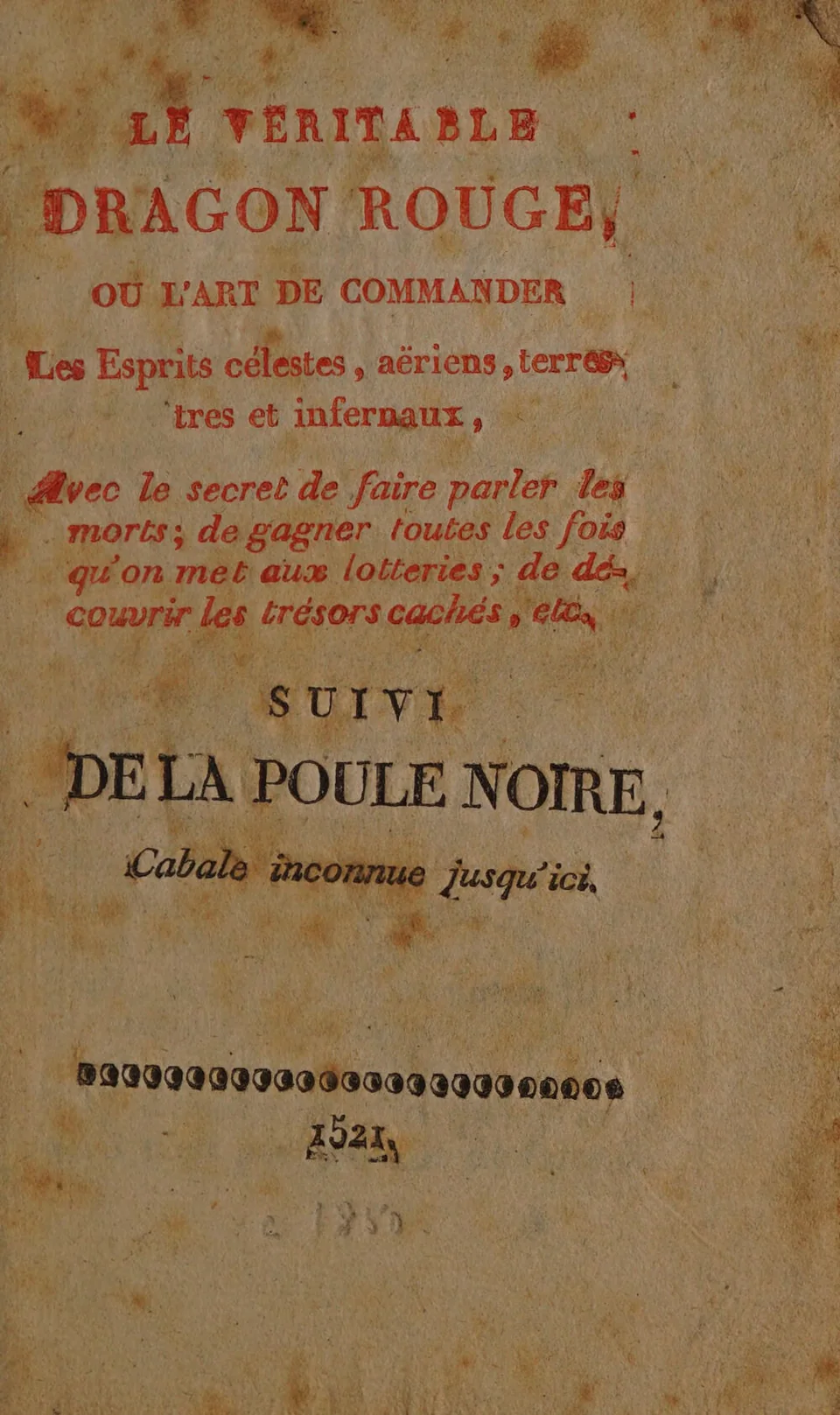
The wording on the Wellcome joint volume, whose printed 1521 year is catalogued as a probable false date for an edition around 1850.
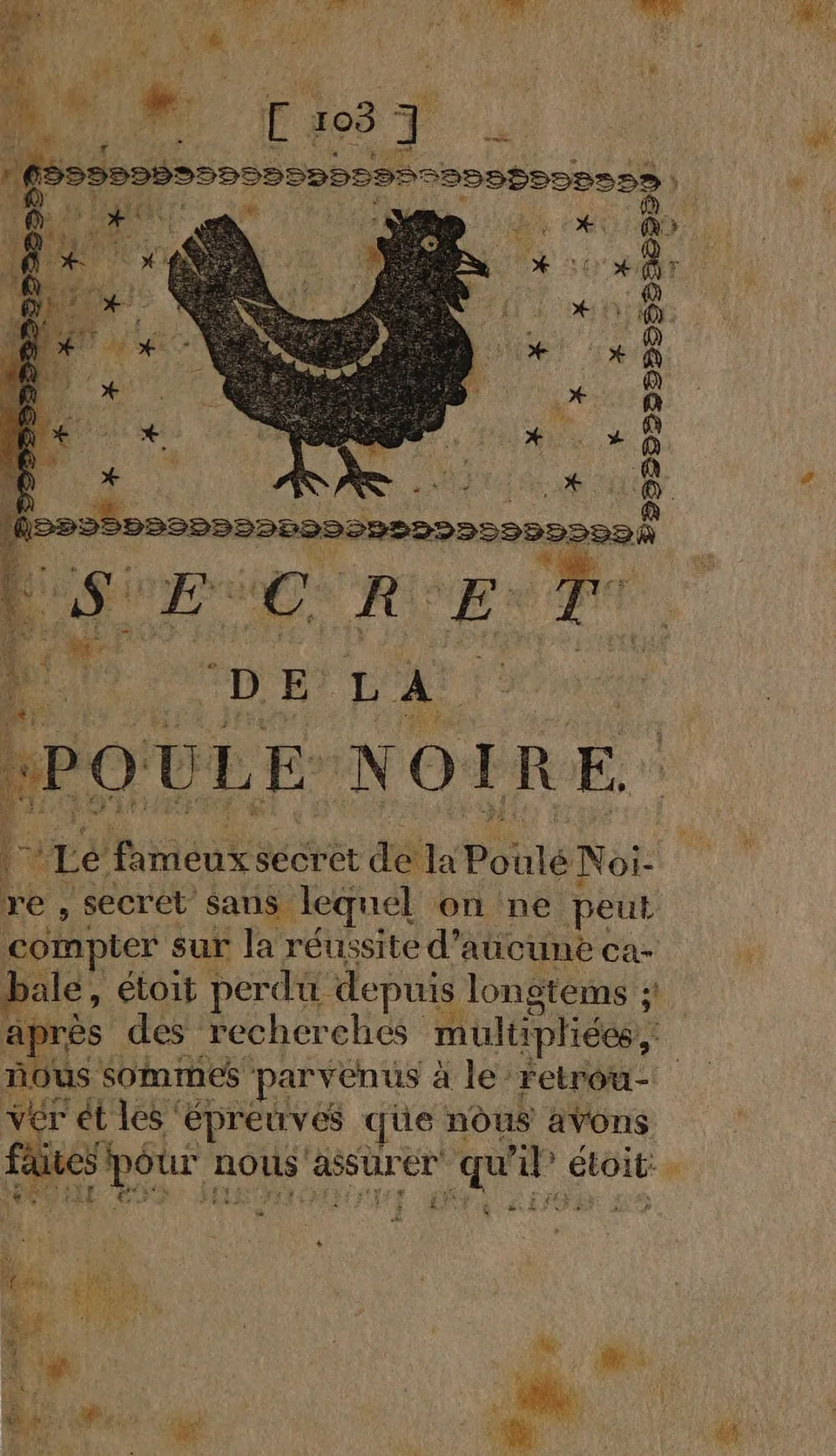
A separate grimoire placed after the Dragon Rouge in the Wellcome volume. Its own heading begins on numbered page 103.
Start with the surviving object
The Wellcome copy preserves the discrepancy. Its title page prints 1521, yet the catalogue supplies “[i.e. 1850?]” and leaves both place and publisher uncertain. The same object has two unnumbered preliminary leaves, 108 numbered pages, a frontispiece, and woodcut illustrations. Its IIIF manifest contains 116 canvas images because the digitization includes covers and other views outside the numbered sequence. A date printed inside the book and a library’s estimate for the physical edition are different kinds of evidence.
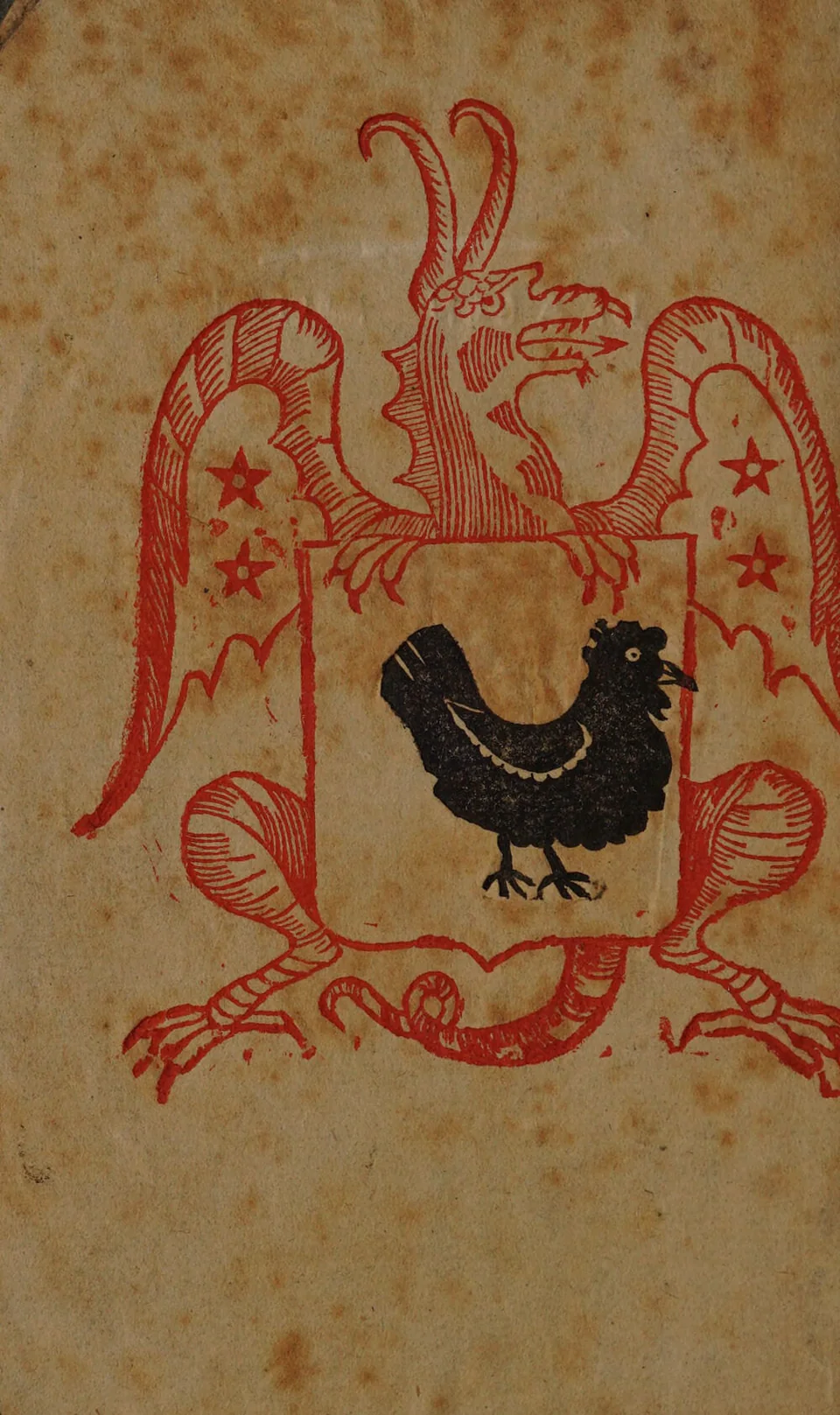
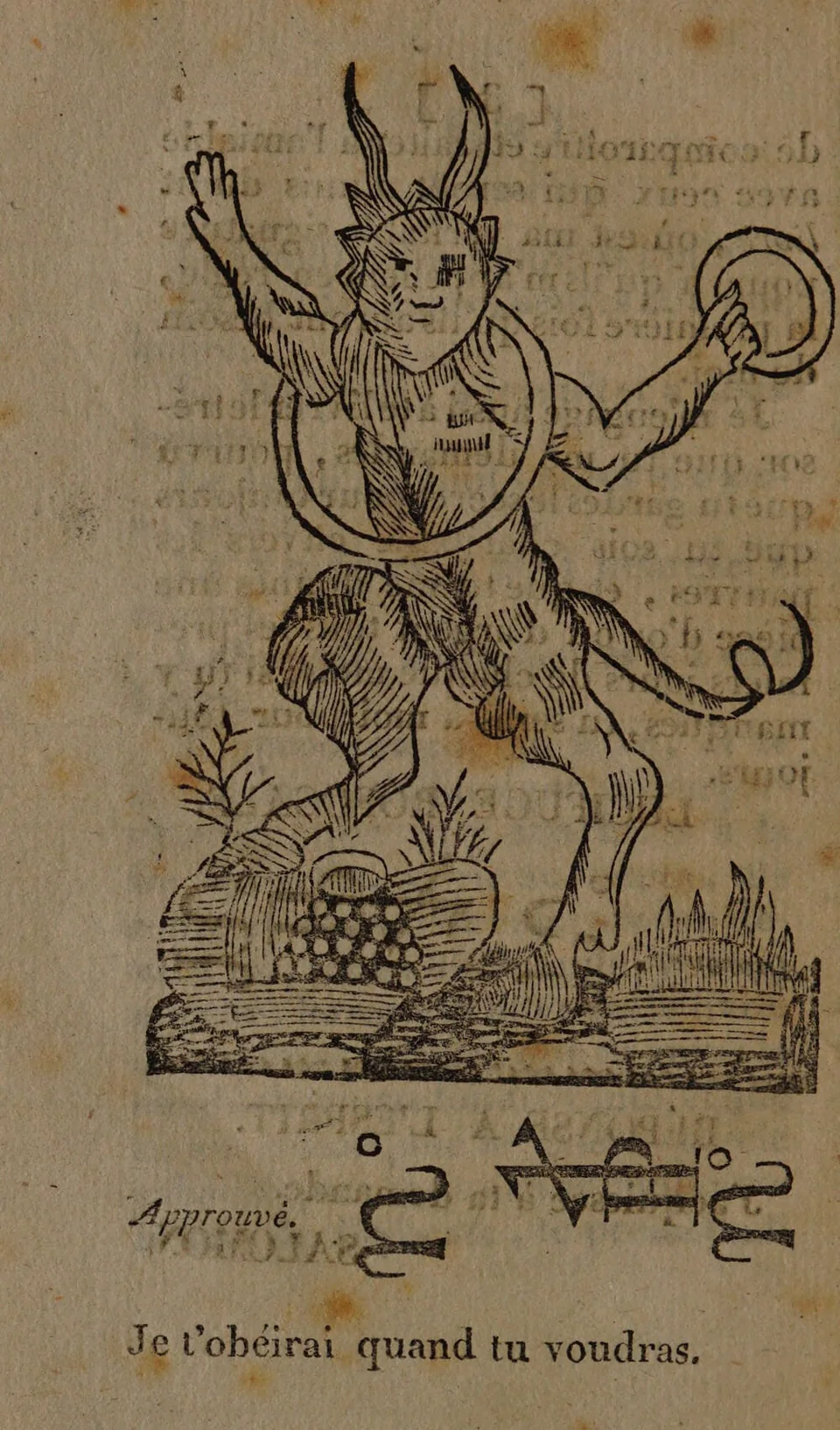
The frontispiece joins a red dragon to a black hen, previewing the two titles sold together. Farther inside, a horned figure and sign visualize the book’s Lucifuge episode. Near the end, a fresh heading and hen woodcut open the Black Pullet. The images follow the publisher’s sequence: title, spectacle, narrative authority, and appended attraction. They also keep the claims attached to a specific witness rather than turning every woodcut into an emblem shared by all editions.
| Date | Evidence | What it establishes |
|---|---|---|
| 1702 | BnF Grand Grimoire record | A catalogued 84-page witness under the Grand Grimoire title |
| By 1818 | Mention traced by Papot-Libéral | The Dragon Rouge title tradition was circulating by this point |
| 1823 / 1838 | Nîmes and Paris witnesses in the edition study | Early nineteenth-century print states with changing titles |
| About 1850 | Wellcome work qss4ugsf | The joint Dragon Rouge and Black Pullet volume falsely dated 1521 |
| 1873 | BnF record, V. Goupy, Paris | A later expanded joint edition available through Gallica |
What the Grand Grimoire claims to contain
The work presents an infernal administration headed by Lucifer, Beelzebub, and Astaroth. Lucifuge Rofocale appears as a first minister associated with riches and hidden treasure. Other named figures receive military or courtly offices and specialized powers. The pact narrative stages negotiation and coercion through that hierarchy. These are roles asserted by the printed text, not observations about a verifiable supernatural order.
Christian sacred names, inherited Solomonic authority, fragments of several languages, diagrams, signatures, and commercial promises share the page. Grimoires typically compile and reframe older material in this mixture. The operator is written as compelling spirits through superior names, so the book’s religious logic is more complicated than a simple manual of devotion to the devil. Its organization can be studied without repeating its operational directions.
The BnF’s 1873 Goupy record shows how the package grew: Dragon Rouge and Black Pullet appear together with added “secrets.” The Wellcome witness probably predates it, while the BnF Grand Grimoire record catalogued as 1702 represents another state. Their differences as witnesses explain the false date, author signature, and changing contents.
Catalogue records and research
- Wellcome Collection, Le véritable dragon rouge (work qss4ugsf) ↗
- Wellcome Collection IIIF manifest, b33030169 ↗
- Bibliothèque nationale de France, Le grand grimoire catalogue record ↗
- Bibliothèque nationale de France, 1873 Véritable dragon rouge catalogue record ↗
- Mélanie Papot-Libéral, Le Dragon Rouge: éditions et réception (2017) ↗
- Owen Davies, Grimoires: A History of Magic Books (Oxford University Press) ↗