
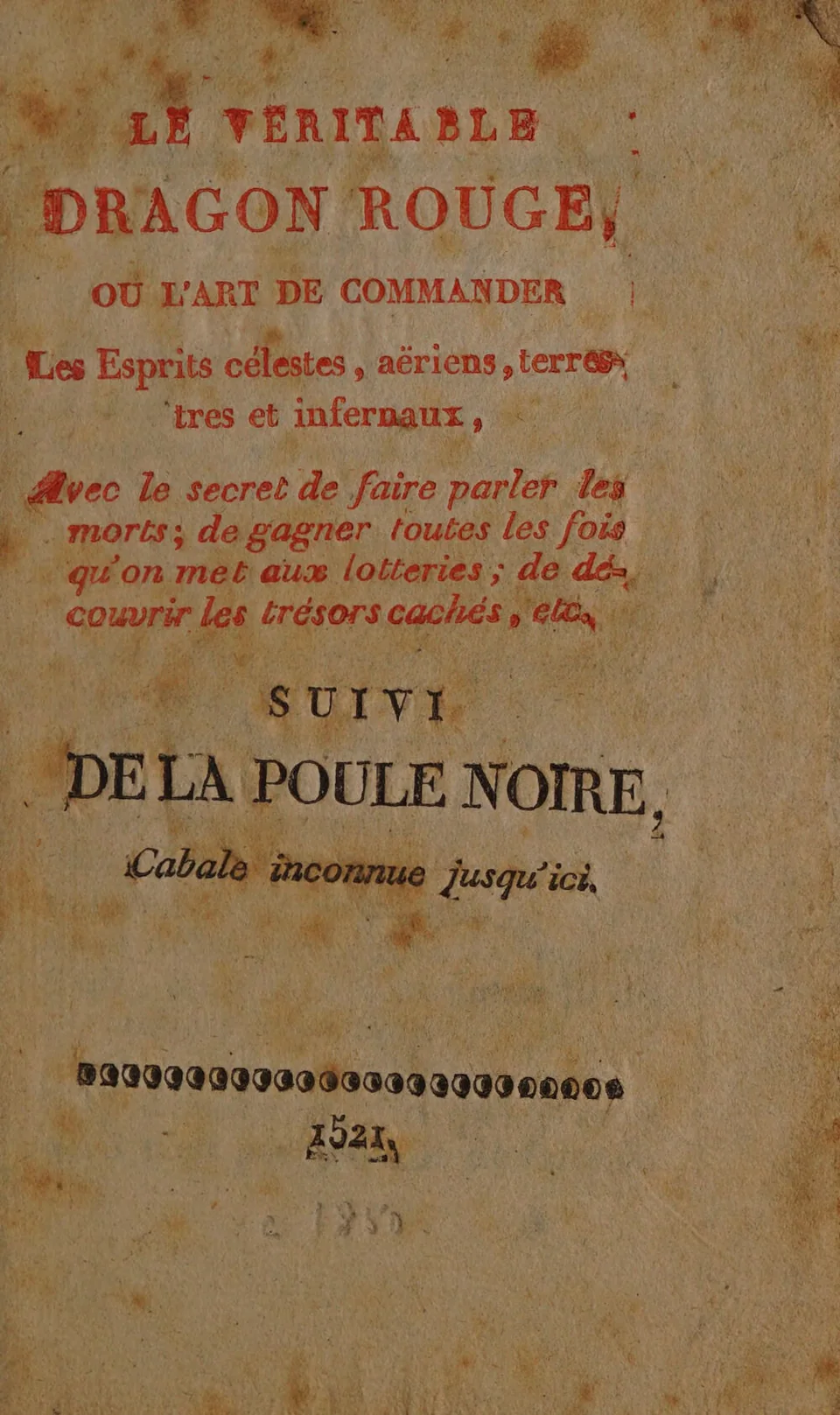
The most arresting date in the Wellcome copy is also the one a reader should trust least. Its title page prints 1521; the library record supplies a probable nineteenth-century date in brackets.
- Printed claim
- 1521 on the title page
- Wellcome estimate
- [1521 [i.e. 1850?]
- Later fixed witness
- Paris, V. Goupy, 1873
The false date participates in the book’s authority claim
The Wellcome title page sets 1521 beneath a title printed in red and black. The catalogue instead supplies “[Paris?] : [publisher not identified], [1521 [i.e. 1850?]” and describes two unnumbered leaves, 108 pages, a frontispiece, and woodcuts in a small duodecimo volume. The two dates do different work. About 1850 is the library’s cautious estimate for the surviving object; 1521 is part of the object’s presentation of itself.
That presentation continues inside. The first chapter says the little book condenses the essence of more than twenty difficult volumes, then claims descent from genuine writings of Solomon found by chance. It attributes command of spirits to a talisman or “clavicle” and describes a blasting rod first used by God against rebellious angels. Ancient king, hidden library, divine weapon, and remote date accumulate before the central dialogue begins. The false imprint is therefore not an isolated error at the bottom of a title page. It is one component of a larger literary machine that turns a recent, inexpensive print into the supposed residue of primordial authority.
Two books repeat and sharpen the same dramatic problem
The Wellcome witness is organized as more than a list of spirit names. Its first book moves from claims of Solomonic transmission into preparations, offerings, prayers, a sequence of three appeals addressed to the emperor Lucifer, the appearance of Lucifuge Rofocale, a demand, a response, a convention, recovery of treasure, dismissal, and thanksgiving. The progression alternates objects, speech, and narrated consequences. Each stage tries to close a point at which the imagined encounter might fail.
A second book opens under the heading Sanctum Regum and calls itself the “true manner of making pacts.” It restates the infernal hierarchy, assigns functions to senior and subordinate figures, and then supplies a model exchange. This repetition is editorial rather than accidental. The first book dramatizes one extended operation; the second abstracts its bargaining logic into a reusable contract pattern. A reader encounters the plot once as a story of escalating appeals and again as a classified system of offices, responses, and obligations.
The hierarchy routes a request through delegated offices
The second book places Lucifer, Beelzebub, and Astaroth at the top, then names six senior officers: Lucifuge Rofocale, Satanachia, Agaliarept, Fleurety, Sargatanas, and Nebiros. Eighteen further names are divided three at a time beneath those officers. The text says that a person contracting with one principal should ask for one of the three subordinates to serve. The list therefore functions like a routing table. Rank determines which figure authorizes the encounter, which officer owns a field of action, and which subordinate is imagined as carrying out the work.
Lucifuge is expressly the first minister associated with riches and treasures; he is not another spelling of Lucifer. The model appeal first addresses Lucifer as emperor, invokes Beelzebub and Astaroth as higher powers, and only then calls Lucifuge to appear. That grammatical chain keeps the figures separate even when damaged type and unstable spelling make the page difficult to read. The book’s bargain depends on the distinction: authority is requested from the rulers and negotiated with the minister.
Worked comparison: appeal, refusal, and counteroffer
The first book builds pressure through three appeals to Lucifer and a warning that other superior spirits will compel obedience. In the second book, the “great appeal” compresses that escalation into one speech: Lucifer is asked to favor the action, Beelzebub to protect it, Astaroth to assist, and Lucifuge to appear. The change reveals the text’s internal logic. Sacred names and superior ranks do not decorate the scene; they are presented as enforcement clauses that move the request down the hierarchy.
The ensuing dialogue is structured like a negotiation. The human speaker demands immediate riches. Lucifuge answers with a twenty-year claim over body and soul. A written pact is offered, refused, and followed by a renewed coercive appeal. Lucifuge then returns with narrower counterterms: a nearby treasure, a recurring dedicated payment, a limit on how often he may be called, and the same twenty-year penalty for breach. The operator accepts only on condition that the treasure be shown at once. Neither side simply submits. Each response changes price, timing, access, or enforcement.
The manuscript-like formula becomes a physical prop within the printed scene. The pact is signed, thrown toward the spirit, later placed on the treasure, and backed by the wand and words of the clavicle. The sequence closes with a dismissal and thanksgiving, as though the book must terminate the contract as carefully as it initiated it. This worked passage explains why the Grand Grimoire reads differently from a bare demon catalogue: its central unit is a hostile exchange whose turns the book scripts for both voices.
Changing editions change the frame around that pact
The BnF records an eighty-four-page Grand Grimoire under the date 1702, with an anonymous title page and a first chapter signed “Antonio Venitiana del Rabina.” Papot-Libéral finds no independent identity for that signer and treats the name as likely pseudonymous; some witnesses substitute “Dr. J. Karter” while retaining much of the surrounding text. The unstable name fits the chapter’s role as a voice of authority more readily than it supplies a documented modern author.
The Wellcome copy places La poule noire after the Dragon Rouge material, with a new heading and hen woodcut on numbered page 103. The BnF’s 1873 Goupy edition again joins the works and advertises still more “secrets.” Bundling changes the promise made by the volume: a pact narrative aimed at delegated infernal power becomes one attraction inside a larger commercial collection of treasure, invisibility, lottery, and divinatory claims. The appended Black Pullet remains a separate work, and Grimorium Verum belongs to a separate bibliographic tradition. The overlap among covers and market labels should not erase those internal boundaries.
Papot-Libéral’s survey places the Dragon Rouge tradition around the end of the eighteenth or beginning of the nineteenth century and shows it known by 1818; she also records nineteenth-century witnesses dated 1823 and 1838. That reconstruction and Wellcome’s circa-1850 estimate are more compatible with the book’s changing packages than a single unaltered edition from 1521. The surviving objects show a short pact drama repeatedly retitled, expanded, and sold beside new material.
Catalogue records and research
- Wellcome Collection, Le véritable dragon rouge (work qss4ugsf) ↗
- Wellcome Collection IIIF manifest, b33030169 ↗
- Bibliothèque nationale de France, Le grand grimoire catalogue record ↗
- Bibliothèque nationale de France, 1873 Véritable dragon rouge catalogue record ↗
- Mélanie Papot-Libéral, Le Dragon Rouge: éditions et réception (2017) ↗
- Owen Davies, Grimoires: A History of Magic Books (Oxford University Press) ↗