
Sigil of Haures
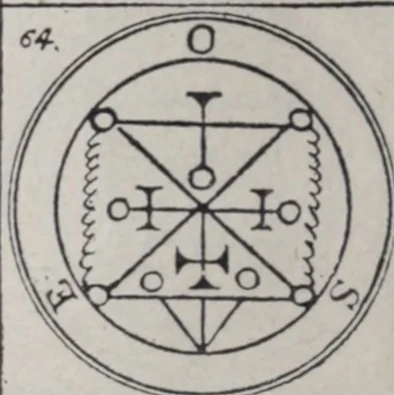
At a glance
- Entry
- 64 of 72
- Rank
- Duke
- Legions
- 36 in the text
- Also written
- Hauras, Havres, Flauros
Description in the text
Haures is said to answer questions about the past, present, and future and recount the creation and fall of spirits. The text warns of deception outside the ceremonial triangle and also associates him with destroying enemies.
Read entry 64 on page 42 of the 1916 edition
Appearance
A fearsome leopard that changes into a human figure with fiery eyes.
Topics attributed to this entry
- Divination
- Fallen spirits
- Enemies
Reading this entry
Haures appears under several spellings, including Hauras, Havres, and Flauros. The duke begins as a powerful leopard and then becomes a human figure with fiery eyes and a terrifying face. The passage says he answers questions about past, present, and future, but only truthfully under a stated ritual constraint; otherwise he deceives. As with Furfur and Shax, the condition on truth is central to the entry.
Haures also discusses creation, divinity, and the fall of spirits. The text attributes harm toward enemies and protection from temptation by other spirits. These opposing functions are claims within its religious drama. He governs 36 legions and has a seal. The unusual number of name forms and the combination of theological speech, deceit warning, aggression, and protection make this a particularly complex profile.
Read entry 64 on page 42 of the 1916 edition or compare the 1904 transcription.
A closer reading of entry 64
What the numbered text says
Haures has four printed name forms and a two-stage portrait, first a formidable leopard and then a fiery-eyed human figure. The passage makes its truth claim conditional: outside the described triangle, it says the spirit will deceive the questioner. That is a claim about the grimoire’s ritual logic, not an instruction to perform it or a method for evaluating factual answers. The account also includes creation and the fall of spirits, protection from temptation, and destruction of enemies. These topics make the entry broader than a simple divination label.
About the printed seal
The fifth plate contains seal 64, but the passage additionally calls it a lamen. The image is a numbered printed witness; it offers no way to infer whether a leopard or human appearance is present, or to validate the source’s condition about truthful speech.
Compare another entry
Compare entry 55: Orobas. Orobas also addresses time and creation, yet is presented as faithful to the summoner. Haures’s text makes deception a central concern and states a ritual condition. Comparing those assertions reveals a difference in narrative role without treating either as a reliable witness.