
Sigil of Gaap
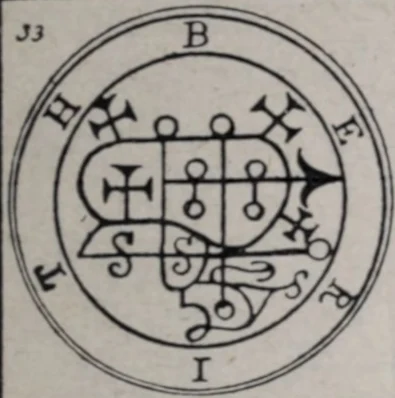
At a glance
- Entry
- 33 of 72
- Rank
- President and Prince
- Legions
- 66 in the text
- Also written
- Gäap
Description in the text
Gaap is described as able to affect understanding, teach philosophy and the liberal sciences, and stir love or hatred. The text also credits him with answering questions across time and carrying people rapidly between kingdoms.
Read entry 33 on page 32 of the 1916 edition
Appearance
A human guide preceding four kings when the sun is in a southern sign.
Topics attributed to this entry
- Knowledge
- Love and hatred
- Travel
Reading this entry
Gaap is both president and prince. He appears in human form as a guide before four kings when the sun is in southern signs, a condition the text leaves imprecise. His offices span opposites: causing ignorance or insensibility, but also teaching philosophy and the liberal sciences; causing love or hatred; and reporting past, present, and future. The source also assigns rapid movement between kingdoms and the release of familiars held by others.
Gaap is said to have belonged to the Order of Potentates and to serve Amaymon in a consecration context. These hierarchical references are part of the book’s internal system, not proof of an external organization. His 66 legions and seal conclude an entry whose striking feature is range. It would be misleading to choose only the educational or only the harmful side of the account.
Read entry 33 on page 32 of the 1916 edition or compare the 1904 transcription.
A closer reading of entry 33
What the numbered text says
Gaap is both president and prince in this account, with a guide’s place before four kings rather than a throne scene of his own. Its offices are deliberately contradictory: the same figure is said to make people ignorant or learned, and to cause love or hatred. The journey between kingdoms is another attributed capacity, distinct from the entry’s claim to answer questions about time. Amaymon is named as his king, placing this unusually broad profile within a hierarchy.
About the printed seal
The entry places Gaap’s sign after its account of 66 legions. The numbered image is on frontispiece 4 of the 1916 printing. Neither its shape nor its placement explains which of the four accompanying kings is pictured; the prose supplies no such key.
Compare another entry
Compare entry 9: Paimon. Paimon also travels in a royal company, but the text names two attendant kings and makes him the central ruler. Gaap instead precedes four unnamed kings as a guide. Their processions should be read as different scenes, not interchangeable illustrations of rank.