
The seven Ensigns are easy to mistake for either the table itself or the seven angles of the Sigillum Dei Aemeth. Dee’s records and later witnesses give the objects separate names. The signs belong around the central seal in a Holy Table arrangement, while the seal and scrying stone have distinct positions and histories. The surviving Oxford marble table is a later copy, not the painted wooden original.
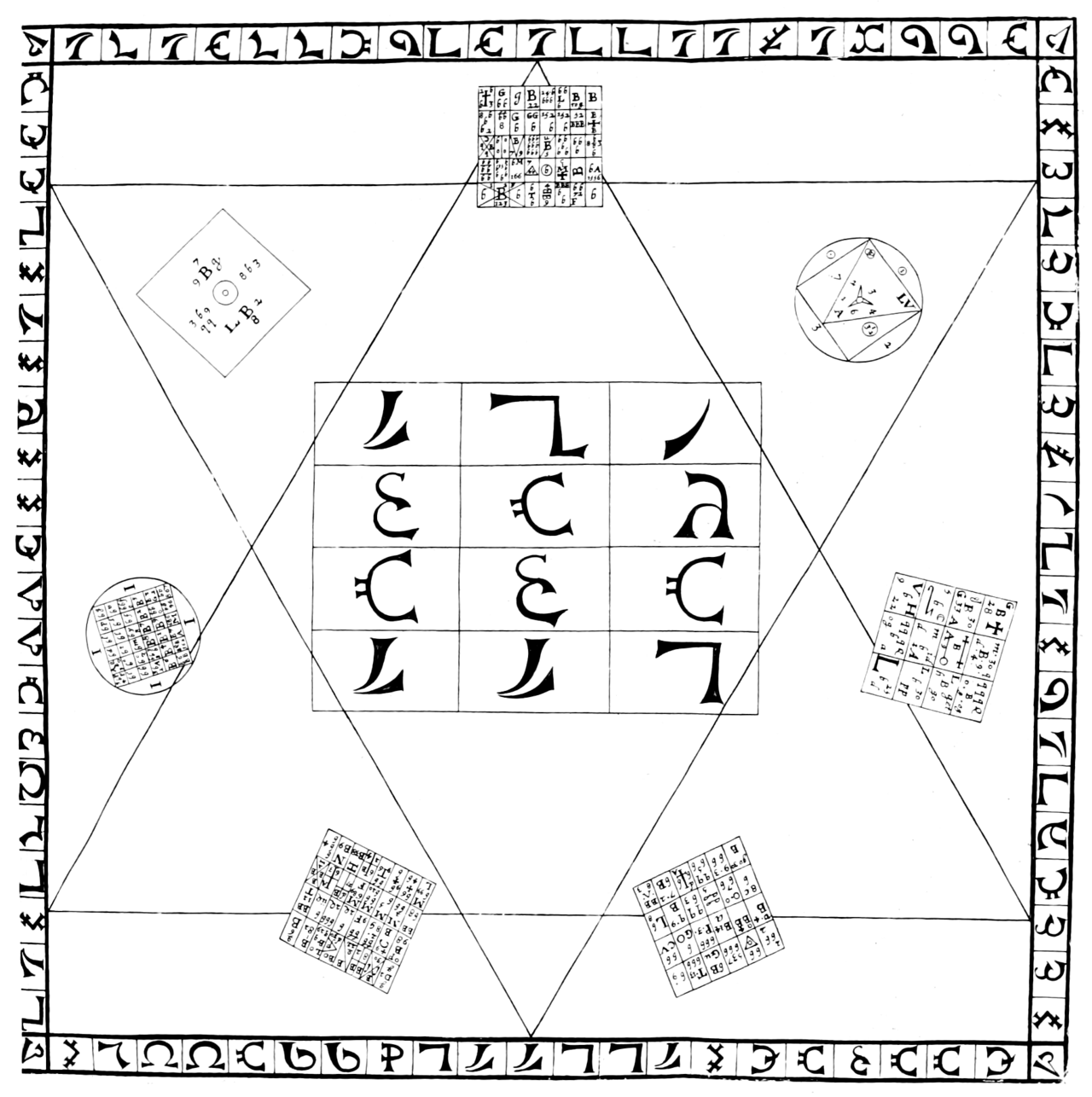
- Central element
- Sigillum Dei Aemeth
- Seven small signs
- Ensigns of Creation
- Later witness
- 1659 engraving and marble copy
Four parts in one visual field
The tabletop has its own border and lettered design. Dee’s Heptarchic notes place the large Sigillum Dei Aemeth in the middle, with seven smaller Ensigns associated with the sevenfold material. The scrying stone is another object above the table. Calling all these marks “the Enochian seal” collapses several named parts into one image.
The 1659 engraving shows a whole visual scheme, but it is a later published witness. A viewer cannot infer directly from that image which individual paint strokes were on Dee’s lost wooden table. Its lettering and arrangement belong to the printed history of Casaubon’s Relation as well as to the older material it presents.
Separate plates and painted signs are both recorded
A source comparison drawing on Dee’s manuscripts reports tin lamins bearing the seven signs, with an alternative of setting them around the Holy Seal or painting them on the table. An Ashmole description of the table says the seven signs were painted with red letters and blue lines. These statements are useful evidence about possible physical form, but they do not authorize a modern replica to claim it preserves the only original arrangement.
The manuscript tradition also contains measurements and directions for letter orientation. The edited Ashmole MS 1790 witness records the first Ensign at the top point of a geometric figure and notes a dimensional disagreement with Sloane MS 3188. The differing dimensions show that the design changed as it was copied and interpreted; a modern diagram that merges both versions can hide the variation.
Worked comparison: the first Ensign as a tin lamen and a painted table sign
The two material options create different objects. In the instruction summarized from Sloane MS 3188, the seven Ensigns may be engraved on tin and laid before the operator on the table, or kept at the seven angles of the Holy Seal. The first Ensign in that version is a small independent plate. It can be placed, lifted, reordered, or stored apart from the furniture. Its relationship to the central seal is established by where the plate is set during an action, not by a permanent painted border.
The painted alternative fixes the same sign to the tabletop, seven inches from the outer edge of the Holy Seal. Ashmole’s description adds a material vocabulary that a black-and-white outline loses: red letters and blue lines for the Ensigns, with a gold ground elsewhere in the table. Here the first sign is part of a measured surface. Its orientation, spacing, and color become properties of the table itself. A modern image that shows a free-standing lamen and a painted sign with identical outlines may still represent two different ways of making the apparatus work as an object.
Casaubon’s 1659 engraving compresses those choices into one reproducible page. It shows seven small signs around the central design, but engraved ink cannot decide whether Dee’s working version used separate tin pieces, painted forms, or both at different moments. The first Ensign is therefore a useful material control: manuscript instructions permit mobility, the painted description makes it architectural, and print turns the arrangement into a portable visual plan. Those are three stages of use and transmission, even when their geometry looks related. The physical alternative changes handling even when a familiar outline survives.
What actually survives?
The original painted wooden Holy Table is lost. Oxford’s History of Science Museum identifies a later marble copy, useful for the reception and material history of the design. A marble copy can show that an arrangement had a life after Dee, but it cannot by itself prove the surface appearance of the missing wooden object. The British Library catalogue identifies the manuscript books; the image above belongs to a public-domain copy of the 1659 printed Relation.
The small sevenfold signs appear across a chain of witnesses: dated early record, Dee’s later handbook, later descriptions, printed engraving, and later copy. Each stage may preserve something important, but each also changes the question the image can answer. The manuscript and image comparison traces that chain, while the 1582 guide returns to the earliest recorded sequence.
Sources and witness limits
- British Library · Sloane MS 3188 ↗The catalogue identifies Dee’s early conference books, 1581–83. It does not authenticate a modern reconstruction of an individual ensign.
- British Library · Sloane MS 3191 ↗The later Dee-hand volume includes De Heptarchia Mystica at ff. 32r–51r, distinct from the earlier Sloane MS 3188 conferences.
- Dee · Compendium Heptarchiae Mysticae, edited text ↗A later Dee compendium calls the seven small tables ensigns of creation and distinguishes their role from the central Sigillum. Consult folio markers in the edition.
- John Dee’s Holy Table and Lamen · witness comparison ↗Peterson compares MS 3188, Dee’s compendium, Ashmole’s description, and the 1659 engraving. The page is an edited comparison, not Dee’s autograph.
- Bodleian · Ashmole MS 1790, ff. 55r–56r, edited transcription ↗A later witness describes measurements and identifies the first ensign’s placement. Variations are reported against MS 3188.
- Wellcome Collection · A True and Faithful Relation (1659) ↗Public-domain seventeenth-century print, used here as a later visual witness rather than a facsimile of the 1582 notebook.
- History of Science Museum · marble copy of the Holy Table ↗Museum object history for a later copy of the lost wooden table; it cannot verify the exact form of Dee’s original plates.
- Wikimedia Commons · 1659 Holy Table engraving ↗The already-held site image has a Public Domain Mark. Its caption identifies the printed edition, not a manuscript photograph.
Reported angelic speech is treated as a historical claim in Dee’s record, not as a verified account of an external event.