
Many online pictures of Dee’s Holy Table are actually photographs of a later object or copies of a seventeenth-century engraving. Meric Casaubon’s True and Faithful Relation appeared in 1659, after Dee’s death, and printed a table design. The History of Science Museum dates its marble Holy Table to the mid-seventeenth century and says it was based on that engraving. This is evidence of how the design was transmitted and remade, not proof that the copy preserves every feature of the lost painted wood.
- Publication
- Casaubon’s Relation, 1659
- Museum object
- Oxford inv. 15449
- Original wood
- Lost
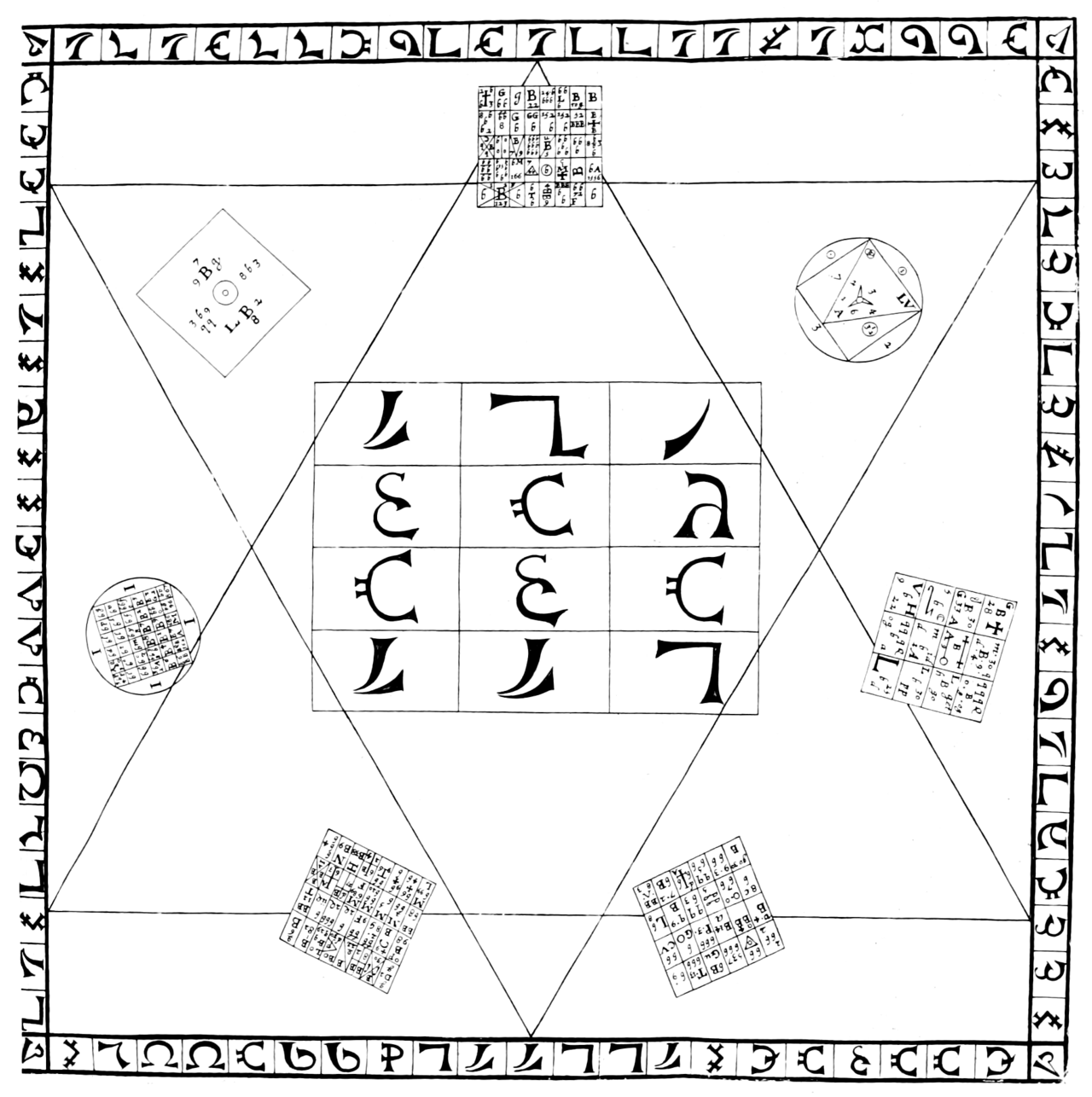
The printed plate has its own date
The black-and-white image on this page is the Holy Table plate from the 1659 Relation, available through a public-domain Commons file record. The Folger Shakespeare Library catalogues the edition as a posthumous printing prepared by Casaubon. Cornell provides a digitized copy that lets readers inspect the plate in book context. That matters: an isolated image file may be labeled “Dee’s table” with no indication of the printer, page, or intervening decades. A seventeenth-century printed plate can transmit an earlier design while introducing typographic, compositional, and editorial choices. The 1659 print date is part of the image’s history.
Oxford’s marble copy
Oxford catalogues a marble copy as inventory 15449 and dates it to the mid-1600s. The museum explicitly says the original painted wooden table is lost and the marble object was based on the 1659 engraving. Its account adds that the copy may have belonged to astrologer William Lilly. “May” is a provenance qualifier, not a confirmed ownership statement. The marble object therefore tells us that interest in Dee’s design extended beyond his lifetime into a culture of copying and collecting. Its enduring surface is valuable evidence for that later reception, even as it cannot settle the finish, dimensions, or exact letter forms of the missing wooden furnishing.
Later reconstructions of the table
A modern maker may turn the printed layout into painted wood, adjust letter spacing, select colors, add a stone, and cast supporting seals. Such a reconstruction helps a viewer imagine a physical setup, but its measurements and colors may come from different historical descriptions. It does not turn a twentieth- or twenty-first-century object into a sixteenth-century survivor. The phrase “Table of Practice” is useful shorthand for this design. Later ceremonial orders also adapted it in their own ways, adding another stage to its history.
A three-witness comparison
The manuscript record is closest in date to Dee and establishes that table instructions belonged to the early conferences. The 1659 engraving shows a particular printed arrangement that later readers could copy. Oxford’s marble table is a surviving response to that print, made after the original wooden table. These witnesses answer different questions: what Dee recorded, what Casaubon’s readers saw, and what a later maker produced. A modern digital rendering adds a fourth, dated reconstruction layer. This chain avoids claiming that any one clean diagram is the uniquely authentic Holy Table while still allowing a useful visual comparison of the design’s survival.
Sources and witness notes
- Folger Shakespeare Library · 1659 Relation catalogue ↗Catalogue for Meric Casaubon’s posthumous printed edition; the engraved plate belongs to this later editorial witness.
- Cornell · digitized 1659 Relation ↗Digitized copy of the printed edition, useful for checking plate placement and the surrounding book.
- Wikimedia Commons · Holy Table plate ↗The 1659 engraving is marked public domain. The local image is a reduced-size version already used by this site.
- History of Science Museum · Holy Table, inv. 15449 ↗Museum account of the lost painted wooden original, the mid-seventeenth-century marble copy, and its relationship to the engraving published in 1659.
- British Library · Sloane MS 3188 ↗Catalogue for Dee’s five books of conferences, 22 December 1581–30 May 1583. The volume is a manuscript witness, not the surviving table.
- British Museum · wax disc 1838,1232.90.a ↗Object record describing the large engraved wax disc, two smaller companions, the proposed table arrangement, and the limits of Dee-lifetime attribution.