
The Malleus Maleficarum, or “Hammer of Witches,” is a late-fifteenth-century argument that witchcraft was real and should be investigated and punished. It is evidence of persecution and the ideas used to justify it. It is not a neutral guide to an occult practice or a catalogue of the seventy-two Ars Goetia spirits.
- Period
- First printed c. 1487; 1494 witness shown
- Form
- Latin printed treatise and legal polemic
- Anchor witness
- Library of Congress, Nuremberg 1494 printing
Three parts turn a premise into a court process
The Malleus is organized as an escalating argument. Part I supplies the conceptual system: an alleged work of witchcraft requires a demon, a human agent called a witch, and divine permission. Its questions then address generation, sex, illness, bodily illusion, weather, and the unequal accusation of women. Part II converts that system into stories about recruitment, alleged harms, and remedies. Part III addresses judges, witnesses, imprisonment, defence, interrogation, torture, and sentence. The movement is from “can this exist?” to “what does it do?” and finally “how should an accused person be processed?”
This architecture matters because the procedural section depends on conclusions built earlier. If Part I has already defined denial as suspect and Part II has classified misfortune as an effect of a hidden pact, Part III’s judge meets an accused person inside a closed explanatory system. Silence can be read as obstinacy, confession as confirmation, and ordinary illness or conflict as a possible trace of maleficium. The work does not simply collect beliefs; it arranges them so that a theological premise can authorize an investigation with material consequences.
Printed preliminaries stage authority before the argument
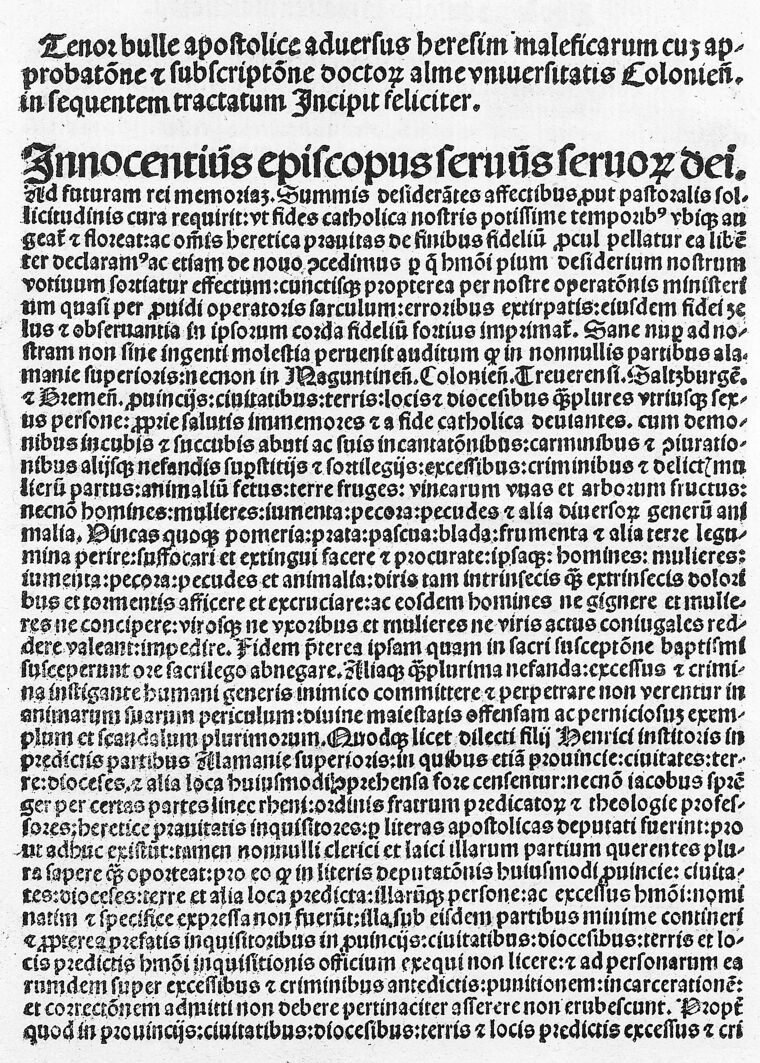
The 1494 Nuremberg copy places Innocent VIII’s bull before the treatise. On the page shown here, the bull’s official form and dense black-letter columns precede the book’s questions. Visually, that sequence lets papal language frame the argument before a reader reaches Kramer’s reasoning. The bull concerns inquisitorial authority and reported witchcraft in named territories; its inclusion does not make every proposition or procedure in the following treatise a papal ruling. Page order can create an impression of institutional continuity stronger than the documents themselves establish.
Authorship is another constructed authority. Heinrich Kramer, or Institoris, is central, while Jakob Sprenger’s contribution remains disputed. Christopher Mackay lays out the attribution problem, and Hans Peter Broedel describes the Malleus as a highly personal response shaped by Kramer’s failed prosecution and frustration with resistance. The familiar double attribution makes the text sound like a settled corporate handbook, while the disputed contribution and Kramer-centered evidence reveal a more contested authorship. Its scholastic form, prefatory documents, and claims to orthodoxy are rhetorical resources deployed by a polemical work.
Worked reading: Question I builds the book’s prosecutorial premise
Question I appears to ask whether denying witches is heretical, but its structure controls what may count as an acceptable answer. The opening objections draw on the canon concerning women who believe they ride with Diana and on the possibility that apparent transformations are fantasies. Those materials could support doubt about spectacular stories. The response narrows their force: false appearances may be imaginary, yet the cooperation of demon and human agent is said to remain real. A distinction meant to reject one belief is repurposed to secure another.
The question then assembles scriptural, patristic, and legal authorities so that disbelief becomes more than an intellectual error. The crucial move is from “some reported effects may be illusions” to “obstinate denial of the category itself savors of heresy.” That move shifts the burden of proof. Instead of asking each accusation to establish an event, the book treats the general reality of witchcraft as a premise protected by orthodoxy. Particular stories can then be sorted into real demonic effects, permitted illusion, or human participation without reopening the premise.
The section also announces the three-agent model developed across Part I: demon, witch, and divine permission. This distributes causation in a way that preserves every part of the system. A demon supplies power, the accused person supplies consent or instrumentality, and God’s permission explains why evil can occur within providence. The model absorbs an obvious theological objection; why an all-powerful God would allow the claimed harm; without weakening the accusation against a person. Question I thus performs essential legal work before the legal part begins: it makes categorical doubt look culpable and gives later judges a framework in which contrary evidence need not dismantle the theory.
How the premise reaches the accused body
Part III reveals the practical destination of that reasoning. Its numbered questions cover the quality of witnesses, disclosure of their names, acceptable defence, imprisonment, repeated examination, torture, shaving the accused in a search for hidden tokens, and graded sentences. These are not detachable curiosities after a theological treatise. They are the procedural end of the earlier claim that hidden cooperation with demons is real, dangerous, and difficult to expose. The invisible premise generates increasingly invasive ways to make the body yield visible evidence.
That progression is why the Malleus belongs in the history of persecution rather than a demon encyclopedia. It offers no neutral field report about people who were accused. It supplies a machine for interpreting them. Weyer and Scot later challenged important parts of witch prosecution, while James VI defended belief and punishment in a different setting. The relevant comparison is argumentative: what each writer permits to count as evidence, how doubt is characterized, and what a magistrate is urged to do to a living defendant.
Sources and editions
- Library of Congress, 1494 Nuremberg Malleus and digitized leaves ↗
- University Library of Basel, Speyer printing before April 1487 ↗
- Wellcome Collection, photograph of the papal bull in the 1494 printing and Public Domain rights ↗
- Cambridge University Press, Mackay edition excerpt on disputed authorship ↗
- Cambridge Core, historical study noting the contested Sprenger attribution ↗
- Library of Congress, Broedel’s open scholarly study of the Malleus ↗
- Cambridge University Press, Mackay translation of the Malleus ↗
- Folger Shakespeare Library, The Discouerie of Witchcraft in the Vaults ↗