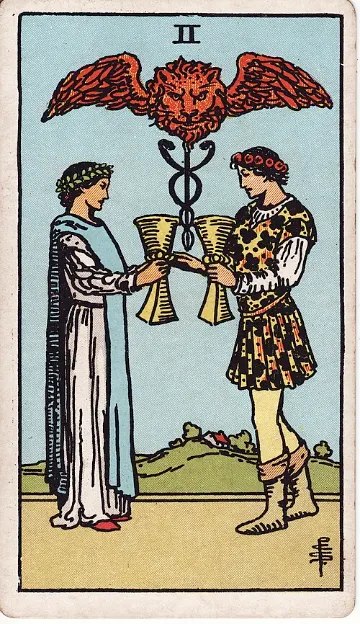
Two people face one another with separate cups raised between them. The Two of Cups is about a meeting that can become friendship, romance, reconciliation, or a partnership when both sides take part. Upright, it points toward mutual exchange and clear agreement. Reversed, it asks whether the apparent accord is real, uneven, or simply mistimed. The winged lion head and entwined serpents above the pair make the encounter feel ceremonial, but the image cannot supply the other person's answer. Watch what is offered, accepted, and followed through.
Look at the image
Pamela Colman Smith places two people opposite one another, each holding a cup. Their hands reach into the space between them, but the cups remain separate. Above them, two serpents wind around a staff beneath a winged lion's head. A. E. Waite called the emblem the caduceus of Hermes and associated the card with love, friendship, affinity, and union. The elevated symbol makes the meeting look momentous; the human action is smaller and more useful to a reading. One person offers something and the other has room to answer. The picture shows an encounter, not a completed marriage, contract, or promise.
Upright: the exchange goes both ways
Upright, the Two of Cups favors a connection in which both people can make an offer and respond freely. It may describe a first conversation that feels easy, a friendship becoming more trusting, or colleagues finding a shared aim. Notice the actual exchange rather than the mood alone: who initiated contact, who listened, and what happened afterward? Mutuality does not mean identical feelings or equal contributions at every moment. It means both sides can name what they want and adjust without one person having to guess. A small, clear invitation is often more faithful to this card than a dramatic declaration that asks for an immediate commitment.
Reversed: when the meeting is uneven
Reversed, the Two can point to an agreement that sounds mutual but works differently for each person. Perhaps one person wants a relationship while the other wants a single date; perhaps a collaborator praises a plan but never takes on their share. Poor timing, unspoken expectations, or an old hurt can create the gap. The reversal does not prove deception or announce a breakup. Waite's older list even gives the reversed Two the word passion, a reminder that the historical meanings were not a single modern verdict. Ask what was actually said and done. Repair may begin with clearer terms; a persistent mismatch may call for stepping back.
Two of Cups in love and reconciliation
In a new romance, this card can describe the pleasure of discovering that interest is returned. Enjoy the invitation without treating chemistry as proof that both people want the same future. For an established couple, it can favor a conversation that restores a sense of being on the same side. Reconciliation needs more than a warm reunion: each person must be able to name the hurt, the desired change, and what they are willing to do. Reversed, affection may still be present while expectations diverge or trust remains thin. A direct question about pace or commitment serves the relationship better than assuming two raised cups already settle it.
Two of Cups as feelings
If you drew the card about your own feelings, the Two may describe attraction joined by a wish to meet the other person as an equal. You might feel ready to listen, share something honest, or see whether a friendship can deepen. If the question is how someone else feels, the image cannot disclose a private thought. It gives you a way to examine the interaction: do they initiate contact, make time, ask questions, and follow through? Reversed can reflect mixed signals, caution, or unequal interest, but none can be diagnosed from the card alone. Give the other person room to state what they actually want.
Two of Cups in career and partnerships
Outside romance, two cups can fit a promising client meeting, coauthor, mentor relationship, or agreement between teams. Upright, the connection has room for both contributions and a reason to continue. Before calling it a partnership, put the practical exchange into words: responsibilities, credit, payment, deadlines, and how decisions will be made. A pleasant first meeting cannot carry an entire project by itself. Reversed, one side may be doing the invisible work or expecting a different outcome. That does not make cooperation impossible; it makes a candid revision necessary. The strongest version of this card is an alliance that remains fair after the initial warmth has faded.
Two of Cups versus The Lovers
The Ace of Cups shows an offered cup before anyone else enters the scene. The Two adds a second person and a response. The Lovers raises a larger question about choice, values, and what a bond asks of the people in it. When the Two appears, stay with the exchange in front of you instead of jumping ahead to a lifelong decision. Did both people choose to participate, and do their actions match the agreement they seem to have made? In a spread with The Lovers, the cards can move from meeting to commitment or conflict over values. On its own, the Two need not carry that later conclusion.
Is the Two of Cups a yes or no card?
For a modest step that allows a real answer, the upright Two can lean yes: invite the conversation, propose a collaboration, or ask whether the other person wants to meet again. It is less reliable as a yes to “Are we destined to be together?” because a future relationship depends on continuing choices. Reversed may suggest a pause to clarify expectations rather than a permanent no. Frame the question around an action within your control. “Should I ask what role they want in the project?” can lead to useful information; “Will they always agree with me?” cannot be settled by two painted cups.
A reading example: a shared project
Imagine a friend asks you to organize a small exhibition together. You enjoy their work and draw the Two of Cups upright. The card fits the moment when both of you see a possible partnership, but it does not divide the labor for you. Ask who will contact artists, manage the budget, make decisions, and receive credit. If those answers suit you both, the early rapport has somewhere to grow. If the card is reversed, you might notice that one person imagines a casual favor while the other expects months of unpaid work. Naming that difference now can protect the friendship whether the exhibition goes ahead or not.
Questions to ask
- What has each person offered and accepted in practice?
- Where do our expectations match or diverge?
- What question would make the next step clear to both of us?