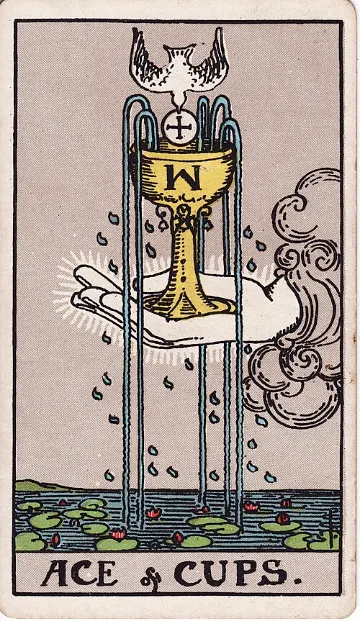
The Ace of Cups marks the beginning of a feeling, invitation, or creative impulse, not a finished relationship. Upright, it suggests openness; reversed, it asks whether emotion has somewhere safe to go. In Pamela Colman Smith's card, a hand offers an overflowing cup above water lilies while a dove descends toward it. No second person appears, which matters in love readings: the card can describe a chance to connect, but mutual affection still has to be discovered in conversation and action.
Look at the image
Smith gives the cup no human owner in the scene: it rests in a hand from a cloud, high above a pool of water lilies. Streams and separate drops descend around it; a dove brings a cross-marked wafer toward the rim. The dove and wafer belong to the deck's Christian imagery, while the water and lilies keep the scene rooted in a landscape. In The Pictorial Key to the Tarot, A. E. Waite associated the card with joy, nourishment, and abundance and its reversal with instability. The picture itself does not show two lovers or a future outcome. It shows something arriving and asks what could receive it. That distinction keeps an emotional opportunity from being mistaken for a promise.
Upright: an opening that needs attention
Upright, the Ace of Cups may mark a first honest conversation, a new friendship, an easing of old hurt, or an idea that makes you eager to create again. Its abundance is a beginning rather than an unlimited supply. A person can feel moved and still need time, trust, and practical room before a bond grows. If you are considering an invitation, say what you can actually offer and notice the response. If you are returning to an abandoned art project, set aside one hour to make something instead of waiting for inspiration to stay on its own. The card favors receiving an opening and giving it a place in ordinary life.
Reversed: too much feeling or too little room?
Reversed, the Ace can suggest that feeling is present but difficult to hold, express, or welcome. Perhaps the timing is poor, the invitation is unclear, or you have been giving care without enough rest. It can also mark a genuine mismatch: an appealing possibility may not meet your needs once you learn its terms. These are different situations, so avoid treating the reversal as a fixed verdict of rejection or an empty heart. Look at the question and neighboring cards, then ask what has actually happened. A pause to regain capacity calls for patience; a repeated lack of reciprocity calls for a clearer boundary. Neither can be diagnosed from the cup alone.
Ace of Cups in love and relationships
For someone dating, the Ace often fits the moment when interest first becomes worth exploring. Upright may support a simple invitation or a conversation that lets both people discover whether the feeling is mutual. It does not turn one warm exchange into a commitment. In an existing relationship, it can point to renewed tenderness: making time to listen, apologizing without demanding forgiveness, or sharing something that has been hard to say. Reversed, ask whether affection has too little room because of fatigue, fear, or unresolved conflict. Do not pressure either person to open up on command. A relationship grows through what both people choose and do, not through the appearance of a single card.
Ace of Cups as feelings
If the question is about your own feelings, the Ace can help name an early response before you have decided what it means. Attraction, relief, gratitude, and creative excitement can feel similar at first. Write down what stirred the feeling and what you want to know next. If you ask how another person feels, the card cannot reveal their private state. It may describe the emotional possibility in the situation, but their words, consent, and repeated actions are better evidence of their interest. Reversed may suggest holding back, being overwhelmed, or simply needing more information. A respectful question will tell you more than an elaborate guess about the cup.
Ace of Cups in career and creative work
At work, this cup is less about a guaranteed promotion than about the return of interest in what you make or whom it helps. A new role, collaborator, subject, or audience may feel nourishing after a dry period. Upright can encourage a small creative trial, a meeting about meaningful work, or time to develop an idea. Reversed may ask whether enthusiasm is being used to overlook pay, workload, or a lack of support. Feeling drawn to a project matters, but it is one part of the decision. Check the terms and make a manageable first piece. If the work still gives energy after contact with reality, there may be something worth building.
Ace of Cups versus Two of Cups
The Ace shows one offered cup and no second person; the Two of Cups shows two people meeting with separate cups. That visual difference helps when a love question turns on reciprocity. The Ace can describe a new capacity to care, a welcome invitation, or a feeling that has not yet been answered. The Two moves the question toward exchange: what has each person offered, and how did the other respond? Neither image guarantees permanence. If you drew the Ace, resist rushing to the Two's conclusion. Make space for a first conversation and let the other person's response be real information. An opening deserves attention, not an invented agreement.
Is the Ace of Cups a yes or no card?
For a small, reversible step toward connection, the upright Ace can lean yes: invite a conversation, accept a kind offer, or try the creative work that has caught your attention. It is a weaker answer to “Will they love me?” or “Will this new role fulfill me?” because those outcomes depend on more than your feeling. Reversed is not automatically no; it may suggest waiting until you have capacity, asking a missing question, or declining an offer that asks too much. Name the exact action and its cost before using a one-card answer. “Should I ask whether they want to meet again?” is a clearer question than “Is this my future?”
A reading example: a promising new connection
Imagine you meet someone at a weekly drawing class. Conversation is easy, and they mention a weekend exhibition. You draw the Ace of Cups upright while wondering whether to ask them along. The image's offered cup fits a sincere invitation, but it says nothing about their answer or the future of the connection. Ask directly, give them room to decline, and keep your own plans for the exhibition either way. If the card appears reversed, consider whether you are exhausted from a recent breakup or treating one pleasant class as proof of a relationship. You might wait a week, ask a smaller question, or decide you want friendship. The useful result is a choice that respects both people and the feeling that started it.
Questions to ask
- What has actually been offered, and what am I imagining?
- What would give this new feeling room without forcing a result?
- What small response can I make while leaving the other person free to choose?