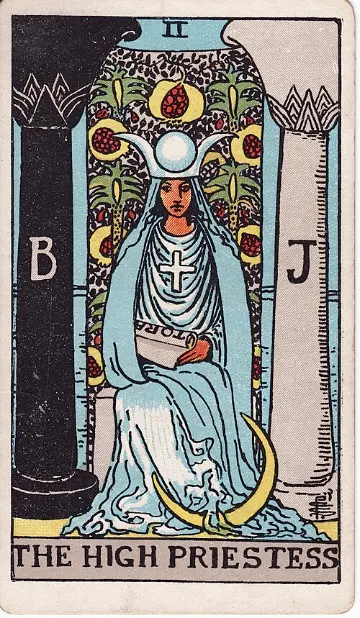
The High Priestess tarot card can suggest a pause to listen, study, and notice what is still unclear. Upright, it often favors patient attention and a boundary around private thoughts. Reversed, it may ask whether silence has become avoidance or whether a hunch is being treated as fact. Pamela Colman Smith seats her between two pillars, holding a partly hidden scroll before a patterned veil. The image makes room for mystery without promising access to someone else's secrets. In a useful reading, ask what you know directly, what you sense, and what respectful step could clarify the difference.
Look at the image
The High Priestess sits between a black pillar marked B and a white pillar marked J. A veil embroidered with pomegranates and palms closes the space behind her. At her feet is a crescent moon; a scroll marked TORA is partly covered by her mantle. A cross rests on her chest, and her crown carries another crescent shape. These details matter because Smith does not draw a person announcing an answer. She draws a threshold and a text that can be seen only in part. A. E. Waite explained the partly covered scroll as a contrast between what is spoken and what is implied. In a reading, the visible symbols can prompt a question about access, timing, and interpretation. They do not establish that a particular secret exists in your life.
Upright: listen before deciding
Upright, The High Priestess often suggests giving a question enough quiet to become clear. That may mean reading a document carefully, hearing someone without preparing your reply, or letting an early idea develop before you show it to everyone. The card is not a command to do nothing. Choose an attentive action: take notes, ask one precise question, or notice which facts have not yet been supplied. It can also support a healthy boundary around an experience that is yours to share when you are ready. Waite's historical divinatory list includes mystery, silence, wisdom, and science; modern readings often put more weight on intuition. Both approaches work best when silence remains a choice rather than a substitute for an answer that another person reasonably needs.
Reversed: when quiet turns into avoidance
Reversed, The High Priestess can describe a useful pause becoming an indefinite retreat. You may be waiting for perfect certainty before asking an ordinary question, or holding an impression so tightly that no new information can reach it. The reversal can also ask whether another person is pressing you to disclose something before you feel safe. Those are different situations, and the card alone cannot sort them. Notice whose boundary is involved and what the actual decision requires. If a conversation matters, put one part of your concern into plain words. If an issue is private, decide what you need in order to revisit it. Waite’s older reversed list includes “surface knowledge”; the present reading treats that as a reason to test an impression. Reversed does not prove that someone is hiding a betrayal, nor does it make your intuition worthless.
The High Priestess in love and relationships
In love, the card can draw attention to the difference between privacy and disconnection. Early in a relationship, it may be reasonable to learn about each other slowly instead of demanding immediate disclosure. In an established partnership, an unspoken concern may deserve a calm conversation before it grows into a story about motives. Upright can favor listening and respect for pace; reversed may point to avoidance or to pressure that makes honest speech harder. If someone has become less communicative, The High Priestess does not tell you whether they are distracted, hurt, or concealing something. Ask about the change you have noticed and let the answer inform your next step. A tarot reading can help you prepare for that exchange, but it cannot reveal another person's private feelings without them.
The High Priestess in career and money
At work, The High Priestess may fit a project still taking shape, a confidential discussion, or a decision with important details missing. Upright, it can favor careful research, listening to people who will do the work, and protecting information that is not yours to share. Reversed may suggest that an important question has been left unasked, or that a vague process is being mistaken for a thoughtful one. If you are weighing an offer, read the duties, pay, deadlines, and decision process in writing. The card is not evidence that a colleague is withholding a fact or that an investment will succeed. Its useful contribution is to remind you that timing and access matter: find out what is knowable before you commit, and respect legitimate boundaries while you do.
Intuition, dreams, and what you can verify
The High Priestess is often called an intuition card, and its moon and veil can make that association feel natural. An intuition may help you notice a pattern before you can explain it; it may also echo a fear or a hope you already carried. A remembered dream can work the same way. Record the impression, then separately record what you observed. If you feel that a conversation went badly, ask which words, tone, or event led to that feeling before deciding what the other person meant. If the concern is about your own creative direction, the impression may be enough to inspire an experiment. If it concerns another person's conduct or a costly choice, seek a respectful question or a concrete source. The card gives a language for uncertainty, not a shortcut around it.
Is The High Priestess a yes or no card?
The High Priestess is rarely an unconditional yes or no. It often suggests that the answer depends on something you have not learned or are not ready to say. For “Should I sign this before I read the terms?”, the useful answer is to read them first. For “May I keep this idea private while it develops?”, the card may support a temporary yes, provided the choice does not deny someone else information they need. Upright can favor patience and inquiry; reversed can warn against either stalling forever or forcing disclosure too soon. Neither position guarantees a future event. Turn the binary question into a smaller one: what do you need to know, who can answer it, and what can safely wait?
A reading example: the unclear collaboration
Imagine a friend invites you into a creative project but says the roles can be worked out later. You like the idea, yet the conversation leaves you uneasy. The High Priestess upright does not tell you that your friend has a hidden agenda. Its covered scroll and veiled space match the simple fact that the agreement is incomplete. Ask what each person will contribute, who owns the finished work, and when decisions will be made. You can keep your own doubts private until you have words for them, but do not promise time or money on terms you have not discussed. Reversed, the same card might ask whether you are avoiding that conversation because you fear spoiling the friendship. The next step is a clear question, not a verdict about character.
Questions to ask
- What do I know directly, and what am I inferring?
- Whose privacy or boundary matters here?
- What respectful question could clarify the next step?