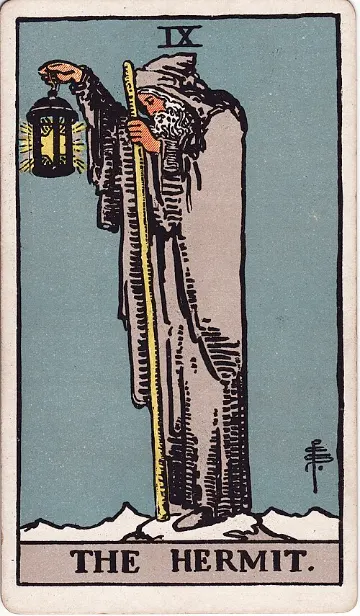
The Hermit tarot card can ask you to make room for careful thought, then put what you learn to use. Upright, a modern reading may favor a purposeful pause, research, or guidance from someone experienced. Reversed, it may ask whether privacy has become avoidance or whether you have had too little quiet to think at all. Pamela Colman Smith shows a cloaked figure on a snowy height, raising a lantern that holds a star. A. E. Waite saw a beacon of attained knowledge offered to others, not simply a lone seeker. The useful question is what needs reflection and who may benefit when you return.
Look at the lantern and the height
Smith's Hermit stands alone on a snowy height, wrapped in a gray cloak. One hand grips a staff; the other lifts a lantern with a star inside it. The figure faces outward rather than bending over a book or hiding the light. In The Pictorial Key to the Tarot, Waite rejects the familiar idea that this is merely someone still searching for truth. For him, the raised lamp is a beacon held by one who has attained something and can guide others. Modern readings often emphasize the solitude needed to reach insight. The image can hold both ideas, provided they are not confused: where do you need distance to think, and what would it mean to share the result?
Upright: make a purposeful pause
Upright, The Hermit may favor stepping back from competing opinions long enough to examine a particular question. You might read the terms of an offer, take a walk without messages, keep a journal, or ask a mentor how they reached a decision like yours. Solitude is useful when it changes what you can see; it is less useful as an indefinite delay. Choose a question, a source of evidence, and a time to return to the people affected by your choice. Waite's older divinatory list starts with prudence and circumspection, but also includes deception and corruption. A modern upright reading should not turn those historical keywords into an accusation. They can prompt the simpler check of whether caution is helping you see clearly.
Reversed: isolation, concealment, or no room to think?
A reversed Hermit can raise several different questions. Have you withdrawn so long that a useful conversation now feels harder to begin? Are you keeping information from someone who needs it to make their own choice? Or has constant noise left you with no private time at all? Those situations call for different actions: reconnect, disclose what matters, or protect a short interval for thought. Waite's reversed list names concealment, fear, and unreasoned caution; it does not give the modern formula that every reversal means loneliness. Look for evidence in the situation before choosing an interpretation. The card cannot diagnose another person's motives or tell you how long a pause must last. It can help you notice whether your retreat has a purpose and a way back.
The Hermit in love and relationships
In love, The Hermit can describe a need for space to understand a feeling or make a considered choice. That need can coexist with care. Upright may favor saying what you need, how long you expect to be quiet, and when you will check in again. Reversed may draw attention to silence that leaves a partner guessing, or to a relationship that offers no room for either person to think independently. The card does not prove that someone loves you, has lost interest, or will return. Ask what each person has actually said and done. If the question concerns reconciliation, a private insight is only one part of it; the other person's willingness to talk and consent to a new arrangement must be known directly.
The Hermit in career and study
At work, The Hermit can favor research, concentrated practice, or the advice of someone who knows the field. A quiet hour to test a proposal may prevent a rushed public commitment. A mentor can be valuable when they explain their method and show where it may fail, rather than giving you a verdict to copy. Reversed may suggest that analysis has become a way to avoid a deadline, or that meetings and messages have crowded out the work that needs attention. Neither orientation promises a job, a good grade, or a flawless plan. Write down the decision, the evidence still missing, and who needs an update. The lantern is most helpful when the light reaches the next real choice.
The Hermit as feelings or as a person
When you ask how someone feels, The Hermit is a theme in the reading, not access to that person's private thoughts. It may reflect a wish for space, caution about speaking too soon, or a preference for thoughtful conversation. It might also reflect your own distance from them. As a person card, it can suggest someone experienced, private, or willing to guide without taking over, regardless of age or gender. None of these possibilities establishes affection, rejection, or a secret plan. Notice the observable behavior: do they explain when they need time, answer important questions, and make room for your perspective? If the relationship matters, ask them directly rather than treating the cloaked figure as a report on their mind.
Is The Hermit a yes or no card?
The Hermit can lean toward yes when the question is whether to pause, investigate, or seek wise counsel before acting. It is less of a yes to an immediate leap whose terms you have not examined. Upright may support a defined period of reflection followed by a decision; reversed may ask whether another delay would only repeat the same thoughts. A single card cannot guarantee a result or decide whether another person will agree. Try making the question more precise: “Should I ask for the contract in writing before accepting?” gives the lantern a practical job. “Will everything work out?” gives it none. Name what you need to learn, set a reasonable deadline, and use the answer you actually find.
A reading example: an offer with a short deadline
Imagine you receive an appealing job offer on Monday, but the role's travel demands are vague and you must answer by Friday. You draw The Hermit upright. Rather than disappearing until the deadline, set aside Tuesday to compare the written terms with your needs, then ask the hiring manager how often travel occurred in the last six months. Speak with one person who has done similar work. By Thursday, decide using the answers you have, and respond on time. A reversed Hermit might point to a different problem: you have already gathered enough information but keep searching to avoid choosing, or you have let everyone else's excitement drown out your own concerns. The card does not tell you to accept or refuse. It helps you make the decision more informed and accountable.
Questions to ask
- What question needs a defined period of quiet?
- What evidence or conversation would move me forward?
- Who needs to hear what I have learned?