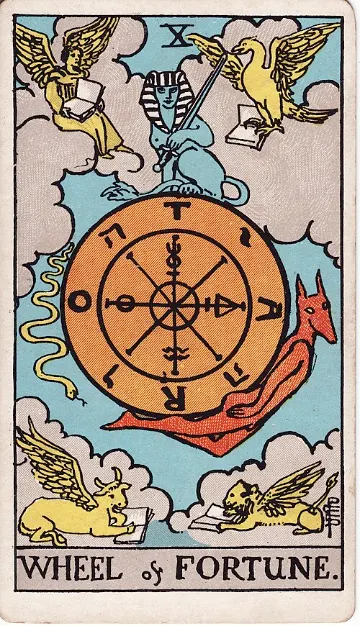
The Wheel of Fortune tarot card points to changing conditions: an opening, setback, or turning point that may alter what is possible. Upright, it can invite you to recognize an opportunity without assuming it will last. Reversed, a modern reading may ask whether a recurring pattern or poorly timed plan needs attention; A. E. Waite's older reversed meaning was abundance and excess, not simply bad luck. Pamela Colman Smith places a sphinx above a lettered wheel, with figures rising and falling around it. The card does not promise a lucky break. Its practical question is what is moving, what remains steady, and how you can prepare for more than one outcome.
Look at the moving wheel
A blue sphinx holds a sword above the wheel; a yellow serpent descends on one side, while a red, jackal-headed figure rises on the other. Four winged creatures occupy the corners with open books. The wheel bears the letters T, A, R, and O among other marks. Waite called the serpent Typhon, connected the corner figures with Ezekiel's living creatures, and described the sphinx as a point of balance amid motion. He did not claim the tarot originated in Egypt. Smith's picture lets the eye move between a turning center and figures that appear to watch or travel with it. You do not need to decode every symbol to ask the central question: which part of your situation is changing, and where can you keep your footing?
Upright: notice the opening without trusting luck alone
Upright, the Wheel can fit a new opportunity, a change in timing, or circumstances that make an old plan possible again. Waite's historical divinatory list includes fortune, success, and elevation. In an actual reading, those words are possibilities, not a promise that the next result will favor you. Find out what has changed: a vacancy, a person's availability, a deadline, a rule, or a resource. Then decide what action is yours. A chance introduction may open a conversation, but you still need to prepare for it; an improved market may help a project, but it cannot repair a weak offer by itself. Enjoy a favorable turn while giving yourself ways to respond if the conditions shift again.
Reversed: a difficult turn or too much of a good thing?
Many contemporary readers take a reversed Wheel as a delay, an unwelcome change, or a repeated cycle. Waite's own reversed list is different: increase, abundance, and superfluity. It can be more useful to hold both possibilities than to announce that reversal means bad luck. Has an expanding opportunity begun to consume more time than you can give? Are you treating a temporary setback as permanent, or repeating a response that no longer works? Some changes are genuinely outside your control and may call for help rather than self-blame. Others expose a pattern you can alter. Check the facts and the surrounding cards before deciding which kind of turn the reversal describes. A card cannot tell you that every hardship was deserved or fated.
The Wheel of Fortune in love and relationships
In love, the Wheel can bring changing circumstances into focus: schedules shift, a long-distance arrangement ends, or two people find themselves ready for different commitments. Upright may encourage a conversation when an opening appears. Reversed may ask whether the same disagreement keeps returning because nothing about the arrangement changes. Neither orientation proves that a bond is destined, that an ex will return, or that a partner's feelings have secretly changed. Ask what is different now and what each person wants to do about it. A relationship can adapt through explicit agreements about time, contact, and responsibility; it cannot be steered by one person's hope that the cycle will turn on its own.
The Wheel of Fortune in career and money
At work, this card can fit an opening caused by a team change, a project that depends on a supplier, or a role affected by a shifting budget. Upright may suggest acting while an opportunity is real, after checking its terms. Reversed may point to a delay, a repeated process failure, or growth that exceeds the time and staff available. For money, the Wheel is a reminder to separate what you can influence from what you cannot: read the contract, understand the cost, and keep a fallback where possible. It does not predict a windfall or make a risky investment safe. Ask what would happen if the favorable conditions lasted only a short time, and whether the plan would still be workable.
The Wheel as feelings and timing
If you ask how someone feels, the Wheel may describe a changing situation around the relationship rather than a fixed emotion inside that person. They may be responding to a new job, a move, or a decision that affects their time. The card does not let you read their mind. Look for what they say, what they do consistently, and what you can ask without pressure. As a timing card, the Wheel suggests that conditions can turn; it does not supply a reliable date. Instead of waiting for a mysterious perfect moment, name the event that would make action sensible. A confirmed schedule, available funding, or a direct reply is more useful than guessing how many weeks one symbolic wheel takes to turn.
Is the Wheel of Fortune a yes or no card?
The Wheel can lean toward yes when an opportunity is open now and you can act without staking everything on luck. It leans toward wait or investigate when the answer depends on a condition you have not checked. Upright is not an automatic yes, and reversed is not an automatic no. “Should I apply while the position is open?” has an action within your control; “Will they hire me?” depends on other people and information you do not have. Identify the moving part of the question, the deadline, and a sensible fallback. If a favorable turn would make the choice worthwhile but an unfavorable one would cause serious harm, reduce the commitment or gather more evidence before deciding.
A reading example: the outdoor book fair
Imagine your neighborhood group plans an outdoor book fair. A larger venue becomes available, but the weather forecast is uncertain and the new space requires a nonrefundable deposit. You draw the Wheel upright. The opening is real, yet the turning image is a poor reason to assume sunshine. Ask the venue about shelter and cancellation terms, check whether sellers could use a smaller indoor room, and set a date for the final decision. If the Wheel appears reversed, perhaps the group has already expanded the fair beyond its volunteers and budget. Scale it back or recruit help before accepting the bigger space. Neither version forecasts the weather. The reading helps you enjoy an opportunity while preparing for conditions that may change.
Questions to ask
- What condition has changed, and what evidence shows it?
- Which action is mine even if the outcome is uncertain?
- What fallback would keep this choice workable?