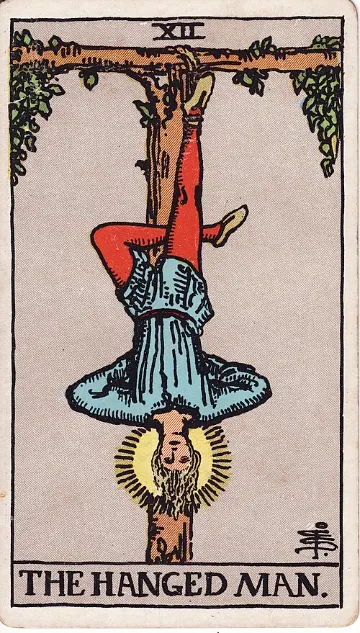
The Hanged Man tarot card can mark a pause that changes how you see a problem. Upright, it may favor waiting for a reason, releasing an unhelpful approach, or considering what the situation looks like from another position. Reversed, a modern reading may ask whether a delay has become an excuse or whether you are being pressed to move before you can. Pamela Colman Smith shows a calm figure suspended by one ankle from a leafy wooden frame, with a halo around his head. The picture does not establish that he chose this position. Its practical question is what the interval reveals and what would make it time to act.
Look at the suspended figure
One ankle is tied to a wooden frame that still carries leaves. The other leg bends across it, and the arms rest behind the figure's back. Red trousers, a blue tunic, and a bright halo make the upside-down body the center of Smith's image. The face looks composed rather than pained. Waite described the frame as living wood and the expression as entranced, and rejected a simple martyrdom reading. The card shows suspension, but it does not show how the figure got there or how long he must remain. That uncertainty matters. Is this pause a choice, an imposed limit, or a moment in which the usual way of seeing has been turned upside down? Read the situation before praising sacrifice.
Upright: use the pause for something
Upright, The Hanged Man can favor stopping a familiar response that no longer helps. Rather than sending another hurried message, you might listen to an account you have not heard. Rather than forcing a project through the same bottleneck, you might change the order of the work. Waite's older list included wisdom, discernment, trials, and sacrifice. A useful contemporary reading asks what the pause can actually provide: evidence, rest, a different view, or time for someone else's decision. Name that purpose and the point at which you will review it. An interval can be valuable without becoming a virtue in itself. You need not give up every option merely to prove that you can wait.
Reversed: is the delay still helping?
A modern reversed Hanged Man reading often asks whether a pause has become avoidance, or whether a sacrifice keeps being requested without a clear benefit. It can also signal the opposite: pressure to act before a necessary interval is over. Waite's historical reversed list named selfishness and the crowd, not a single rule about stagnation. Look at the actual constraint. A delayed answer from an institution, a recovery period, or another person's consent cannot be hurried by willpower; an overdue decision within your control can be made. Ask what has changed since you first stopped, what information is still missing, and who carries the cost of waiting. The reversal does not make patience foolish or action automatically wise.
The Hanged Man in love and relationships
In love, The Hanged Man can bring a pause in contact, commitment, or a shared plan into view. Upright may favor giving each other space to think after a difficult conversation, provided both people know what the pause means and when they will speak again. Reversed may point to indefinite limbo in which one person keeps asking the other to wait without saying what could change. It does not prove a partner will return, nor does it tell you what they feel in private. Ask directly what each person can offer now. A relationship decision may need time, but one person's uncertainty does not require the other to suspend their own life without agreement or a review point.
The Hanged Man in career and money
At work, this card can fit a stalled project, a pending offer, or a method that needs rethinking. Upright may favor pausing long enough to test an assumption, gather feedback, or let a dependency become clear. Reversed may ask whether everyone is waiting because no one owns the decision, or whether a deadline is forcing a choice before essential terms are known. The card cannot guarantee a job, a payment, or a better offer after delay. Put the actual dates and obligations on paper. If you are asked to sacrifice pay or time for a promised future benefit, ask what is written, who bears the risk, and when the arrangement will be reviewed. A new perspective should improve the decision, not erase its cost.
Perspective is not the same as surrender
The figure sees the scene from an angle no upright observer shares. That is a useful image for questioning a familiar story: perhaps the person called “difficult” has been carrying an unseen burden, or a failed plan was measured against the wrong goal. Try describing the problem from another affected person's position, then check that account with them instead of assuming you have understood it. Seeing differently need not mean accepting every condition. A pause can reveal that the situation asks too much, or that the next step is smaller than you feared. The Hanged Man becomes most useful when the changed view leads to a clearer choice about what to keep, change, or release.
The Hanged Man as feelings and timing
Asked about someone's feelings, The Hanged Man may suggest uncertainty, reflection, or a change in perspective around the question. It is not access to their thoughts. Notice what they have actually said, whether they have requested time, and whether they communicate during it. As a timing card, the image suggests suspension but gives no dependable date. “Wait until the contract arrives” is a testable condition; “wait until fate decides” is not. Set a reasonable time to review what you know, especially if another person depends on your answer. If the pause belongs to someone else, you can respect their pace while deciding what limits you need for your own plans.
Is The Hanged Man a yes or no card?
The Hanged Man often leans toward “not yet” when the question would benefit from a defined pause, a different perspective, or one missing fact. That is not a promise that the eventual answer will be yes. Upright may support waiting when the interval has a purpose. Reversed may ask whether another delay would only protect you from choosing, or whether a rushed yes would cost too much. “Should I ask for the full offer before replying?” is a question the card can help frame. “Will the employer choose me?” depends on someone else's decision. Decide what would make the answer possible, set a review point, and do not treat silence as an answer from a person who has not spoken.
A reading example: two job offers on different clocks
Imagine you have a written offer that expires Thursday, while a second employer says it may decide next week. You draw The Hanged Man upright. The unusual view suggests changing the question from “Which job is fated?” to “What can I learn before Thursday?” Ask the first employer for the full terms and whether the deadline can move; ask the second for a realistic timeline. Compare the offer you have with your actual needs, and decide before the deadline if no new information arrives. A reversed Hanged Man might highlight the cost of waiting indefinitely for the possible second offer, or the pressure to accept the first without reading it. Neither orientation predicts the employers' choices. It helps you use the pause without giving up your own decision.
Questions to ask
- What could this pause help me learn?
- Who bears the cost of waiting?
- What date or event will prompt my next decision?