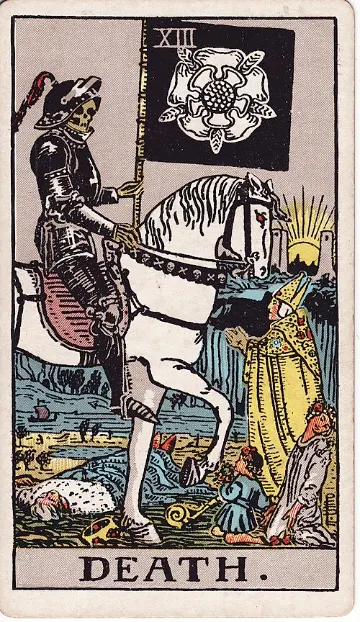
Death (XIII) is a tarot card about endings, transition, and what survives a change. In the Rider–Waite–Smith image, an armored skeleton rides a white horse past a fallen king and kneeling figures while light glows between distant towers. Upright, the card can focus attention on a chapter that is closing and the care required to move through it. Reversed, it may suggest resistance to change or grief that has been hurried rather than heard. In love or work, it does not automatically announce a breakup or job loss, and it cannot predict anyone's death. Ask what has actually ended, what remains, and what decision you can make now.
Look at the image
The skeletal rider has no visible weapon. Instead, the black banner bears a white rose, while a fallen king lies beneath the horse. A robed figure clasps his hands, a child watches, and another figure turns away. Behind them, a boat crosses water and the sun shines between two towers. Waite described the rose as a sign of life and the distant light as the sun of immortality. These details do not make the foreground painless. Look from the crown on the ground to the living figures still facing the horse: the scene gives us a way to consider both the reality of an ending and the people who must live through it.
Upright: acknowledge an ending
Upright, Death can bring a clear ending into view, especially when you have been treating it as a temporary interruption. A role may be changing, a project may be complete, or a relationship may no longer work under its old terms. The card does not require you to celebrate a loss or pretend that the next chapter is already better. Ask what has finished, what responsibilities remain, and who needs to hear the news. If you chose the change, close it with care. If it was imposed, attend first to practical needs and support. Renewal is possible, but it need not be immediate or guaranteed.
Reversed and in context
Reversed, Death can point to an ending resisted: continuing a commitment because it is familiar, delaying an overdue conversation, or preserving a process after its purpose has gone. Yet resistance is not the only reading. Someone who has been pressed to move on too quickly may need time to mourn before making another change. The question and neighboring cards matter. What remains useful in the old arrangement, and what is being kept only from fear? A reversed Death does not prove a breakup, redundancy, or hidden disaster. It can ask you to give a transition its proper pace and name the part you are reluctant to release.
Death in love and relationships
In a love reading, Death may concern the end of a relationship, but it can also describe an old way of relating that cannot continue. A couple might need to leave behind an unspoken agreement about time, money, or care while choosing to stay together. If you are dating, the card may draw attention to a past attachment or expectation you are bringing into a new connection. Neither upright nor reversed reveals a partner's private feelings. Use what people have said and done, then have the conversation the reading brings into focus. When a relationship really has ended, allow the loss to be real rather than rushing to call it a new beginning.
Death in career and work
At work, Death can fit a completed project, a changing role, a retired product, or the need to leave an unsustainable routine. It does not certify that you will lose your job. Ask which part of the work is ending and which skills, contacts, and obligations carry forward. If a change is already announced, plan the handover and check the dates, finances, and options available to you. If you are considering leaving, compare the actual terms of staying and going. Reversed, the card might expose a process maintained out of habit, but it might equally reflect a team that has not been given enough time or resources to make a fair transition.
Is Death a yes or no card?
Death gives a more useful answer when the question names what would have to change. “Can everything stay exactly as it is?” leans no: the card's central image is an ending that cannot simply be ignored. “Can I begin again after closing this chapter?” may allow a cautious yes, provided the practical steps are possible. Reversed is not an automatic no; it may show that the timing, support, or terms need more attention. The card cannot deliver a guaranteed verdict about another person's decision. If a yes-or-no draw feels frightening, turn it into a better question: What is ending, and what choice is actually mine?
Does the Death card mean someone will die?
No tarot card can establish that someone is going to die. The image uses mortality openly, and Waite's historical account of Death included mortal endings as well as spiritual change; claiming that the card has never had a literal association would erase that history. But a symbolic reading is not evidence about a person's life or health. If the card appears after a bereavement, it may help you speak about loss and what follows without predicting another one. If you have a real concern for someone's safety or health, respond to the circumstances and seek appropriate help rather than using the draw as a diagnosis or forecast.
A work transition in practice
Suppose your team learns that its main product will close in six months and you draw Death while asking whether to leave now. The card cannot tell you to resign. It makes the ending specific: the product is closing, but the team, your skills, and your financial obligations still exist. Ask your manager what the timetable and redeployment options are; document what the next team will need and plan a responsible handover. Compare those facts with any new offer before deciding. If the card is reversed, consider whether you are clinging to the old role or being asked to adapt without enough information. The same image can open very different, concrete questions.
Mark what changes
List what is ending, what remains, and what practical tasks need attention. That might include informing people, saving records, arranging care, or creating a small ritual of closure. If the change is painful, seek company and allow the timeline to be uneven. If it is welcome, still notice what you are leaving behind. Death becomes more useful when it helps distinguish release from denial and prepares you for the ordinary work that follows a major change.
Questions to ask
- What has already ended, even if I have not named it?
- What needs care during the transition?
- Which parts of the past are worth carrying forward?