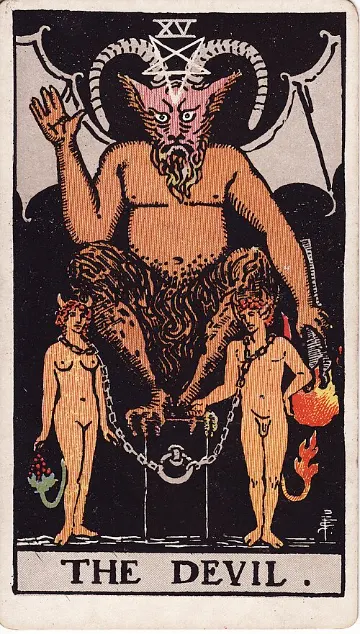
The Devil tarot card can bring an appealing bargain and its hidden cost into focus. Upright, a modern reading may ask how desire, status, fear, or material pressure keeps a pattern going. Reversed, it may point to a loosening hold or to a problem you have only begun to name. Pamela Colman Smith shows a horned, bat-winged figure over two people chained to a pedestal. The image does not prove that a real person is trapped, at fault, or able to leave easily. Its useful question is what the arrangement gives, what it takes, and which support could widen the choices available.
Look at the chains and the figure above
A horned figure with bat wings stands over two smaller people. One hand rises, while the other holds a torch pointed down; an inverted pentagram marks the forehead. Chains run from a ring on the pedestal to the two people's necks. Waite compared the raised gesture with The Hierophant's blessing turned around and said the elevated figure would not be their master forever. That is his symbolic reading, not evidence about any present relationship. The image asks you to examine power: who appears to stand above the bargain, what links the people below, and what options can you actually see? It does not show the resources, risks, or obligations that might make a real exit difficult.
Upright: name the benefit and the cost
Upright, a contemporary Devil reading can fit a reward that has begun to narrow your choices. A job brings status but consumes every weekend; an expense buys relief now but creates a recurring bill; a familiar relationship feels intense while important needs go unspoken. Pleasure and ambition are not wrong in themselves. Ask what you gain, what you pay, and whether the terms are visible and freely accepted. Waite's older divinatory list used much darker language about force and fatality; modern attachment readings should not be mistaken for his exact meaning. If a person controls money, housing, safety, or access to help, calling the situation a mere “bad habit” misses the real power involved. Start with the facts of the bargain.
Reversed: recognition is not yet release
Reversed, The Devil may suggest that a pattern is changing: a cost has been named, a boundary has been set, or support is becoming available. It can also ask whether relief is being declared before the pressure has truly eased. Waite's own reversed list named weakness and blindness rather than a guaranteed escape. Look for concrete changes. Has a harmful term been removed, has dependable help arrived, or has the same demand returned under a new name? A person can understand a constraint clearly and still lack a safe way to leave it today. Treat that as a practical problem, not a failure of courage. The card can begin an honest inventory; it cannot supply missing resources by itself.
The Devil in love and relationships
In love, The Devil can bring attraction, dependency, jealousy, or a repeated bargain into focus. Strong desire can be welcome when people have room to choose and say no. Upright may ask whether the excitement leaves space for respect, privacy, and other relationships. Reversed may point to a change in the pattern, but it does not prove that a partner has changed or that a breakup is safe or necessary. Do not label someone abusive from a card alone; look at their conduct and at your ability to set limits without retaliation. If control or fear is part of the real situation, a trusted person or specialist support can help assess options safely. Chemistry is not a substitute for consent.
The Devil in career and money
At work, The Devil can fit a prestigious role with hidden costs, a contract that limits future work, or pressure to remain because income is uncertain. Upright may invite a close reading of pay, hours, exclusivity, penalties, and who can change the terms. Reversed may suggest a renegotiation or a new option, but avoid assuming someone can resign without a financial plan. For money, the card may prompt you to total recurring costs and compare them with the benefit received; it does not predict debt or profit. Power matters here too. Ask what you could say no to, what happens if you do, and which advice or alternative would improve your position. A small increase in choice can matter even before a complete change is possible.
The Devil as feelings or as a person
Asked how someone feels, The Devil may evoke desire, fixation, fear of losing access, or the sense that a bond is hard to change. It cannot tell you which of those is inside another person's mind. As a person card, it may describe someone with influence over a situation, or your own concern about the power they hold; it is not a character diagnosis. Notice behavior instead. Do they respect a no, tell the truth about the terms of an arrangement, and allow you contact with other people? Intensity by itself proves neither care nor harm. If the question matters, ask directly and judge the response alongside actions over time, especially when your resources or safety depend on the relationship.
Does The Devil mean addiction?
The card is often linked with compulsive behavior, but a draw cannot diagnose a substance-use disorder or explain why a person repeats a behavior. Shame can make a difficult situation harder to discuss. If you recognize a pattern that affects health, work, or safety, describe what is happening in concrete terms and seek qualified support when needed. Avoid the claim that the pictured chains are easy to remove and therefore anyone can simply stop. Real change may involve treatment, money, housing, other people, and repeated attempts. The card is most helpful when it prompts an honest question about what support would make a safer choice possible, without turning a person into the name of a problem.
Is The Devil a yes or no card?
The Devil may lean toward no when the question is whether to repeat a bargain whose costs are already clear and unacceptable. It can lean toward yes when the proposed action is to read the terms, ask for help, or test a safer alternative. Upright is not a universal no to pleasure; reversed is not an automatic yes to freedom. “Should I sign without checking the exclusivity clause?” is different from “Can I leave this job today?” The first invites a practical pause. The second requires facts about income, obligations, and available support. Name the action within your control and the consequence you are trying to avoid. A single card cannot decide whether another person will change or whether a difficult exit is safe.
A reading example: the prestigious contract
Imagine a freelance designer is offered a well-known client. The project would look excellent in a portfolio, but the draft contract forbids similar work for a year and pays less than the time required. You draw The Devil upright. Instead of calling ambition a flaw, list what the client offers and what the restriction would cost. Ask for a narrower clause and a realistic fee, and compare the offer with the income you need. If declining immediately would create hardship, seek advice and plan another source of work before deciding. A reversed Devil might point to a successful renegotiation or to realizing that the new draft still holds the same constraint. The card does not decide the contract; it makes the bargain visible.
Questions to ask
- What benefit keeps this pattern attractive?
- What are its real costs and constraints?
- Which support would widen my choices safely?